






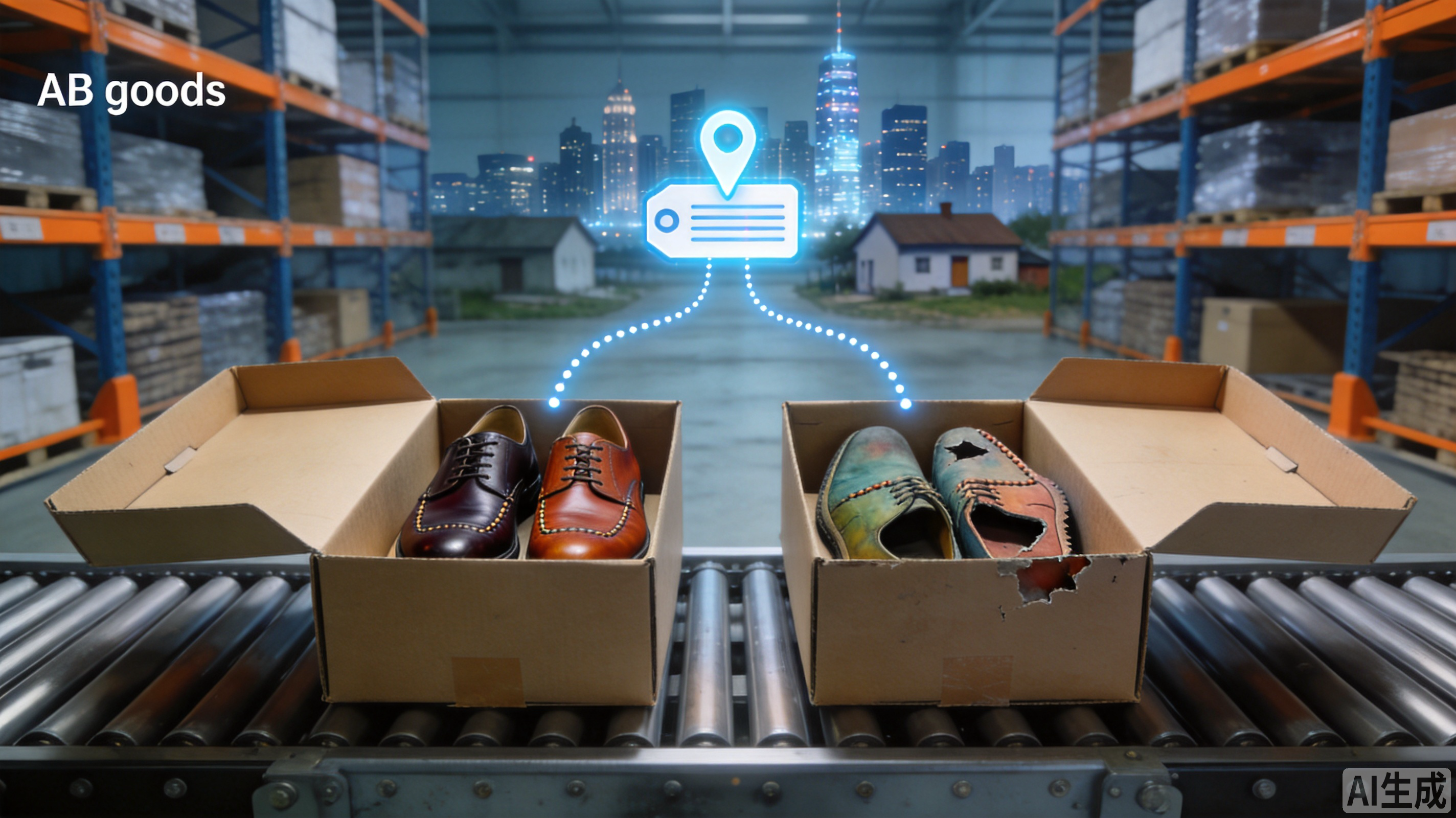
NextFin News -- In China’s fiercely competitive e-commerce market, the same product listing may no longer guarantee the same product. Some merchants are quietly tailoring what they ship according to customers’ locations, sending higher-quality goods to consumers in major cities and cheaper versions to buyers in smaller cities and rural areas, according to industry insiders.
For the same product, under the same listing, the moment you enter your delivery address, it has effectively already been decided whether what lands on your doorstep will be a well-made “Grade A” item—or a cost-cut “Grade B” version. This tiered fulfillment practice—known within the trade as “A/B goods”—is spreading from a handful of merchants’ gray-area tactics into a broadly adopted, industry-wide norm.
A pair of branded shoes feels comfortable and substantial in an offline store, but the pair from the brand’s official flagship store online looks ashen in color and feels nowhere near as good. Under the very same product link, a hair clip shipped to a provincial capital is visibly larger than the one sent to an outlying township back home.
That’s the long-circulating “A/B goods” phenomenon in e-commerce.
It’s not a new term, but it has lingered for years in consumers’ private discussions—and is now being brought into the open. According to media reports, Mr. Lin in Jieyang, Guangdong, and a friend in Shanghai bought the same rice cooker from the same store. The friend in Shanghai received a newer model with a stainless-steel inner pot and a timer function; Mr. Lin received an older model with peeling coating and blurred measurement markings. Same price, same listing—down to an identical product title.
He argued with the merchant for seven days, and customer service replied with only one line: “Dear, you purchased the special-offer version.” Only after filing a complaint with the platform did he discover there were no fewer than fifty people who had run into the same situation. Chance can’t explain that kind of pattern.
So who is “grading” whom behind the scenes? What trade-offs lead merchants and brands to choose this path—and what signal does it send?
One Listing, Two Products
Lao Chen (a pseudonym), a clothing merchant with annual sales exceeding 100 million yuan, ran the numbers. A 79-yuan base-layer top made as “Grade A”—using combed cotton and double-needle overlock stitching—costs about 35 yuan. Switch to “Grade B” made with ordinary cotton and single-line serging, and the cost drops to under 20 yuan.
At 1,000 orders a day, shipping all Grade A yields a daily gross profit of 44,000 yuan. If half the orders are swapped to Grade B, gross profit can jump to 51,500 yuan—more than 2.7 million yuan in additional earnings over the course of a year.
This arrangement only works on the premise that the return rate for “B-grade goods” isn’t as high as people might expect. Based on long-term data, they found that B-grade goods shipped to county-level cities and townships can keep a stable return rate below 2%; ship the same B-grade goods to top-tier cities, and the return rate can be as high as 20%.
“So we don’t ship blindly—we ship based on the address. That’s precise risk control, not messing around.” This practice of “shipping by address” is nothing new.
Its earliest prototype can be traced back to 2011–2014, when Taobao was rapidly expanding from cities down into county towns and rural areas. Merchants soon confirmed that urban and rural consumers differed markedly in both return rates and their ability to defend their rights.
Buyers in top-tier cities are more rights-conscious; a single negative review can drag down a new store’s ranking weight. In county towns and rural areas, picking up a parcel may mean traveling several kilometers, and return shipping can cost almost as much as the product itself. So even when people receive something they’re not happy with, most will often just put up with it.
After 2015, as e-commerce platforms’ algorithms became increasingly mature, merchants began using more efficient ways to “tag” consumers.
Once a shipping address is entered, the backend automatically segments the user. Higher-tier cities are judged to have stronger rights-awareness and higher sensitivity, so they’re prioritized to receive A-grade goods; county-level cities and townships are deemed to face higher rights-protection costs and to be more tolerant, becoming the main destination for B-grade goods.
After 2019, live-streaming e-commerce took off, and this playbook became even more standardized: the streamer shows a heavily retouched sample on camera, but what viewers receive after placing an order is a different story.
Some industry insiders said that in recent years, this approach has been refined all the way down to “different districts within the same city”: the city center gets A-grade goods, the suburbs get B-grade goods, and remote townships get C-grade goods.
Tang Jiansheng, deputy secretary-general of the Shanghai Consumer Protection Commission, previously pointed out that for merchants to pull off “regional A/B-grade goods,” they must precisely calculate demand in higher-tier and lower-tier markets, then procure separately, warehouse separately, and ship separately. This isn’t an accidental mix-up—it’s a system-level project that requires meticulous coordination.
The Economics Behind Grade A/Grade B Supply
In May this year, the product-review creator “Xiaobai Shu” conducted an on-the-ground verification: he bought more than a dozen items online and had them shipped separately to Shenzhen, Guangdong; Dezhou, Shandong; and Huangmei County, Hubei. Local friends received the packages and then forwarded them to him, and he compared the unboxings side by side throughout the process. The results showed that for most products, the differences were not obvious, or amounted only to normal quality-control variation, and did not exhibit the pattern of “widespread, deliberate tiering.”
Yet slippers and padded pants showed a noteworthy “coincidence”: the items shipped to Shenzhen were clearly in better condition, while those sent to Dezhou and Huangmei County had similar quality issues—for example, the slippers were noticeably lighter in color and had obvious dents and pitting on the surface, and the elastic at the cuffs of the padded pants was almost nonfunctional.
Uncle Xiaobai’s own take was: “When I realized that the same product delivered to Shandong and to Huangmei County had the exact same quality problems, it probably wasn’t random anymore.” But he also admitted that to confirm whether “region-discriminatory shipping” existed systematically would require more rigorous real-world testing across more categories and more locations.
Beyond deliberately engineered tiering, there is also a more random form of “same listing, different quality”, rooted in quality-control swings caused by a fragmented supply chain.
Chen Yu, a veteran in the apparel e-commerce business, put it bluntly: “Back then, you couldn’t find inventory; now there’s too much.” A single clothing item might be produced by dozens or even hundreds of factories at the same time. Homogenization is severe, and merchants’ main concern is no longer how much they can make, but how to move the stock. So they source from multiple factories at once—lowest price wins—and quality control naturally becomes uneven.
Deliberately designed graded shipping and random fluctuations caused by an out-of-control supply chain are not the same in nature, but the outcome is identical: consumers place an order based on the same product information, yet what they receive is something completely unequal.
This problem had already grown from isolated cases into a public issue: according to statistics from the Xiaofei Bao platform, throughout 2025 the platform received more than 760,000 complaints related to the e-commerce sector, involving 1.109 billion yuan, and the complaint resolution rate was only 31.85%.
If batch differences and intentional mixing are more often choices made by small and mid-sized sellers under supply-chain disorder or cost pressure, then the earlier concept of “e-commerce exclusive supply” revealed another version of the same logic on the brand side.
Only this time, the party deliberately blurring the boundaries shifted from individual merchants to the brands themselves. Yao Jianfang, an analyst who had long studied consumer-rights protection in e-commerce, summed up the chaos around “e-commerce exclusive supply” into three scenarios: same model, different quality; same brand, different quality; and the more serious issue of unauthorized use of brand authorization.
What these three scenarios had in common was that brands needed to maintain stability in the offline channel pricing system while also staying price-competitive online. So they specifically developed a product line with “similar appearance, different specs.”
Take the home appliance industry as an example. A past survey found that for an e-commerce “online-exclusive” refrigerator model, the insulation foam layer was made 3.5 cm thick, while the “same model” sold in brick-and-mortar stores was made 5 cm thick. That 1.5 cm gap directly affected cooling performance and energy consumption, and the two products’ energy-efficiency ratings diverged accordingly. The back panel material was also switched from steel to plastic.
Although cases like this are relatively old, the mechanism they reveal still holds today. The reason this playbook has been able to persist for so long lies in the channel conflict between online and offline sales.
Offline distributors need brands to protect the pricing system, while brands are unwilling to give up the price competitiveness of e-commerce channels. Creating an “online-exclusive” version that has “a different model number but a similar look” happens to satisfy both demands: the model-number difference gives distributors a technical explanation that it is “not the same product,” while the similar appearance allows brands to keep leveraging the trust and conversion rates accumulated over years by their flagship models.
The cost is that consumers’ right to be informed is the first thing sacrificed in this design.
This “tiered supply” logic does not stop at online versus offline.
Starting in 2016, Chinese authorities rolled out the “same line, same standard, same quality” policy, requiring export-oriented manufacturers to produce domestic products to the same standards; the policy has continued to expand in scope to this day. This in itself shows that “tiered supply for different markets” is a more widespread industry habit, and A/B goods are merely a specific slice of that habit in the e-commerce era.
Regulators Moves to Close the Loophole
In today’s economic environment, A/B goods have proliferated on a large scale and proved hard to stamp out. As price wars squeeze profit margins, quality becomes the easiest part to trade away.
There is also tension between platforms’ incentives to govern and their commercial interests. According to earlier investigations, even after being complained about, some merchants were able to evade ongoing accountability by issuing refunds, offering compensation, taking products down, or switching stores—and some even dodged enforcement by splitting product links or changing main images. That such tactics could repeatedly work is, to some extent, also related to how strict or lenient platforms were in imposing penalties.
Against this backdrop, the regulatory stance has been shifting toward more systematic, institutional constraints.
In May 2025, the State Administration for Market Regulation released the Regulations on the Supervision and Administration of Quality and Safety of Key Industrial Products Sold Online (Draft for Public Comment), explicitly advancing “integrated online-offline regulation.” It required platforms to verify whether information such as manufacturers’ names and addresses and applicable standards matched those in brick-and-mortar stores, and it encouraged traceability through product coding. This was an attempt to move from “spot checks and penalties” to “reducing information asymmetry at the source.” The regulations were formally issued in December 2025 as SAMR Order No. 110 and are set to take effect on December 1, 2026.
By 2026, the State Administration for Market Regulation (SAMR) had further tightened its stance: this year it planned to conduct more than 16,000 rounds of supervisory spot checks covering 173 key product categories, explicitly focusing on “the chaos of online sales” and the “race to the bottom of low prices and low quality.” It also listed categories such as induction cookers and power banks as key targets for ongoing monitoring, aiming to push the industry to “shift from competing on price to competing on quality.”
Risks and opportunities converge at this inflection point.
The pace of market maneuvering often runs ahead of the pace at which rules are refined; if this gap persists, A/B goods may evolve into a vicious cycle in which bad money drives out good.
Nanjing University School of Social Sciences associate professor Hu Xiaowu’s warning is not without reason: if this logic continues, the business ethics originally built on quality will be eroded, harming not only consumer rights but also the industry’s own capacity for innovation and upgrading.
Yet this is also a window of opportunity. When regulators link the A/B goods problem to the broader governance issue of “involution,” the solution will not stop at “penalizing a handful of merchants,” but will instead require a recalibration of the relationship among price, quality, and trust.
Tiered supply itself is unlikely to be eradicated entirely. Providing products with different positioning for markets with different levels of purchasing power is a standard feature of mature commerce.
What will truly be squeezed is the space created by information asymmetry.


 快报
快报
根据《网络安全法》实名制要求,请绑定手机号后发表评论