






Text | Giant Tide WAV, Author | Lao Yuer, Editor | Yang Xuran
NextFin News -- In June 2023, a prominent red storefront emerged in Tokyo’s upscale Omotesando district, marking the official entry of Mixue Bingcheng into the Japanese market. At the time, China’s largest ice cream and tea franchise harbored aggressive expansion goals. According to contemporary reports from The Nikkei, the corporation intended to establish approximately 1,000 stores across Japan by 2028, aiming to capture a significant market share in an already highly consolidated and mature beverage sector.
Three years later, this ambitious footprint target remains stalled in the single digits. Data published by Nikkei Chinese Network indicates that as of June 2026, Mixue operates only four physical storefronts across Japan.
This deceleration is not isolated to the Japanese market. Financial disclosures from the previous fiscal year reveal that Mixue’s overseas retail network contracted on a net basis for the first time since its international debut in 2018. The company closed a net total of 428 international locations over the fiscal year, reducing its total global footprint outside mainland China to 4,467 stores by year-end. The brand, recognized domestically for ultra-low price points and lightning-fast scaling, is experiencing systemic friction as its operating model faces varying international market dynamics.
Cross-Border Trajectory and Early Successes
Mixue’s push into developed Asian markets followed a highly successful blueprint validated across Southeast Asia. In September 2018, the brand opened its first international direct-operated store in Hanoi, Vietnam, under the banner "MIXUE." The location recorded opening-day revenues of 9,681 RMB, selling nearly 1,400 units of cold beverages and demonstrating the initial viability of its low-cost strategy in regional developing markets.
At the time, the Vietnamese tea market was heavily dominated by established Taiwanese brands, and local consumer awareness of the Henan-based newcomer was virtually non-existent. Mixue quickly deployed its core domestic strategy: combining aggressive low-cost positioning with accessible franchise terms. Pricing its signature pearl milk tea at 25,000 Vietnamese Dong (approximately 7 RMB), the brand achieved parity with or undercut local competitors. Concurrently, it lowered entry barriers for prospective franchisees, going so far as to waive franchise, design, and management fees entirely in 2021 to secure rapid regional coverage.
This operational playbook initially yielded robust results. By December 2021, the Vietnamese network expanded past 200 stores, reaching 249 locations by the end of March 2022. Building on this momentum, Mixue expanded into Indonesia in March 2020, launching its inaugural store in Bandung. Within two years, the Indonesian footprint reached 317 locations. Both Indonesia and Vietnam sustained high compounding growth rates for several quarters; by the end of the third quarter of 2024, store counts reached 2,667 in Indonesia and 1,304 in Vietnam.
This swift regional expansion prompted corporate management to target higher-income economies. In 2022, Mixue entered South Korea, establishing a flagship site near Chung-Ang University in Seoul to target student demographics with its signature budget pricing. In October of the same year, the company announced its entry into Tokyo, aiming to scale its Japanese operations to 20 stores by December 2023.

However, by late September 2024, the Japanese store count stood at just five, declining further to four locations by June 2026. This multi-year stagnation fell significantly short of its initial short-term targets and wider long-term objectives.
Similar growth resistance has emerged across other high-income markets. In late 2023, Mixue entered Hong Kong, drawing initial crowds at its Mong Kok debut where its HK$9 lemonade was labeled a budget phenomenon. Yet, as initial consumer curiosity waned, subsequent network expansion slowed dramatically. By June 2026, the Hong Kong store count remained in the single digits, well below initial market forecasts.
South Korea has yielded similarly modest progress. Following its 2022 launch, the brand managed only seven stores by September 2024. While the network experienced marginal subsequent growth to reach 16 stores by early 2026, the trajectory remains starkly detached from the exponential scaling vectors observed in its domestic operations.
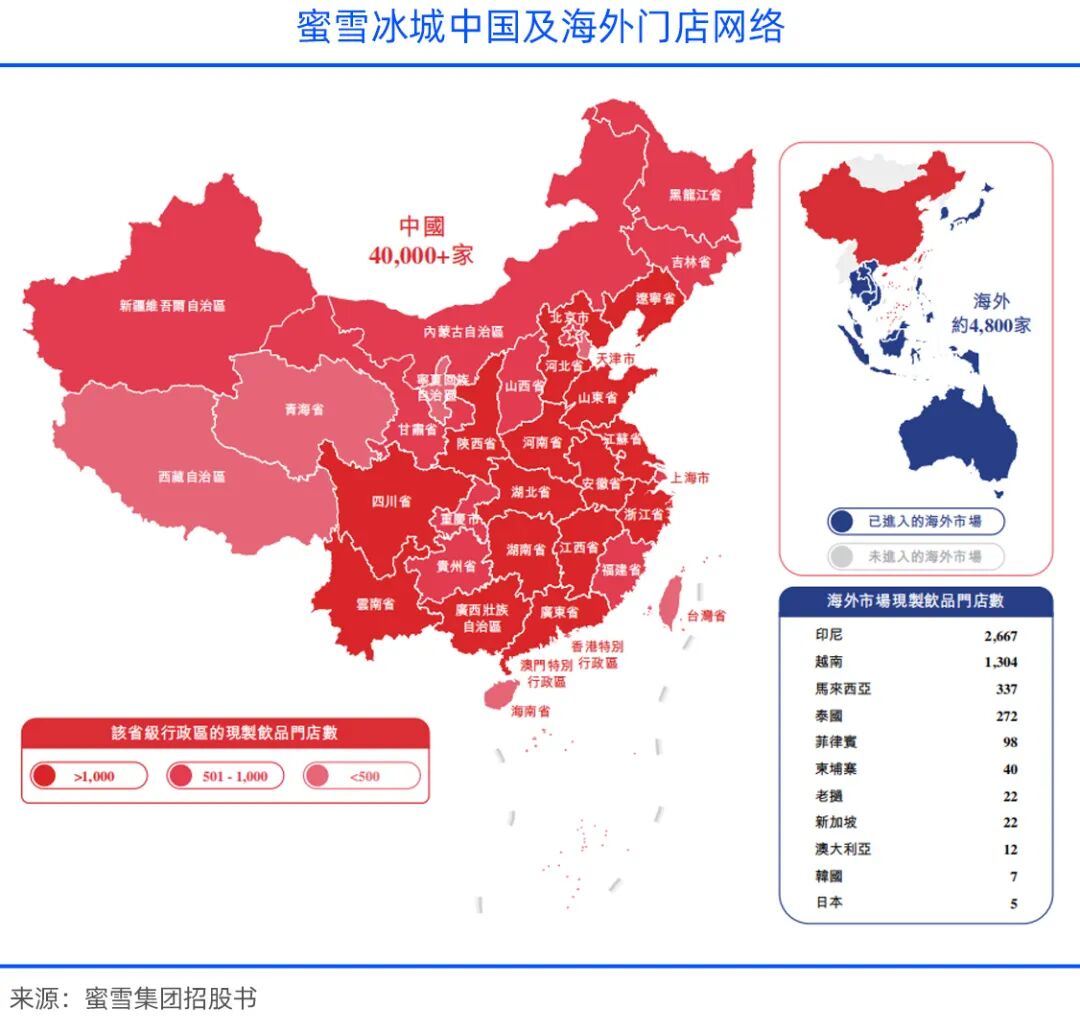
Of greater concern to analysts is the evident loosening of the company's core Southeast Asian foundation. The net closure of 428 overseas locations in 2025 was primarily concentrated within its two most mature international strongholds: Indonesia and Vietnam.
Out of Its Element
Operational Frictions and Cost Realities
Mixue’s domestic dominance relies on an integrated architecture comprising an optimized supply chain, high-volume low-cost sales, and aggressive franchise scaling. When exported, however, this underlying operational logic encounters severe headwinds across differing regulatory and economic landscapes, impairing the brand's ability to maintain its low-price leverage.
The primary disruption stems from escalated overhead structures. Domestically, Mixue’s pricing model is sustained by low commercial rents, optimized labor overheads, and localized ingredient sourcing. In developed markets, this cost-containment matrix faces severe pressure.
Hong Kong media estimates indicate that monthly commercial rent for Mixue's Mong Kok location at Bank Centre Mall hovers around HK$200,000. To offset this fixed lease cost alone using its signature HK$9 lemonade, the location must sell more than 22,000 units per month before accounting for variable outlays. Labor expenses add further pressure, with standard beverage preparation staff commanding monthly salaries between HK$16,000 and HK$22,000, and part-time wages averaging HK$50 to HK$60 per hour. These structural expenses directly undermine Mixue's historical single-store profitability modeling.
Operational conditions in Japan present parallel difficulties. Commercial rents and labor costs rank among the highest globally, while Mixue’s reliance on importing primary raw ingredients directly from mainland China adds compounding logistics and customs overheads. This forced the company into an atypical positioning shift, resulting in retail prices that exceed domestic benchmarks and culminating in a rare price increase across its Japanese network in 2024.
"The price adjustments were driven heavily by macroeconomic shifts, including material increases in bulk raw commodity prices, foreign exchange volatility, and escalating outlays across logistics, customs clearance, utilities, and labor," Mixue's corporate office stated at the time.
Furthermore, the Japanese beverage landscape is deeply saturated, with low-cost alternatives widely accessible via ubiquitous vending machines and convenience stores, heavily diluting Mixue’s relative value proposition.
Divergent regulatory frameworks and market entry compliance protocols present additional structural hurdles. Mixue required over eight months to transition from its initial October 2022 Japanese market announcement to its June 2023 store opening, a delay industry analysts attribute to prolonged import inspection and quarantine compliance checks. Separately, in Hong Kong, a Mixue retail location was publicly cited by municipal health regulatory bodies after frozen dessert samples exhibited coliform bacteria and total bacterial counts exceeding statutory legal thresholds.

These challenges highlight broader constraints within the company's international operational management. Mixue’s rapid initial scaling across Southeast Asia was characterized by a high-velocity, volume-first approach. During its early phases in Vietnam and Indonesia, regional corporate infrastructure remained lean, and market insight was limited. To prioritize rapid footprint acquisition, site selection parameters, franchisee vetting protocols, and quality control enforcement were relaxed. As market conditions normalized, issues regarding suboptimal site placement, localized over-saturation, and inconsistent quality control became apparent.
Management's characterization of the 2025 store closures as a period of "proactive operational adjustment and optimization measures" serves as an implicit acknowledgement of these early systemic oversights. Ultimately, Mixue’s operational blueprint was engineered for China’s specific consumer tiers, supported by a vast demographic base, rapidly rising beverage consumption habits, manageable real estate and labor costs, and a highly mature domestic supply chain. Replicating this ecosystem across highly distinct foreign jurisdictions has proven more complex than executive leadership anticipated, leading to a visible stabilization phase in its international trajectory.
The Imperative of International Consolidation
Despite localized setbacks, international expansion remains an absolute operational priority for the organization. Seven years ago, Mixue's global pivot began when its Chengdu regional branch sought options in Vietnam due to intensifying market saturation across southwestern China. While that initial move was exploratory, international diversification has transitioned from a discretionary growth vehicle into an essential strategic hedge.
The era of hyper-growth within China’s freshly prepared beverage sector has cooled. According to the 2025 Freshly Prepared Beverage Industry Research Report published by ChaKa Observer, the domestic market size surpassed 300 billion RMB across more than 400,000 operational locations. However, sector-wide growth decelerated from 19.3% in 2023 to 6.45% in 2025, confirming the arrival of a mature consolidated phase.
Industry rationalization is accelerating. Data from Zhaimen Nanyan indicates that between December 2024 and December 2025, the domestic beverage sector saw 102,000 new store openings counterbalanced by 131,000 closures, resulting in a net structural reduction of 29,300 locations.
As the market leader, Mixue is highly sensitive to these domestic headwinds. Although the brand added a net total of 13,772 locations across mainland China in 2025, absolute franchise closures rose to 2,527 locations—a 57.1% year-on-year increase. This elevated the franchise attrition rate from approximately 3.46% to 4.23%.
With store density peaking, localized customer dilution has intensified. This has reduced the real estate quality of newer sites, weighed on single-store average revenues, and accelerated diminishing marginal returns across the entire domestic network. With multiple Mixue storefronts operating in close proximity across lower-tier counties and townships, remaining domestic penetration capacity is tightening.
Capital markets have responded with visible valuation adjustments. Following Mixue’s listing on the Hong Kong Stock Exchange in March 2025, its equity value initially appreciated, peaking at a historical closing high of HK$618.5 on June 4, 2025, which pushed its market capitalization past HK$230 billion. However, the stock experienced a sustained downward trend thereafter. By June 30, 2026, the share price adjusted to HK$247.8, representing a market capitalization contraction of nearly HK$140 billion—a retraction of over 60% from its historical peak.
In January 2026, UBS downgraded Mixue’s equity rating from "Buy" to "Neutral," forecasting that its 2026 same-store sales growth would pivot from an 8% expansion in 2025 to a 5% contraction. This followed a prior downgrade by Bank of America to "Underperform," reflecting analyst consensus that the company's core fundamentals could no longer sustain premium growth valuations.
With domestic expansion plateaus and valuation adjustments underway, overseas markets are critical to establishing a viable secondary growth driver. However, current performance metrics indicate that international operations are not yet fully positioned to assume this role.
Throughout its seven-year overseas tenure, Mixue has omitted granular, standalone financial disclosures regarding its international revenue mix. In a 2025 equity research brief, UBS estimated that Mixue's overseas operations contributed a modest 5.2% to total corporate revenue in 2024, forecasting that this share could moderate further to 4.5% through 2025. Bank of America analysts similarly concluded that Mixue’s international segments continue to face operational friction, intensifying regional competition, and a diminishing price advantage. For the brand, transitioning from nominal geographic presence to deep, localized operational integration remains a critical strategic hurdle.
Produced by | WEGO Research Institute


 快报
快报
根据《网络安全法》实名制要求,请绑定手机号后发表评论