







TMTPOST -- In a mature market, developing a brand-new operating system has never been an easy task. It must not only deliver a differentiated experience, but also stay in sync with ecosystem developers.
At the recently concluded Huawei Developer Conference 2026, Huawei released its latest report card: more than 66 million devices in the field, and the official launch of the HarmonyOS 7 Developer Beta, pushing HarmonyOS into the agent era.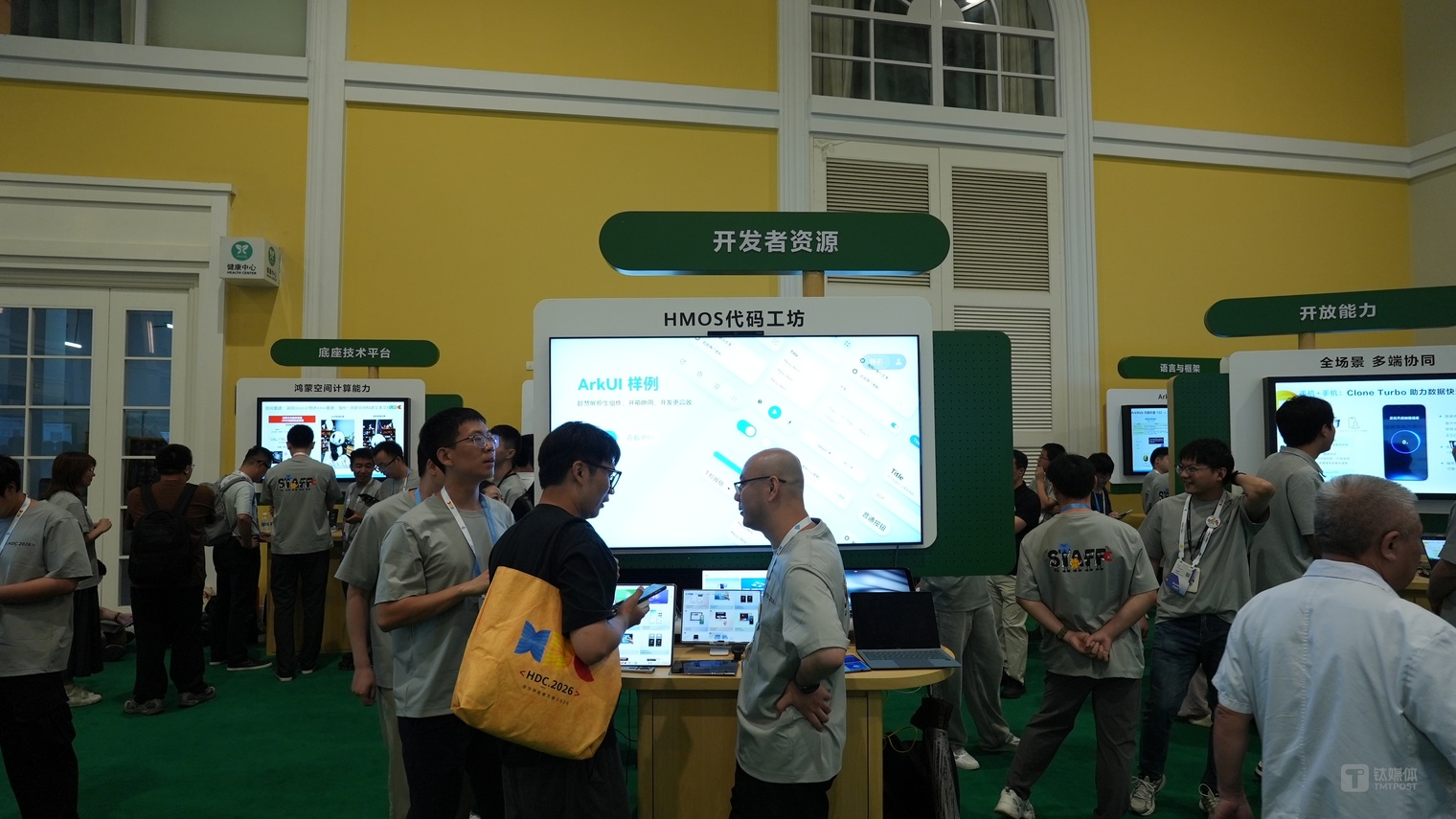
However, compared with improvements in system capabilities, the bigger highlight at this year’s HDC was Huawei’s increased investment in developer support and a shift in its thinking—for example, lowering the barrier to entry through products such as the HMOS Code Workshop App, enabling more developers to build at a lower cost. At the Sanyapo campus, developers from across the country shared the same impression: performance and monetization matter, of course, but what matters even more is how quickly they can get started and develop efficiently.
Competition among operating systems has never been a contest of a single product, but a battle of ecosystems. At present, HarmonyOS has more than 11 million registered developers—but that still isn’t enough. As system innovation becomes increasingly rich, what developers truly need are hands-on tools that are low-threshold, high-efficiency, and reusable. This is precisely the direction HarmonyOS has been working hard to advance in over the past few years.
A New Test Behind 11 Million Developers
A report from market research firm Counterpoint Research showed that in the first quarter of 2026, HarmonyOS reached a 19% share of China’s smartphone operating system market, surpassing iOS to become the country’s second-largest smartphone operating system.
At HDC2026, Gong Ti, President of the Software Department of Huawei’s Terminal BG, said that HarmonyOS 6’s upgrade rate had now exceeded 98%, and user satisfaction with top apps had risen by more than 50% over the past year. Meanwhile, Huawei Executive Director and Chairman of the Terminal BG Richard Yu also revealed that the HarmonyOS ecosystem had brought together more than 11 million registered developers, with AppGallery services surpassing 400,000.
From a data standpoint, HarmonyOS has now moved beyond the “usable” stage, with system capabilities continuing to improve. In this rapid-growth phase, how to enable developers at different levels to enter the ecosystem at low cost—and how to provide them with a more efficient, intuitive path for learning and hands-on practice—has become Huawei’s next set of challenges at this stage.
And this is, in fact, the development path every operating system must take—from 0 to 1, and then from 1 to 100.
Looking back at the history of operating systems, no ecosystem has ever succeeded solely because the OS itself was powerful. Microsoft secured the PC era with open development tools and a mature developer system; Apple led the smartphone era with refined development frameworks and unified ecosystem rules; Google came to dominate the mainstream mobile ecosystem through open source, openness, and a vast developer base.
As one developer attending the event told the author, “HarmonyOS’s future—system performance is certainly important, but what matters even more is how many developers are willing to keep walking alongside it, and whether it can attract more and more people to join in building it together.”
Layered Rollout: Huawei “Distills” Itself
From “usable” to “easy to use” to “love to use,” as new contradictions and challenges emerge, Huawei brought fresh thinking at HDC2026 about its relationship with the developer ecosystem. From an experience standpoint, the HarmonyOS 7 Developer Beta delivered upgrades in multiple directions—AI-assisted development, intelligence, spatial capabilities, and more—creating greater room for experimentation and monetization.
At the same time, Huawei is also using a range of developer tools to answer developers’ questions: How do I use it? Can I get started quickly? In the past, developers’ learning paths were relatively limited—either forums, official groups, or offline classes. Huawei instead chose to “distill” itself, “packaging” years of development experience accumulated by Huawei and its ecosystem partners into a single app, and segmenting it by developer skill level.
Specifically, to help developers understand, get started with, and apply HarmonyOS 7’s new capabilities more quickly, Huawei integrated development examples and code into the “HMOS Code Workshop App.” It comes with hundreds of sample code packages, supports one-click source sharing/acquisition, and supports running on 1+8 devices—helping developers understand how the same app adapts across phones, tablets, foldables, PCs, wearables, and other device types.
On-site R&D staff noted that “HMOS Code Workshop” is more than just a collection of sample code; it’s essentially a “development model room” that bundles the HarmonyOS team’s engineering experience, adaptation standards, and design guidelines into something developers can run directly, inspect in source form, and reuse with a single click.
According to the introduction, the traditional development model is “documentation-driven”: developers read abstract textual descriptions, build the implementation logic in their minds, and then write code. HMOS Code Workshop, by contrast, visualizes these new capabilities and turns the development path into ready-to-follow examples. Developers can run the app directly on their phones and see how features such as “interactive cards,” “immersive light sensing,” and the “wave-wheel menu” actually look and behave in a real interface. Instead of starting from scratch by feeling their way through capability documents, developers can work through individual samples to see the end result, understand the implementation logic, and reuse key code—thereby completing app development.
“You can think of the HMOS Code Workshop app as a ‘HarmonyOS sample library in a developer’s pocket’ and a ‘hands-on practice ground for HarmonyOS’s new capabilities.’ It also keeps iterating with new HarmonyOS features, making it a good fit for developers with some foundation, and for app teams that want to quickly keep up with the latest HarmonyOS capabilities.”
In addition to HMOS Code Workshop, Huawei has also released HarmonyOS Development Quick Start in 2 Hours to address pain points for developers at different stages. Aimed at absolute beginners, it answers the question of “how to take the first step.”
It is understood that the follow-along coding tutorial is designed to take about two hours, with roughly 300 lines of code. It walks through the development approach and uses plain, relatable analogies to help developers build a basic understanding of HarmonyOS development in a short period of time. HarmonyOS R&D staff said, “To lower the barrier to learning and developing for HarmonyOS, the official tutorials will place greater emphasis on clarity and ease of learning.”
More Handy Tools are Needed
From being questioned to being chosen, every step for HarmonyOS has been hard-won. But commercial operating systems are judged by outcomes: behind performance there must also be a developer ecosystem. An operating system is not about showing off tricks—high performance is important, but easy-to-start development matters even more. The successive launch of developer-support tools is HarmonyOS’s concrete response to new ecosystem tensions.
HarmonyOS Development Quick Start in 2 Hours answers “how to take the first step,” while the HMOS Code Workshop app answers “how to actually use the new capabilities.” One is responsible for “acquisition,” the other for “retention and conversion.” By offering a lower-barrier introductory tutorial, they draw students, true beginners, and developers transitioning from other platforms into the HarmonyOS development ecosystem—helping developers turn new capabilities into real app experiences.
In addition, at HDC2026, addressing developers’ demand for AI-assisted development, Huawei also introduced two new HarmonyOS AI-assisted development products: DevEco Code and DevEco CLI. Gong Ti revealed that Huawei has shared all of its HarmonyOS AI-assisted development skills with the OpenHarmony community.
This string of moves has made its intentions clear: in response to the new challenges at this stage, what Huawei wants to do is lower the barrier to HarmonyOS development through tools, sample projects, tutorials, and hands-on case studies—so that everyone can join the HarmonyOS ecosystem, even developers with zero experience. As one Huawei employee wrote on social media: “From high school students in their teens, to PhD holders at Peking University; from non-programmers to people with disabilities joining in—the AI era is narrowing the gap between specialties and academic credentials. As long as you have ideas, you can give it a try in the HarmonyOS ecosystem.”
Of course, challenges remain. The future of an operating system depends not only on performance, but also on how many developers are willing to stick with it for the long haul. HarmonyOS is still in pursuit, and 11 million developers is still a gap compared with a mature ecosystem. For developers to gain more meaningful user growth and commercial returns in the HarmonyOS ecosystem than on other platforms, they will need more “weapons that fit the hand”—lowering the development threshold and making developer services more meticulous. Only when more people from different backgrounds and fields can participate at low cost will the ecosystem’s forest truly flourish. (Author | Du Zhiqiang, Editor | Yang Lin)


 快报
快报
根据《网络安全法》实名制要求,请绑定手机号后发表评论