






NextFin News -- At the Jiangsu Kunshan FCVC Hydrogen Energy Conference that just wrapped up, the hydrogen industry was framed as “entering a new stage of scaled-up development.” According to publicly available statistics, a total of 1,832 hydrogen fuel-cell vehicles were delivered in the first four months of 2026. Policy support has been ramping up as well: for the first time, the Government Work Report positioned hydrogen as a “new growth driver,” and three ministries launched the second round of pilot programs for comprehensive hydrogen applications.
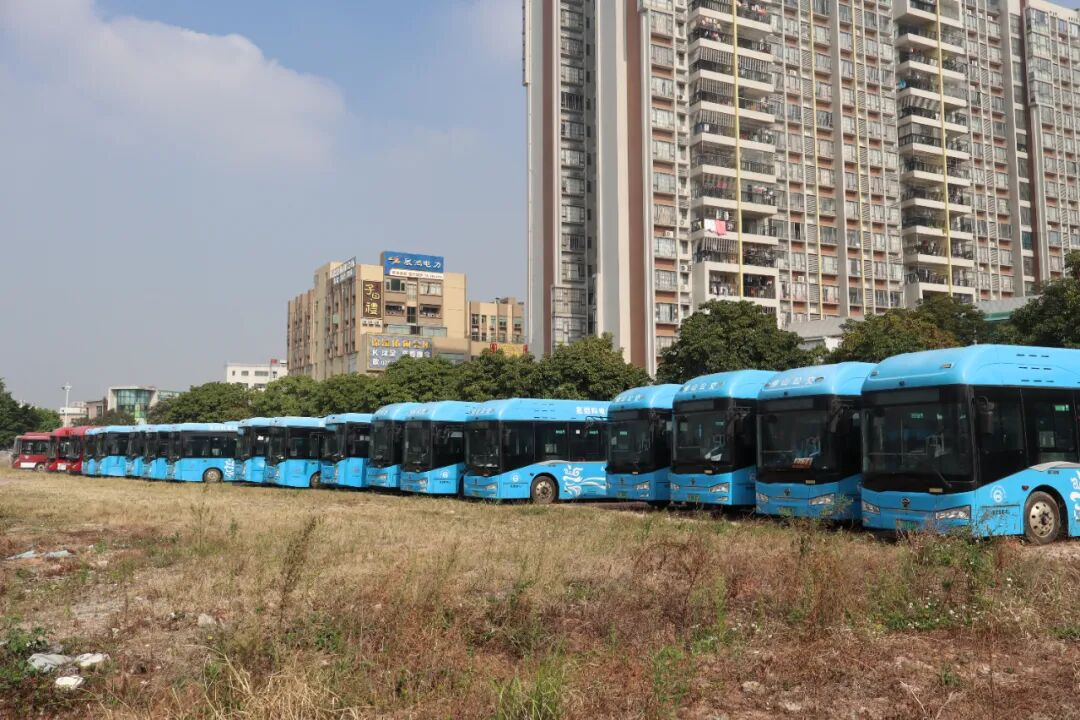
Yet on the same hotbed of industrial enthusiasm, in a parking lot at a passenger transport hub in Nanhai District, Foshan, Guangdong, at the beginning of this year, more than 20 brand-new sky-blue buses had their keys removed and were left sitting quietly on the grass, exposed to sun and wind. There was nothing mechanically wrong with them, but a notice was posted on the windshields: “Hydrogen vehicles: enough mileage has been arranged, service suspended; not allowed to operate.”
No breakdowns—yet they were forced off the road? This is only a microcosm of the contradictions surrounding hydrogen buses.
In Scotland, Aberdeen’s hydrogen-powered double-decker bus fleet—once hailed as a global benchmark and built at a cost of tens of millions of pounds—was halted by the city council in early 2026 and entirely scrapped, with the city pivoting fully to electric vehicles. In southwest China, Chongqing went even further, issuing a document to repeal its guidance on developing the hydrogen-vehicle industry; less than 30% of the official targets were achieved.
All signs seem to be pointing to a major rout for hydrogen buses. Paradoxically, though, in December 2025 Guangzhou dropped a massive 483 million yuan procurement order, buying 450 hydrogen buses in one go. On one side is a wave of shutdowns for existing fleets; on the other, policy and the market are doubling down in tandem. The sense of fracture in the hydrogen industry has never been this stark.
Between the frenzy of suspensions and abandonment, and the cash-fueled charge against the tide, what game is being played with hydrogen buses? To answer that, we need to unpack three layers of logic: the technological bind, the economic bind, and the political economy buried deepest in the books.
In scientific terms, hydrogen-powered buses are almost the ideal eco-friendly vehicle people imagine. Their power does not come from direct combustion in an internal combustion engine, but from an electrochemical reaction between hydrogen and oxygen in a fuel cell. The only byproduct is pure water, achieving zero carbon emissions. Hydrogen has an extremely high gravimetric energy density: filling up a hydrogen bus takes less than 15 minutes, and it can travel 500 to 800 kilometers. By contrast, a battery-electric bus often takes hours to charge, typically offers only 200 to 400 kilometers of range, and must carry a heavy battery pack that eats into passenger space.
If it is this perfect, why has it been so decisively outpaced by EVs in the real world? The core reason is a physical bottleneck in thermodynamic efficiency.
From power generation and electrolyzing water to produce hydrogen, to high-pressure compression, transport by heavy tube-trailer trucks, and then converting it back into electricity in a fuel cell, every change in energy form incurs major losses. Energy experts at the University of Strathclyde in Scotland estimated that with the same input of 100 kWh of initial electricity, a battery-electric vehicle can achieve a final energy utilization rate of 70%–80%, while a hydrogen vehicle is left with only about 30%. With the same energy consumption, an electric bus can travel roughly twice as far as a hydrogen bus in real-world operation.
Second, hydrogen has low volumetric energy density, is extremely difficult to compress, and is flammable and prone to leakage. It must be stored in carbon-fiber high-pressure tanks at 35 MPa or even 70 MPa, keeping manufacturing, storage, and transportation costs stubbornly high. Building a hydrogen refueling station can easily cost tens of millions of yuan, and this infrastructure bottleneck directly shuts down the possibility of large-scale rollout.
The technical conclusion is already clear: in the urban bus arena, hydrogen loses to the battery-electric route on physical efficiency alone.
The Moment Subsidies Stop, So Do the Buses
Looking back, why were Foshan’s hydrogen buses forced to sit idle on a patch of grass even though they were not broken? The answer lies in that notice saying operations were being suspended due to “sufficient mileage arranged for suspension.” Behind it is a heavy local fiscal bill.
Foshan was once the country’s most aggressive early demonstration zone for hydrogen, spending a cumulative total of over 1 billion yuan to purchase nearly 1,000 hydrogen buses. At one point, each bus cost around 1.8 million yuan—more than twice the price of a comparable battery-electric bus. During that policy dividend window, through a dual national-and-local subsidy mechanism, each vehicle could receive up to nearly 800,000 yuan in massive fiscal subsidies.
But there was a hard threshold to claim the subsidy: each vehicle had to accumulate 20,000 kilometers of real operating mileage.
The problem lies in day-to-day operating costs. Nationwide compulsory traffic insurance data and industry figures show that hydrogen fuel buses cost about 1.8 yuan per kilometer to run, while electric buses cost only 0.8 yuan. In Foshan, aside from Nanhai District, which offered hydrogen-refueling subsidies (pushing the retail hydrogen price down to 33 yuan/kg), every other district faced a steep market price of around 50 yuan/kg. The break-even point for hydrogen-powered buses is 35 yuan/kg. That means for a bus that consumes an average of 13 kg of hydrogen per day, daily fuel costs can easily exceed 300 to 400 yuan—losing money on every single trip.
To secure the several-hundred-thousand-yuan purchase subsidy, bus operators had no choice but to absorb hefty daily fuel losses and keep the vehicles running as much as possible. Data from the Guangdong Provincial Department of Transportation show that this batch of sidelined hydrogen buses had each already logged more than 90,000 kilometers safely on average—long past the subsidy threshold. After the subsidies were paid out, with bus ridership shrinking year by year and local finances under strain, operators chose to take the most expensive-to-run hydrogen buses straight out of service, cutting off the daily losses from refueling. It was the most realistic—and the only rational—business decision.
Upstream was just as bleak. Even SinoHytec, the so-called “No. 1 hydrogen stock,” was being tested by the capital markets.
Because it relied heavily on policy windfalls and because delays in subsidies created a black hole in collections, the company posted net losses for six consecutive years, with losses continuing to widen. In 2025, it generated revenue of only 259 million yuan (almost slipping back to the scale of eight years earlier), while its net profit attributable to shareholders plunged into a massive loss of more than 671 million yuan. To survive the cold winter, this company—despite branding itself as a hard-core tech player—significantly cut R&D staff over the past two years; by the end of 2025, its R&D team had shrunk from more than 300 at its peak to just over 90.
The economic conclusion is equally clear: on the operations side, hydrogen buses simply don’t add up—whether for bus companies or for upstream suppliers.
Local Governments’ Bet
If the technology loses to pure EVs, the economics don’t pencil out, and leading companies keep bleeding money, why did Guangzhou still buck the trend and place a big order worth 483 million yuan for 450 buses?
Because what local governments are calculating isn’t bus operators’ “fare revenue,” but the “industrial-economy ledger” of attracting investment and building local industry.
For local governments, spending several hundred million yuan on buses is essentially an “entry ticket” for an industrial investment. Take Foshan as an example: although the bus-operations side has borne massive losses and even ended up with vehicles sitting idle, those enormous government procurement orders enabled Foshan to successfully build an astonishingly valued “Xianhu Hydrogen Valley” in Nanhai District. Today, the area has attracted more than 100 hydrogen-related companies, driven total investment in the region to over RMB 40 billion, and set a goal of surpassing RMB 100 billion in output value by 2035.
Guangzhou’s RMB 483 million order follows the same logic: the bulk of the winning bid went directly to the local company Guangzhou Kaivo, with the unit price pushed down to roughly RMB 1.07 million. Those 450 buses will directly generate over RMB 200 million in output-demand for more than 20 core hydrogen component companies within Guangzhou Development District, forming a highly localized, self-contained “internal circulation” loop. In effect, they are using real fiscal money to foot the bill and transfuse blood into the local high-tech industrial chain.
When a technology wears a “high-tech” halo yet runs into a deep commercialization deadlock in reality, it often attracts opportunists looking to profit. The “water-hydrogen engine” incident in Nanyang, Henan that shocked the whole country in 2019 is the most extreme footnote to industrial speculation.
At the time, local media prominently promoted on the front page the roll-off-line of a “miracle vehicle” developed by Youngman Automobile Group, claiming that “the vehicle only needs tap water, and can produce hydrogen in real time to drive.” This pseudo-science—openly violating the basic physical law of conservation of energy—still reached a cooperation agreement with the Nanyang municipal government for nearly RMB 8 billion in total investment, under which a local government financing platform was required to inject RMB 4 billion. The scientific community quickly pointed out that the so-called “run on water” actually relied on an expensive aluminum-based catalyst reacting with water, and that producing these high-energy catalysts consumes an enormous amount of electricity—an economic bottomless pit. Worse still, companies under founder Pang Qingnian’s name had been listed by China’s Supreme People’s Court as dishonest judgment debtors 158 times, with a serious track record as a “deadbeat” and of gaming policy resources. Amid the massive public outcry, the Ministry of Industry and Information Technology intervened, barred the model from being put on the road, and completely cut off its route to applying for new-energy subsidies—only then did this farce come to an end.
Of course, Nanyang is fundamentally different from Foshan and Guangzhou: the former was pseudoscience used to defraud subsidies, while the latter are using fiscal orders to bring an industrial chain onshore. But what they have in common is that hydrogen buses have never been a purely technological story or a purely commercial one. They are an “industrial tournament” driven by fiscal subsidies, led by local governments, and fought over by industrial capital—where winners take home a trillion-yuan-scale industrial chain, and losers are left with a pile of idle buses and notices reading “service suspended due to insufficient scheduled mileage.”
After three rounds of analysis, the conclusion is now clear: in the urban bus segment, hydrogen lost both to physical limits and to the economics. The industry has largely reached a consensus that hydrogen buses don’t work—neither operationally nor technologically. As for why local governments are still buying them, that’s a different ledger altogether: the industrial-investment-attraction ledger. The two ledgers don’t contradict each other; they’re just being kept by different people.
So where, exactly, is the future of hydrogen vehicles? The answer is commercial heavy-duty trucks.
In 2025, China’s new-energy heavy-truck sales surpassed 230,000 units, with industry penetration approaching 30%. But the vast majority were battery-electric trucks, which can mostly do only short-haul shuttle runs of a few dozen kilometers inside ports or closed industrial compounds. In extreme scenarios—large open-pit mines, bitterly cold regions, or cross-province long-haul trunk logistics—battery-electric heavy trucks have to carry battery packs weighing several tons. That not only eats into valuable payload capacity; charging that often takes hours also drags down logistics turnover efficiency. In May 2026, Dongfeng Motor released the world’s first 400 kW heavy-truck fuel-cell stack; for a 49-ton hydrogen tractor, hydrogen consumption was reduced to 7 kg per 100 km, and total lifecycle costs began to benchmark against diesel vehicles.
This is precisely the window of opportunity for hydrogen heavy trucks.
With the same thermodynamic efficiency of 30%, why did hydrogen lose to battery-electric on buses, yet turn into an advantage for heavy trucks? Because in heavy-truck applications, the physical bottlenecks of battery-electric—battery weight eroding payload and charging time crushing logistics efficiency—are more fatal than hydrogen’s efficiency bottleneck. When forced to choose the lesser evil, hydrogen heavy trucks’ advantages stand out: lighter curb weight, fast refueling, and resilience in extreme cold. In early 2026, the Ministry of Industry and Information Technology (MIIT) and other departments explicitly issued documents defining hydrogen as an important clean fuel for scenarios such as intra–industrial-park logistics.
Over the same period, Dongfeng Motor’s cumulative sales of hydrogen fuel-cell vehicles exceeded 9,200 units, with a market share of more than 30%. Across more than 40 cities nationwide, the commercialization of hydrogen heavy trucks is moving from demonstrations toward scaled rollout.
Following the three layers of logic—technical constraints, economic constraints, and political economy—the real way forward for hydrogen is not urban buses, but mines, frigid regions, and cross-province long-haul trunk logistics. After capital-driven illusions and policy swings, this is the only viable direction left for the hydrogen industry.



 快报
快报
根据《网络安全法》实名制要求,请绑定手机号后发表评论