







NextFin News -- A software company with less than RMB 900 million in cash on its books dared to brandish RMB 8.5 billion in bank credit lines to pry up the leverage of a RMB 4 billion computing-power business; a long-established security (surveillance) vendor with annual revenue only just over RMB 160 million and in the midst of a transformation took on a massive GPU order worth more than RMB 2.7 billion.
And standing at center stage was a “mysterious middleman” less than a year old—one that reporters couldn’t even find at its registered address: Beijing Qimingxinghan Technology Co., Ltd. (Qimingxinghan). With just a handful of contracts, it linked two listed companies and the feverish “computing power” narrative into a transaction chain worth nearly RMB 7 billion.
Yet behind this string of deals, what we really want to unpack is not merely the business logic of a few contracts—but, under the growth anxiety gripping China’s A-share market, a collective cross-industry impulse dancing hand-in-hand with risk.
“Computing-power Lifeline” After the Core Business Struggled
Tianyang Technology (300872.SZ) used to be a leading domestic service provider in the banking IT space. It secured its position by delivering core system software for banks—covering lending, credit cards, and more—and went public on ChiNext in 2020. But over the past two years, the company’s traditional core business has remained under sustained pressure.
Judging from the financials, its performance fell off a cliff. In 2024, net profit excluding non-recurring items came in at only RMB 2.7165 million, a year-on-year plunge of 95.75%; in 2025, it posted a full-year net loss of RMB 138 million, while the loss excluding non-recurring items widened further to RMB 198 million—representing a decline of more than 73-fold year on year. Moving into 2026, first-quarter net profit dropped another 70.54% from a year earlier. Although net profit excluding non-recurring items barely swung back to positive territory at RMB 4.8066 million, that was only a marginal improvement—far from a return to a healthy profit profile.
Tianyuan Technology acknowledged in its announcement that the key reason for the earnings decline came from pressure being passed up from downstream industries. Banks’ own profitability came under strain, their technology spending kept shrinking, and on top of that, price wars within the industry intensified. Reflected upstream onto service providers, this translated into a continued drop in gross margin, ever-longer project cycles, and frequent cost overruns. To reverse the situation, the company had previously tried a diversified transformation: in August 2025 it planned to acquire a 51% stake in the AI company Moshu Zhiqing, but the target ultimately fulfilled only 44.11% of its performance commitment; it also ventured into areas such as a semiconductor fund and aviation internet. However, these scattered attempts failed to generate meaningful incremental growth in the short term.
Against this backdrop, compute-power leasing became the company’s last breakout option. On May 6, 2026, Tianyuan Technology announced that it planned to invest RMB 3.5–4.0 billion and cooperate with Qimingxinghan, formally entering the compute-power leasing track. Yet as of the end of the first quarter of 2026, the company had only RMB 896 million in cash and cash equivalents on its books, while short-term borrowings were as high as RMB 616 million; operating cash flow was a net outflow of RMB 326 million. Its financial resources were severely mismatched with the scale of investment it planned.
Faced with a huge funding gap, Tianyuan Technology chose to lever up through heavy borrowing to drive the business forward. Earlier this year, the company had already applied for RMB 1.5 billion in credit facilities; this time it added another RMB 7.0 billion, sending total credit lines soaring to RMB 8.5 billion—using massive debt to shoulder an asset-heavy project.
"Domestic demand for compute power is still very strong. There are quite a few large compute-power leasing orders in the market right now, and most are released by leading players," an investor who has previously led similar businesses told the author. "Big tech companies also build their own compute centers, but for capital cost reasons, they will release a large portion of their demand to the market to absorb. Once a company takes an order, it naturally has to spend money building compute centers to take on those orders."
But compute-power leasing is not a high-margin business. In a recent exchange with institutional investors, Tianyuan Technology said candidly: "All deliverables can be put into use in 2026. We have already secured end-user demand for five years, so the revenue side is fully certain. The business has a lower gross margin than traditional fintech, but the revenue scale is large and the profit contribution is stable."
"Although these orders are usually sizable, overall profits aren’t particularly high—annualized returns are generally around 6% to 8%," the source added. He said one company that once wanted to cross over into compute-power leasing was dissuaded by that level of return. "But there will always be someone in this market willing to take such orders—some companies have a relatively low cost of capital, while others value the impact these orders can have on the capital markets."
For Tianyuan Technology, whether this RMB 4.0 billion investment falls into the former category or the latter remains to be tested by time.
A Fog of Taking the Long Way Around
What is worth noting is that Tianyang Technology later, via Qimingxinghan, steered a GPU mega-order worth RMB 2.783 billion to Hanbang Hi-Tech, directly stitching together a computing-power project with a total scale of nearly RMB 7 billion. To outsiders, this single project by Tianyang Technology “saved” two listed companies, yet it also left behind even more questions that don’t quite add up.
Public attention once focused on Qimingxinghan’s “invisibility” at its registered address, or on the “snake swallowing an elephant” size of the order taken by Hanbang Hi-Tech. But in my view, the least defensible part of the entire chain is Tianyang Technology’s"decision to abandon a familiar partner in favor of an untested one. As the second-largest shareholder with a 5.02% stake, Tianyang Technology has long had a solid foundation for strategic synergy with CapitalOnline, and the two have already relied on each other in the intelligent computing business for quite some time. Yet in the end, Tianyang chose Hanbang Hi-Tech, a company still in the midst of pivoting into AI and still operating at a loss.
First, consider what this order means for Hanbang Hi-Tech——as a long-established security video company, Hanbang Hi-Tech saw its core business collapse across the board starting in 2021. That year, due to downturns at its subsidiaries Jinshi Weishi and Tianjin Putai, the company booked a total goodwill impairment of RMB 519 million, leading to a net loss of RMB 754 million and its first swing from profit to loss since listing. Over the following years, the company became mired in losses with no way out: from 2022 to 2025, revenue stayed below RMB 200 million for four consecutive years, while losses continued and net profit excluding non-recurring items deteriorated in tandem. In the first quarter of 2026, revenue fell 19.25% year on year; although the net loss narrowed 12.02% year on year, there still appeared to be no clear sign of a business turnaround in the near term.
Then, at that very moment, a RMB 2.783 billion contract for GPU equipment and integrated maintenance services dropped out of the sky. What does that figure mean in practical terms? It was equivalent to 1,515.13% of Hanbang Hi-Tech’s 2025 revenue—exceeding the company’s total revenue for the full eight years from 2018 through 2025—more than enough to revive its financial performance in one shot.
Yet after sorting through the details, I found that whether judged by business synergy, the degree of equity linkage, or capability fit, the first choice for Tianyang Technology’s large order would seemingly have been CapitalOnline (300846.SZ), not Hanbang Hi-Tech.
Because Tianyang Technology and CapitalOnline had long been deeply intertwined, the two sides actually began cooperating as early as 2022 around the digital transformation of small and mid-sized banks. In 2023, they also jointly set up an industrial investment fund—the “Herun Fund”—with each holding a 39.98% stake;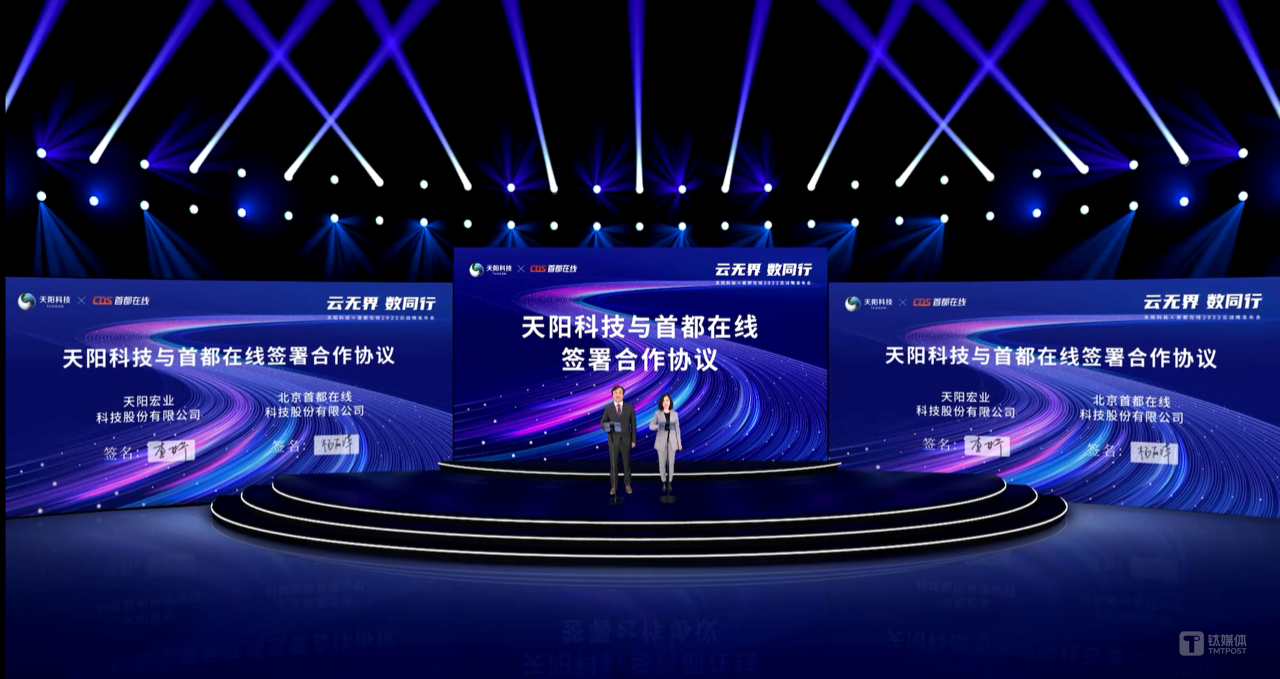
CapitalOnline became a strategic partner as early as 2022 Source: CapitalOnline
What’s more, Tianyang Technology had long since shifted from being a financial investor in CapitalOnline to a strategic investor: it participated in CapitalOnline’s private placements twice, in 2022 and 2024, and cashed out in full at the highs after each lock-up period expired. The second round of selling alone netted a post-tax profit of RMB 160 million. In September 2025, Tianyang Technology went further, paying RMB 443 million to acquire 25.2076 million shares of CapitalOnline, lifting its stake to 5.02% and making it the second-largest shareholder. It also explicitly said it was optimistic about the prospects of intelligent-computing cloud services in the AI era and hoped to promote coordinated R&D between the two parties.
Finally, in terms of business capabilities, CapitalOnline’s core businesses are intelligent-computing cloud services, IDC services, and integrated solutions. In 2025, its intelligent-computing cloud revenue reached RMB 295 million, up 61.08% year on year, giving it full end-to-end capabilities across GPU procurement, networking, delivery, and O&M. Even though CapitalOnline posted cumulative losses of RMB 1.002 billion from 2022 to 2025 and still lost RMB 21.52 million in Q1 2026, its intelligent-computing business was growing strongly and its losses were continuing to narrow. If Tianyang Technology had handed the order to CapitalOnline, it could have reinforced their equity-based synergy, helped the other party return to profitability sooner, and ensured delivery quality—an arrangement that would have delivered multiple wins at once.
But the reality was that Tianyang Technology deliberately bypassed this “insider” and handed a super-sized order—one big enough to change a company’s fate—to Hanbang Hi-Tech, a firm mired in operational trouble.
This abnormal move—choosing a faraway option over a close one, and picking an unfamiliar partner over a proven one—cast a heavy cloud of doubt over the project’s true intent. I previously called Tianyang Technology’s board secretary’s office in the capacity of an investor to ask about the matter, but the other side did not provide a reasonable explanation.
Insider Trading?
The computing-power partnership between Tianyang Technology and Hanbang Hi-Tech is not only a cross-industry pivot at the business level; it also looks like a precisely timed capital-market feast. A string of maneuvers—an unusual stock-price move, shareholders positioning in advance, and the actual controller trimming holdings at elevated levels—has made the deal reek of financial engineering.
Tianyang Technology did not officially disclose its computing-power cooperation announcement until May 8, 2026. Yet before that, the company’s share price had already risen for four consecutive trading days, and on May 11 it touched an intraday year-to-date high of 23.22 yuan—clear signs that the news may have leaked early and that capital had already moved in.
Meanwhile, after comparing changes in the listed company’s top ten tradable shareholders list, the author found that well-known institutions and prominent retail investors had already entered with pinpoint timing. The 2025 annual report showed that Huaxi Xinyu, the controlling shareholder of Bloomage Biotech, had newly appeared among the top ten tradable shareholders, when the share price was still in a bottom range of 14–17 yuan. By the 2026 Q1 report, the top ten tradable shareholders list saw several new faces, including well-known retail investors Liu Zhiyuan, Wang Jieqing, Chen Kun, and others.
Right in the core stretch of the share-price surge, Tianyang Technology’s actual controller, Ouyang Jianping, executed a precisely timed reduction of his holdings. From May 11 to 19, 2026, he sold a total of 5.8257 million shares via centralized bidding and block trades, accounting for 1.19% of the total share capital, cashing out about 123 million yuan.
The market widely questioned whether the actual controller used the computing-power storyline to cash out at the top. The company responded that the sales were part of a pre-arranged plan and had no necessary connection to the computing-power project. But at a critical juncture when the company was splashing out 4 billion yuan and its own funding chain was already tight, the actual controller’s move to sell and cash out in the opposite direction hardly dispels market doubts.
Hanbang Gaoke has also shown signs of “foreknowing” money lying in wait. In the first half of 2025, well-known retail whales such as Yang Xiao and Guo Yongshan built positions at low levels and entered the list of the top ten tradable shareholders; during the 2025 annual report season, Zhang Zhijun and Tan Wei were newly added to the shareholder roster; in Q1 2026, Yang Xiao, Guo Yongshan, and Zhang Zhijun continued to increase their holdings, locking in cheap chips. Then a massive 2.783 billion yuan order landed, and Hanbang Gaoke’s share price immediately hit the daily limit up for consecutive sessions. Every step of capital’s pursuit of profit landed precisely on the beat of this computing-power capital game.Source: Choice
The A-side and B-side of cross-industry forays into computing-power leasing
Pulling our focus back from these two companies to the broader A-share wave of “cross-industry computing-power leasing,” we find that what happened to Tianyang Technology and Hanbang Gaoke is far from an isolated case. Since the arrival of the AI era, listed companies from traditional sectors—ranging from ink makers and banknote-printing plants to textile mills and toy factories—have rushed into computing-power leasing, trying to crudely replicate the capital-market myth of the “Inspur Digital” crowd. But this track is nowhere near as simple as it looks from the outside—certainly not a matter of “as long as you can get the GPUs, you can make money.”
The author previously came into contact with a listed company that, a few years ago, made a high-profile push into computing-power leasing and deployed computing centers in multiple regions. An insider revealed: “At this point, there’s basically no business left.” Someone else involved with an already-built computing-center business was even more blunt: “The market has even seen ‘suicidal’ bidding—tenders priced below cost.”
In reality, the profit model for computing centers is extremely demanding. Jian Ning (pseudonym), who has long been involved in building computing centers, told the author: “A typical computing-center project needs 8 to 12 years to break even, while computing-power leasing agreements are usually signed for three to five years at a time. Want to make fast money? Very hard.”
With fierce competition across the industry, computing-power leasing prices have generally stayed flat or fallen over the past three years. “In Shanghai, the all-in price for a computing cabinet including electricity is about 700 yuan/kw; under the MEP separation model, the MEP portion is about 360 yuan/kw. In areas around Shanghai, like Nantong, electricity is even cheaper. These prices are already close to the cost line, and they’ll most likely keep falling.”
Operational and compliance risks should not be underestimated. Compute leasing is not simply playing “a second landlord” collecting rent; it has a strongly technical nature, involving cluster stability, low-latency networking, compute scheduling, and incident response. Tianyang Technology has long been focused on software and lacks the DNA for operating large-scale physical infrastructure; Hanbang Hi-Tech only shifted from security into its new direction a few years ago. Entrusting tens of billions of yuan in assets to a team without hands-on experience entails extremely high ramp-up costs and operational risk. Jian Ning specifically pointed out: “Whether a large-scale computing center can be delivered on schedule hinges on energy-efficiency reviews and regulatory ‘window guidance.’ The energy-efficiency review must be filed at one of the eight nodes designated by the state; if it’s outside the nodes, local governments are very likely not to approve it.”
Risk from shifts in end-demand. “At the moment, hardware depreciation isn’t the main risk—NVIDIA GPUs purchased a year ago can still be resold at cost. The biggest risk is customers delaying rent payments; that pressure transmits upstream and ultimately triggers defaults across the entire funding chain,” Jian Ning said. Contracts come in “closed” and “open” forms: closed contracts stipulate liquidated damages—if the customer fails to proceed, it must compensate; open contracts are merely a framework with no default cost. Fortunately, Tianyang Technology is using the closed model this time.
Ultimately, compute leasing is a heavy-asset, long-cycle industry that is both technology- and capital-intensive, and the barriers to entry are rising rapidly. The earlier windfall period created by a supply-demand gap is being diluted as capital from all sides pours in.
For Tianyang Technology, the RMB 4 billion compute bet is a decisive battle with no room to retreat: success means a transformational rebirth; failure accelerates a break in its funding chain. For Hanbang Hi-Tech, the RMB 2.7 billion order is life-extending medicine, not a cure for the core business’s losses—everything depends on whether it can be truly implemented and delivered, and converted into recurring revenue.
Amid the speculative frenzy around “compute power” themes in the A-share market, business fundamentals and risk control are often overlooked. In the end, the only companies that can make it through the cycle are those backed by real performance and core competitiveness—not distressed players relying on hype-driven concepts.


 快报
快报
根据《网络安全法》实名制要求,请绑定手机号后发表评论