






In the AI era, entrepreneurship’s possibilities are virtually limitless, and vibe coding is giving rise to more one-person companies and “super individuals.”
On March 7, MiroFish, an open-source project developed by Guo Hangjiang, a senior undergraduate student in China, topped GitHub’s Global Trending list. It is a collective-intelligence engine centered on “predicting everything,” and it has already secured 30 million yuan in investment from Chen Tianqiao, founder of Shanda Group, to support further product incubation.
Last year, an open-source project developed by Guo—the multi-agent public-opinion analysis assistant BettaFish—hit No. 1 on GitHub’s trending chart at the end of the year, drawing Chen Tianqiao’s attention and leading to an invitation to join. Shortly afterward, Guo independently developed MiroFish once again in a very short period of time.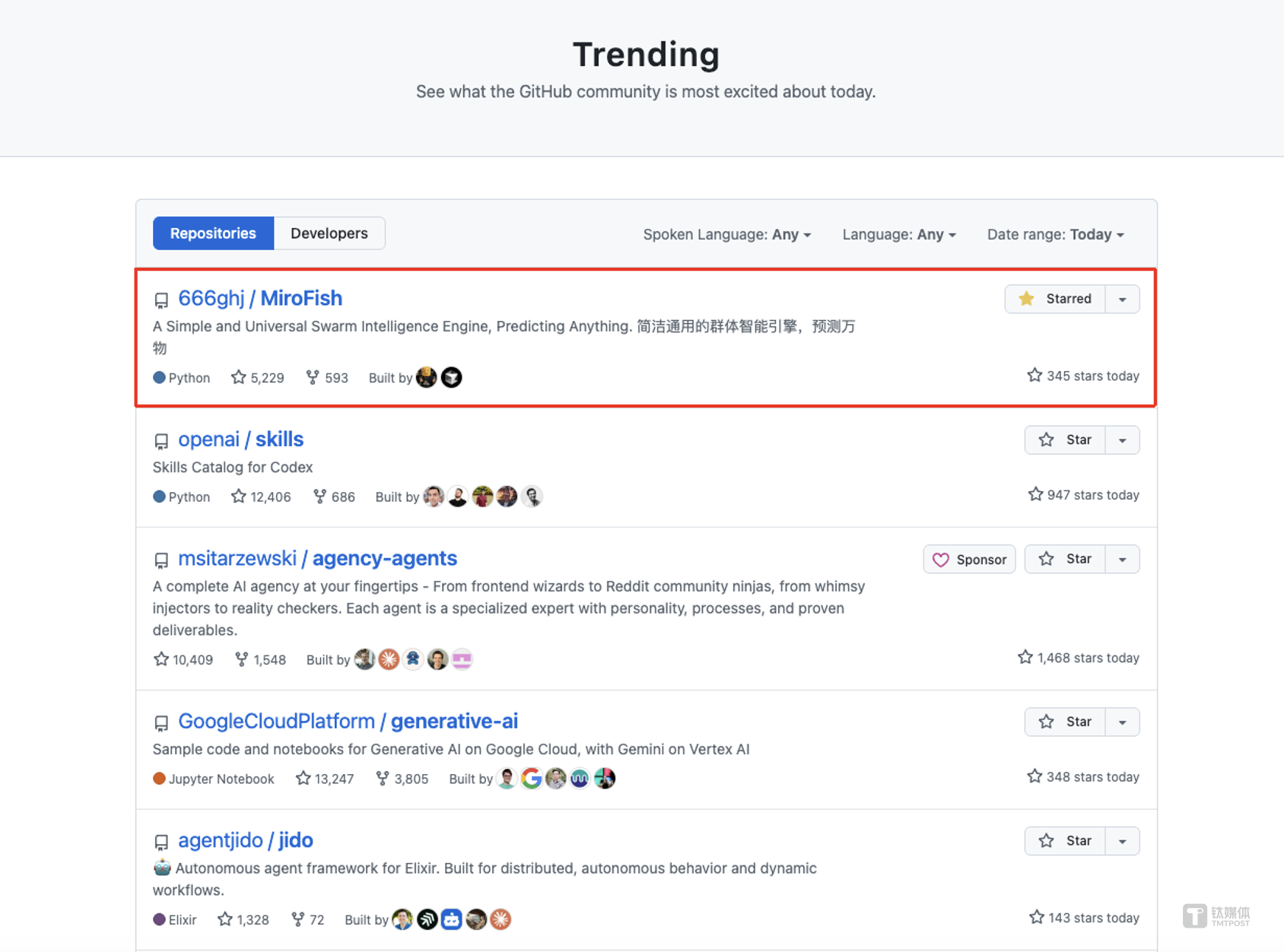
MiroFish topped GitHub’s Global Trending list
As a new-generation AI forecasting engine built on multi-agent technology, MiroFish extracts “seed” information from the real world (such as breaking news, policy drafts, and financial signals) to automatically construct a high-fidelity parallel digital world.
Within this space, tens of thousands of agents—each with an independent persona, long-term memory, and behavioral logic—interact freely and undergo social evolution. From a “god’s-eye view,” users can dynamically inject variables to run precise simulations of how the future may unfold—rehearsing tomorrow inside a digital sandbox, so decisions can prevail after countless rounds of scenario testing.
Users only need to upload seed material (a data analysis report or an interesting fictional story), and describe their forecasting needs in natural language.
MiroFish will then deliver a detailed forecast report, along with a highly realistic digital world that you can interact with in depth.
MiroFish’s core idea is to project the future by building a “parallel digital world.” It doesn’t stop at analyzing the present; instead, it seeks to simulate how society evolves in a virtual environment, thereby forecasting how events may unfold.
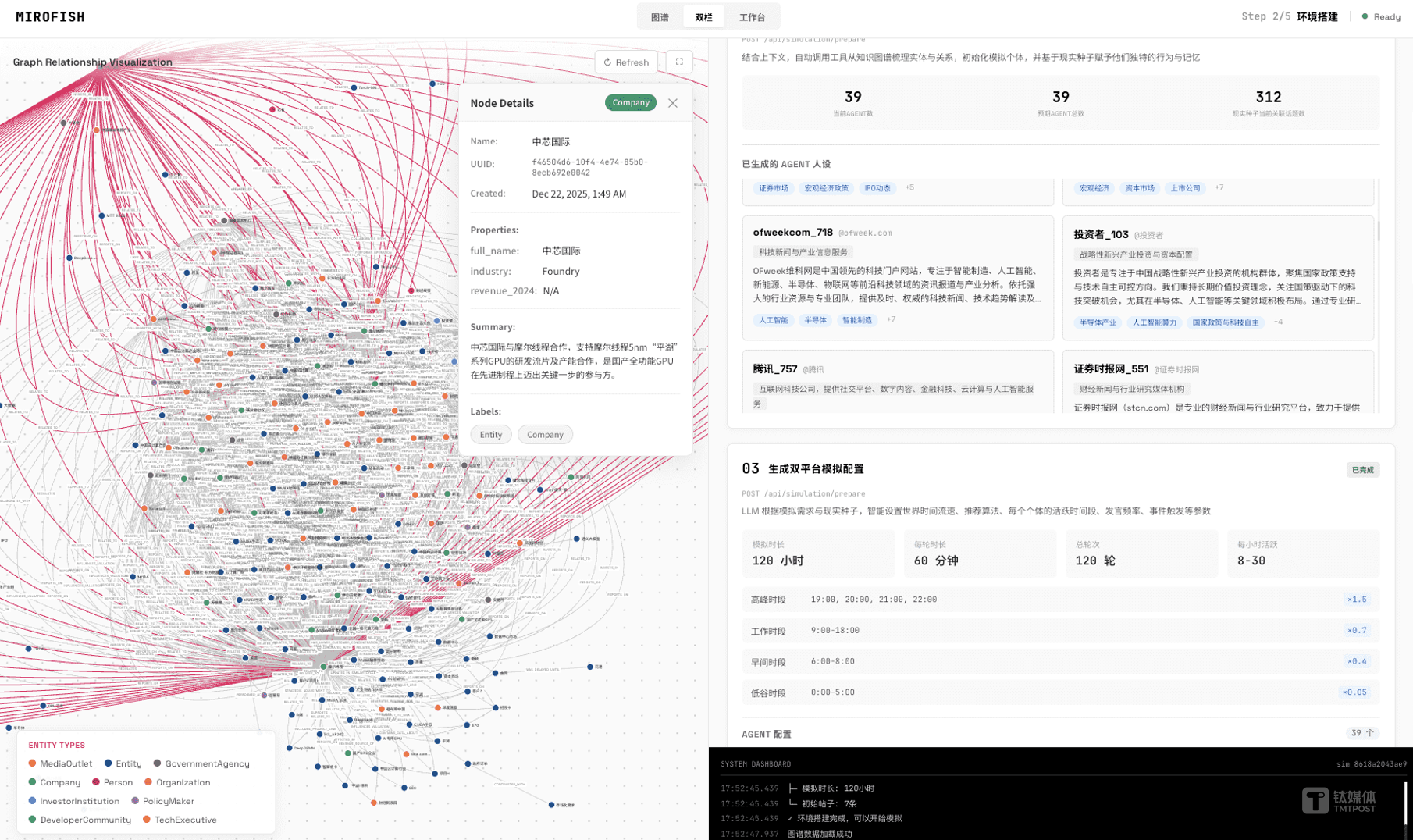
How does MiroFish pull off simulations this complex? Its workflow can be summed up in five core steps:
- Knowledge graph construction: The system first performs an in-depth analysis of the “seed material” uploaded by the user (such as research reports or novel text), extracts key entities and relationships, and uses GraphRAG to build a dynamic knowledge graph—injecting the agent with initial memory at both the individual and group levels.
- Environment setup: Based on the knowledge graph, the system automatically extracts entity relationships, generates agent “personas” with different stances and backgrounds, and has an environment-configuration Agent inject simulation parameters to complete the initialization of the virtual world.
- Start the simulation: This is the most exciting part. MiroFish launches parallel simulations on two platforms, enabling dozens or even hundreds of generated agents to discuss, compete, and act around the relevant topics in two independent simulated environments. Throughout the process, it automatically parses the prediction requirements and dynamically updates every agent’s chronological memory.
- Report generation: After the simulation ends, a dedicated ReportAgent uses a rich toolkit to interact deeply with the post-simulation environment, synthesizing the actions and evolutionary outcomes of all agents to produce a structured, detailed forecasting report.
- Deep interaction: The report isn’t the end. You can choose to talk to any agent in the simulated world to press them on their views and decision logic; you can also talk to the ReportAgent and have it summarize and explain the forecast results in a more flexible way.
MiroFish creates a collective-intelligence mirror that maps onto reality. By capturing group-level emergence triggered by individual interactions, it breaks through the limitations of traditional forecasting. Its typical application scenarios include:
- Macro level: a rehearsal lab for decision-makers, allowing policies and PR strategies to be trialed and iterated at zero risk;
- Micro level: a creative sandbox for individual users—whether you’re working through a novel’s ending or exploring wild ideas, it’s all fun, engaging, and within easy reach.
From BettaFish’s public-opinion analysis to MiroFish’s “prediction for everything,” BaiFu proved its sharp instincts for AI applications by taking the top spot on GitHub twice. With a 30 million yuan investment from Chen and resources from Shanda Group, what was purchased was not merely a “digital sandbox” that predicts everything, but the first ticket to the era of super individuals.
Whether MiroFish can truly evolve from a “digital sandbox” into a real “external brain” for decision-making still needs further validation on the industry side. But whatever the outcome, a swarm-intelligence engine like MiroFish—one that drives Agents’ forecasting and decision-making—has already begun to pry open a cognitive shift in how humans understand complex systems, and young super-individuals are also finding more opportunities.
(Note: 1 U.S. dollar equals 6.9 Chinese yuan.)

 快报
快报
根据《网络安全法》实名制要求,请绑定手机号后发表评论