






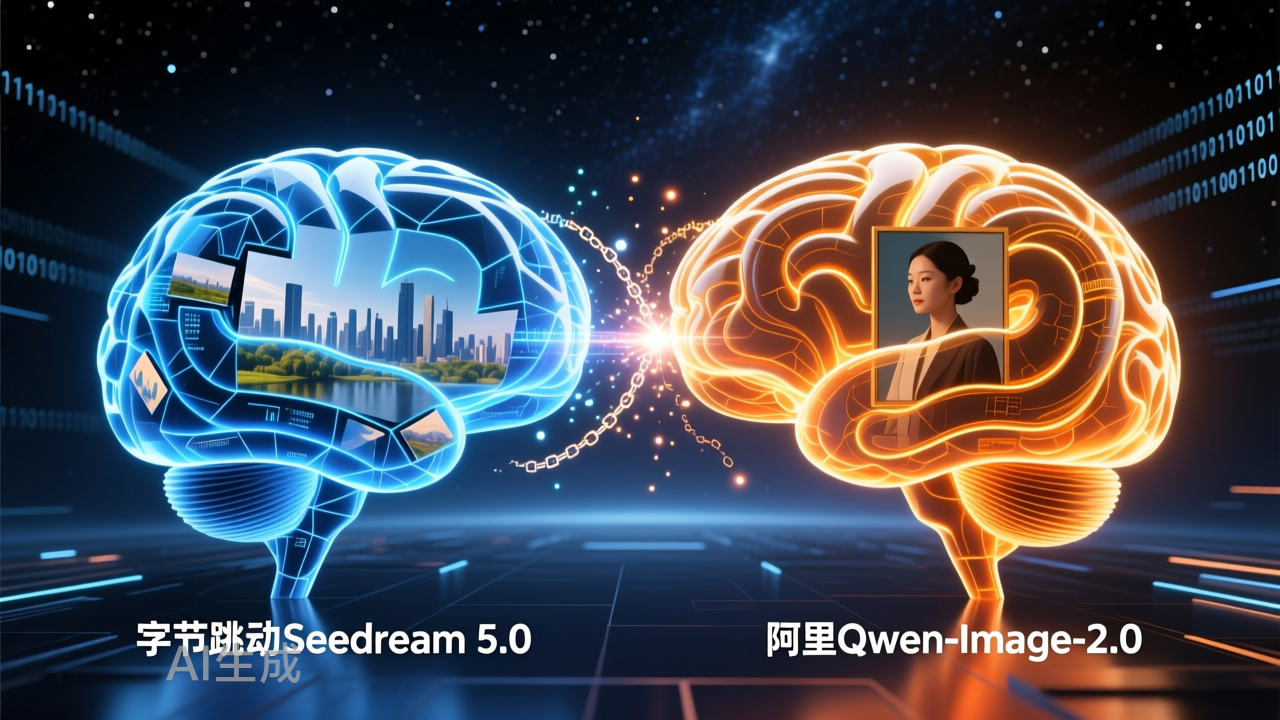
Both Alibaba and ByteDance, China's two tech giants, released their latest AI image-generation models on Tuesday, intentionally or accidently. ByteDance unveiled Seedream 5.0 Preview that features intelligent understanding and high-resolution output, while Alibaba launched Qwen-Image-2.0, an all-in-one model that combines image generation and editing.
Alibaba is opening an API for invitation-only testing via Alibaba Cloud’s Bailian platform, and users can try it for free through Qwen Chat; ByteDance’s Seedream 5.0 Preview, meanwhile, has only just begun closed beta testing on platforms such as Jimeng and Xiaoyunque.
The key innovation of Alibaba’s Qwen-Image-2.0 is that it is the first to unify image generation and editing within a single model architecture, significantly improving performance and flexibility. The model supports complex text inputs of up to 1,000 tokens and can generate images at up to 2K resolution, making it well-suited to demanding scenarios such as professional PPT decks, posters, and multi-panel comics.
Qwen-Image-2.0 is particularly outstanding in rendering Chinese text, accurately producing a variety of fonts and complex text content—for example, generating an illustration accompanied by the full text of “Lantingji Xu.” According to AI Arena evaluation data, Qwen-Image-2.0 ranked third globally in text-to-image tasks with a score of 1,029; its image-editing capability scored 1,034, placing it second and close to the top tier.
By contrast, TikTok parent ByteDance’s Seedream 5.0 Preview supports 2K and 4K output, and emphasizes upgrades in intelligence by improving its ability to understand prompts. It supports retrieval-augmented image generation, multi-step logical reasoning, and integrating web-based knowledge—making it suitable for complex, knowledge-driven tasks, such as generating diagrams that explain detailed step-by-step instructions.
From a technical specifications standpoint, Qwen-Image-2.0’s long-text input capacity (1K tokens) far exceeds the industry average, greatly expanding the model’s ability to understand and carry out complex instructions. This makes it particularly well-suited to professional use cases that require meticulous typography and multi-element composition. Seedream 5.0 Preview, by contrast, enhances the model’s adaptability to complex tasks through multi-step logical reasoning and the integration of web-connected knowledge, excelling especially in knowledge-intensive scenarios such as generating step-by-step instructional diagrams.
In terms of user experience, Qwen-Image-2.0 is available for open access via Alibaba Cloud’s Bailian platform and Qwen Chat. Users report that it produces finely detailed images, renders text with high precision, and offers flexible, versatile editing features—enabling a wide range of creations such as nine-grid selfies and multi-style transformations.
Seedream 5.0 Preview, leveraging ByteDance’s ecosystem, is expected to be deeply integrated into video and content-creation tools such as Jianying and CapCut. Users will be able to conveniently call the model to generate high-quality images and perform precise edits, making it particularly suitable for content creators and knowledge workers.
The release of the two models reflects the trend toward diversified development in China’s AI image-generation landscape. Alibaba places greater emphasis on unifying model architecture and boosting performance, highlighting Chinese-language text rendering and multi-scenario applicability to drive the practicality and wider adoption of AI image generation. ByteDance, meanwhile, focuses on intelligent understanding and knowledge-driven capabilities, strengthening the model’s reasoning ability and high-resolution output to meet more complex professional needs and content-creation scenarios.
Looking ahead, as AI image-generation technology continues to evolve, multimodal fusion capabilities, depth of long-text understanding, and high-resolution detail rendering will become key competitive differentiators.
Alibaba and ByteDance’s respective models represent different technical paths and market strategies, and are expected to compete fiercely across fields such as professional design, content creation, and education and training. At the same time, as APIs and applications become more open, more developers and users will join the AI image-generation ecosystem, accelerating rapid iteration and application innovation.
 快报
快报
根据《网络安全法》实名制要求,请绑定手机号后发表评论