






Scaling and exploring new lines of business became the next growth drivers for Yum China.
According to Yum China Holdings, Inc.’s full-year results, in 2025 the company’s total revenue for the year rose 4% to US$11.8 billion, operating profit increased 11% to US$1.3 billion, and the operating margin expanded 60 basis points year over year to 10.9%. Excluding special items, this marked the company’s highest level since its U.S. listing in 2016. Net new store openings for the year totaled 1,706, bringing the store count to 18,101 and extending coverage to more than 2,500 towns and cities.
In the fourth quarter, system sales grew 7% year over year, and same-store sales rose 3% year over year—marking the third consecutive quarter of growth. Total quarterly revenue increased 9% to US$2.8 billion. Net profit came in at US$140 million, up 24% year over year and above market expectations. Operating profit climbed 25% year over year to US$187 million.
Notably, delivery saw strong growth, with sales up 25% year over year. Delivery accounted for 48% of the company’s restaurant revenue, up from 39% in 2024.
The surge in delivery also became the underlying reason behind KFC’s price increase. Previously, KFC made a slight across-the-board adjustment to prices for delivery items, with an average increase of about RMB 0.8, while dine-in prices remained unchanged.
In response, Yum China CEO Joey Wat said, “This was a mild adjustment that only affects the delivery menu, with no changes at all to dine-in pricing. At the same time, we made no adjustments to our signature promotional campaigns, such as ‘Crazy Thursday.’ We remain committed to offering great value. This price adjustment helps partially offset the increase in rider costs driven by the higher mix of delivery.”
Foraying into Lower-Tier Markets
As Yum China’s core brand, KFC continued to deliver rapid growth.
In 2025, KFC recorded net new openings of 1,349 stores for the year, taking its total store count to nearly 13,000 by year-end. In the fourth quarter, KFC’s same-store sales rose 3% year over year, and same-store transactions also increased 3%, driving an 8% year-over-year increase in system sales and a 16% year-over-year rise in operating profit.
Pizza Hut delivered record-high overall growth in 2025—operating profit rose 19% year on year, while the operating margin improved to 7.9%, up 110 basis points from a year earlier, marking the highest level since its 2016 listing. Full-year net new store openings also hit a record 444, bringing the total store count to 4,168. Among them, Pizza Hut WOW stores expanded into about 100 new cities, and their payback period stayed steady at two to three years, in line with the chain’s average per-store level.
In the fourth quarter, Pizza Hut’s system sales grew 6% year on year, same-store sales rose 1%, and same-store transactions jumped 13% year on year—posting growth for the 12th consecutive quarter. Operating profit surged 52% to US$20 million, a record high for a fourth quarter.
For Yum China, amid such intense competition in Western quick-service restaurants, one key priority for keeping its two core brands—KFC and Pizza Hut—growing has been to deepen its presence in lower-tier markets.
As part of that effort, the “Twin Star” model has become an important vehicle for helping both brands move further down-market. The model is still in its early stage: around 40 pairs of “Twin Star” stores have been opened, and the company planned to accelerate the rollout of this model in 2026.
According to Joey Wat, “At its core, this is a lighter-format small KFC store paired with a streamlined Pizza Hut store. Each brand has its own separate entrance and customer flow, but they share back-end infrastructure resources, including staff, equipment, and rent. This model is particularly effective when entering lower-tier cities, and it is also more favorable in terms of capital expenditure.”
She added that capex for each such paired store was only RMB 700,000 to RMB 800,000, and the company hoped to keep the average payback period for these stores at around two years. “Their menus will be further simplified: KFC’s will resemble a scaled-down version of its small-town format, while Pizza Hut’s menu size may be only about 20% to 25% of a regular store’s.”
KFC's New Businesses
Beyond reinforcing the market position of its core businesses, Yum China has also been actively exploring opportunities in new business models.
Among them, K Coffee also achieved a threefold increase over three years.
In 2025, K Coffee’s store count reached 2,200—nearly tripling from 2024. Average daily cups sold per store also rose 25% versus 2024. At the current pace, it may be on track to reach its goal of surpassing 5,000 stores by 2029 ahead of schedule.
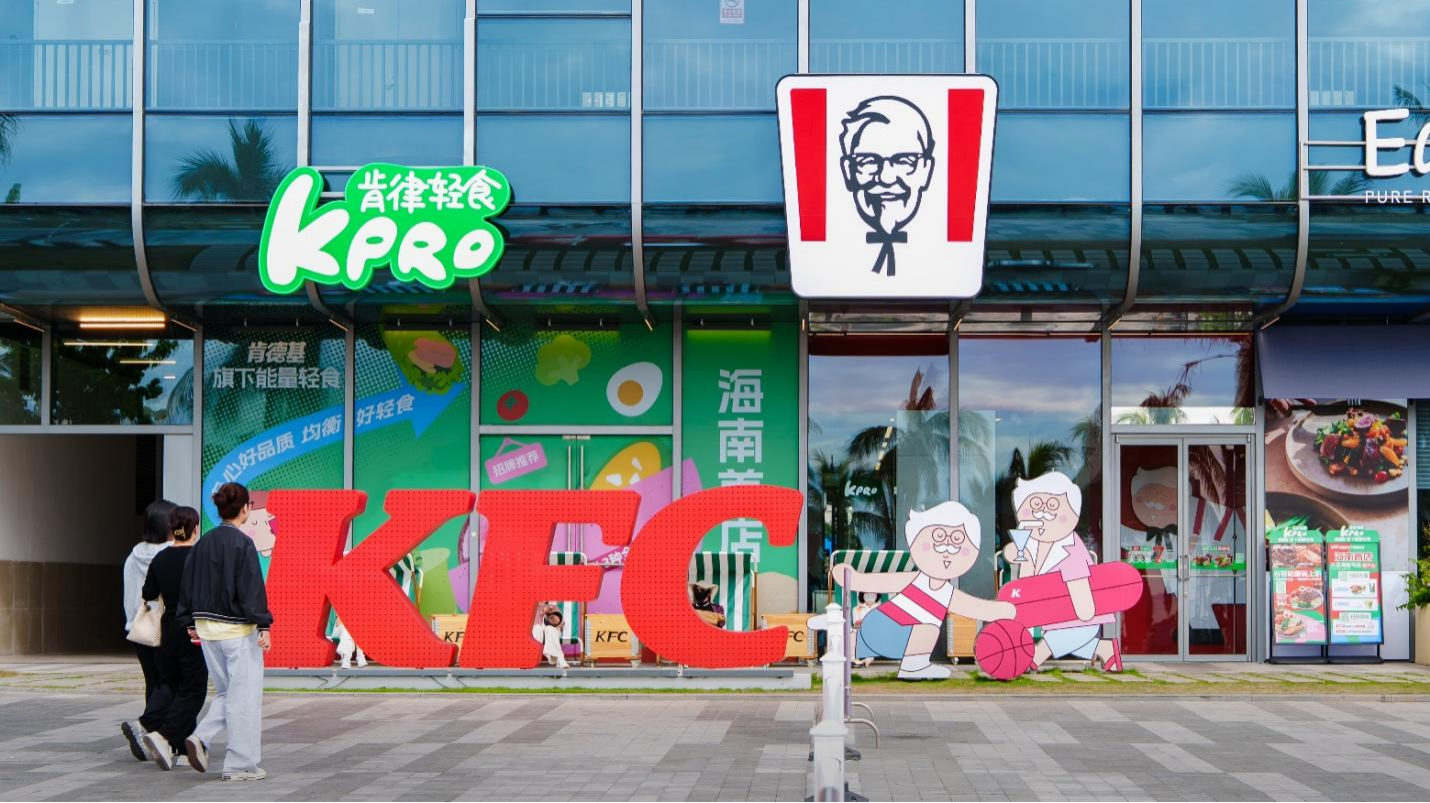
In addition, KPRO, which focuses on the light-meal segment, has also been growing rapidly. Over the course of 2025, it added more than 200 new stores. As KFC’s health-focused meal brand, KPRO centers on healthy light-meal offerings such as energy bowls, pasta bowls, and superfood yogurt smoothies, delivering a double-digit sales lift for its parent KFC stores.
Yum China plans to double KPRO’s store count to more than 400 in 2026, with a focus on top-tier cities, to further tap the potential of the light-meal market.
Behind the rapid expansion of both Kenyue Coffee and KPRO is the boost provided by the “shoulder-to-shoulder” model.
In some eligible KFC stores, a dedicated area has been set aside specifically for Kenyue Coffee’s operations. This model significantly reduces rental costs while improving staff management efficiency, store space utilization, and labor productivity. The front-of-house areas operate independently, while back-end support systems are integrated and standardized, enabling optimized allocation of resources.
In addition, coffee chain brand Lavazza’s total store count reached 146, with a net increase of 34 stores last year. The brand’s same-store sales turned positive in 2025, and its latest model requires only RMB 500,000 in capital expenditure—about half the cost of the previous model. Also in 2025, retail sales of Lavazza’s packaged coffee products rose by more than 40%, while operating profit more than doubled year on year.
From lower-tier markets to dual-brand stores, and from coffee to light meals, Yum is pursuing more efficient, all-around scaled growth in this fiercely competitive market through an increasingly diverse set of formats. As Joey Wat put it, “Our multi-brand portfolio, diversified store formats, and broad menu enable us to reach more customer segments and provide back-end services across a wide range of locations. By sharing and centralizing resources across stores, regions, and even brands, we strengthen synergies.” (Reporting by Xie Xuan, Editing by Fang Yu)


 快报
快报
根据《网络安全法》实名制要求,请绑定手机号后发表评论