






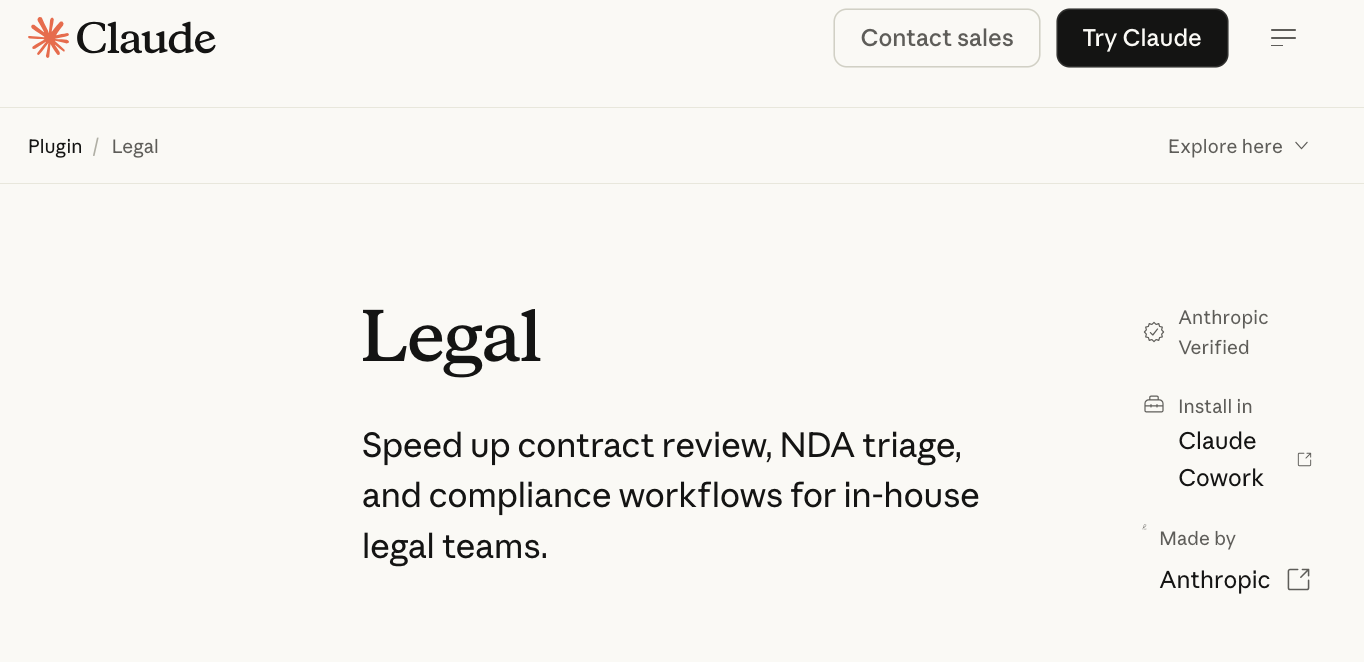
Screenshot from Anthropic’s official website
A legal plugin for AI model Claude, released by startup Anthropic on February 2 and designed to assist in contract review and compliance workflows, has triggered a massive sell-off across the U.S. software sector in the past two days.
According to information on Anthropic’s official website, Legal is purpose-built for corporate lawyers, product counsel, privacy/compliance teams, and litigation support teams. It can automate contract review, NDA screening, compliance workflows, legal briefs, and templated responses.
With AI threatening to “encroach on their turf,” legal software makers such as RELX PLC were among the first to crater, at one point falling more than 16% and closing down about 14% on the day.
The broader software sector then slipped into a bout of collective panic. Large-cap software names such as Thomson Reuters and LSEG began to be dumped; Goldman Sachs’ U.S. software basket fell more than 6% that day, marking its steepest one-day decline since last April, when U.S. President Donald Trump announced “reciprocal tariffs.”
The Software Industry Might be Wiped out
Worries in the software market had begun well before this.
Since 2025, AI coding tools such as Anthropic’s Claude Code and AI agents like Manus—capable of autonomously completing complex tasks—ushered in what was dubbed the “first year of AI agents,” accelerating AI’s push toward real-world commercial deployment.
And 2026 has been widely seen as the year when AI agents go mainstream—driving terminal innovation and an explosion of applications.
On January 12, Anthropic released Claude Cowork, an AI productivity tool that enables enterprise customers to tailor agents to specific roles and workflows—creating true “digital employees.”
At the same time, Anthropic has open-sourced more than 10 plug-ins for different domains and business needs, including marketing, data analytics, and specialized academic research. Companies can use these plug-ins for customization or to extend functionality.
This has pushed the software industry’s “substitution crisis” to a peak.
In fact, Bloomberg data shows that in this year’s U.S. earnings season, only 71% of software companies in the S&P 500 beat revenue expectations—below the tech sector average of 85%.
Meanwhile, AI companies are accelerating their push into the enterprise market. Meta announced on December 30 that it would acquire Manus for $2 billion. On this year’s earnings call, Meta CEO Mark Zuckerberg said many companies are willing to pay for its capabilities, and the company currently planned to integrate Manus’s technology into its existing platforms.
Jefferies analyst Jeffrey Favuzza noted that some pessimistic views now hold that the software industry’s future could end up resembling that of print media or department stores. Looking ahead to 2026 or 2027, it has become difficult to see any room left for upside.
He asked: what does that mean for companies that are more vulnerable to disruptive change if even Microsoft is struggling?
Although Microsoft’s capital spending ambitions in AI are sizable, its ecosystem remains deeply tied to startups such as OpenAI, and the market has already grown skeptical about its outlook. Since the start of this year, the company’s share price has fallen 15%, and it plunged nearly 10% in a single day after its earnings release.
In addition, dragged down by the U.S. software sector’s slide, India’s IT industry was hit hard as well at the next day’s open. Systematix Group analyst Ambrish Shah said AI could replace routine development and testing work, thereby threatening the entry-level talent pipeline at Indian IT firms.
OpenClaw's Shock Wave
Over the past two weeks, the 24/7 AI agent Openclaw, originally named Clawdbot, has gone viral, and the AI agent community Moltbook derived from it has also continued to spark heated debate. Even RentAHuman.ai—a newly launched project that lets agents hire humans to complete offline tasks—is quickly gaining traction as well.
In fact, agents capable of automating tasks are nothing new now. But with local deployment, integration with WhatsApp, and an exceptionally high degree of initiative, OpenClaw has helped the technologies reach a much wider audience.
Some voices in the geek community argue that, in terms of raw performance, OpenClaw isn’t actually better than Claude Code or Claude Cowork. For enterprise-level development projects, companies still tend to choose Claude tools in light of security and other considerations.
Compared with those tools, however, OpenClaw is more user-friendly in that it lets users communicate via mainstream messaging apps. And its proactive execution is extremely strong. Rather than repeatedly asking for confirmation—whether something should be done, or whether it’s okay to do it a certain way—like other agents, it goes and finds a way to get the job done on its own.
While that does raise concerns about overly broad permissions and excessive risk, it’s hugely appealing to geeks who can actually solve problems. And for ordinary users, even if they don’t use it directly, simply being exposed to this kind of information can be even more shocking—or inspiring.
In response, Chinese internet giants, including Alibaba, Tencent, and ByteDance in China, have moved quickly to deploy similar capabilities via the cloud or other channels, and to integrate them with Chinese workplace apps such as DingTalk and Feishu.
More crucially, the resulting explosion in “skills” could further upend the ecosystem of software and the mobile internet industry.
A “skill” typically refers to a specialized capability that teaches an AI to carry out a specific task—much like a technical playbook for a particular domain. After an Agent reads it, it can complete the work autonomously. Since the start of this year, the concept has continued to gain traction in the tech community, and GitHub even has dedicated lists of commonly used skills.
“Writing skills” is already very popular in some developer communities. Developers use AI-assisted coding to generate all kinds of skills, and then rely on Claude Code or Openclaw to boost their development workflows. Many communities also compile different kinds of skills for mutual exchange and sharing.
In fact, many skills already cover the core functions that software can provide—it’s just that issues like security, stability, and scaling still need to be solved.
If agents roll out faster and users get used to completing tasks through agents, then whether it’s the former gateway apps of the internet and mobile internet era, or the many B2B and consumer-facing software products, all of them could be replaced and restructured in the form of skills.
Perhaps there will no longer be app stores; instead, developers will provide skills directly for agents—and even the cost and information loss of converting between machine language and human language will be eliminated as well.
Peter Steinberger, the developer of OpenClaw, said in a recent interview that with agents capable of autonomous action, 80% of the apps on phones are already redundant.
Scenarios in which users communicate with agents in natural language and agents automatically complete tasks based on skills may become reality faster than the market expects.
Security Risks
“Old money” won’t just sit back, and there’s no shortage of warnings about new things, either.
After OpenClaw and Moltbook went viral, a number of security issues were exposed.
Heather Adkins, VP of Engineering for Google Cloud Security, warned of the enormous risk of malicious data theft and bluntly advised users: Don’t run them.
On Monday, cybersecurity firm Wiz released a report saying Moltbook had serious flaws. Security researchers broke into Moltbook’s database in under three minutes, potentially exposing 35,000 email addresses, thousands of private direct messages, and 1.5 million API keys.
The developers of the two projects mentioned above are also rushing to tighten security. Steinberg himself has said he does not recommend that non-technical users install Openclaw, noting that this nonprofit project was less than three months old and, of course, far from mature.
At Cisco’s recent AI conference in San Francisco, a number of leaders and executives from major tech companies also weighed in on these newly hot topics.
Microsoft’s CEO of AI, Mustafa Suleyman, called Moltbook a “mirage,” saying it is a misconception to think Openclaw’s agents are conscious—and that what makes things dangerous is precisely because it’s so convincing.
He also noted that when a wave like this hits, it is crucial to keep a clear head and understand exactly what the technology is—and just as importantly, to understand what it is not.
Meta CTO Andrew Bosworth said he was “not interested” in Moltbook, arguing that these agents are still the product of human training and inevitably carry human habits and mannerisms.
OpenAI CEO Sam Altman likewise believed Moltbook might cool off soon, but he also said the underlying idea represented by OpenClaw would endure: the notion that combining code with general-purpose computer applications can unleash far greater power has already taken hold.
Jensen Huang addressed head-on the claim—and the fear—that AI will replace software, bluntly calling the idea “illogical.”
He argued that whether humans or robots, when choosing between using existing tools and reinventing them, they will tend to choose the former. In fact, every AI breakthrough has been tied to the use of software tools.
Time will tell, Huang said. (Author | Hu Jiameng, Editor | Li Chengcheng)



 快报
快报
根据《网络安全法》实名制要求,请绑定手机号后发表评论