






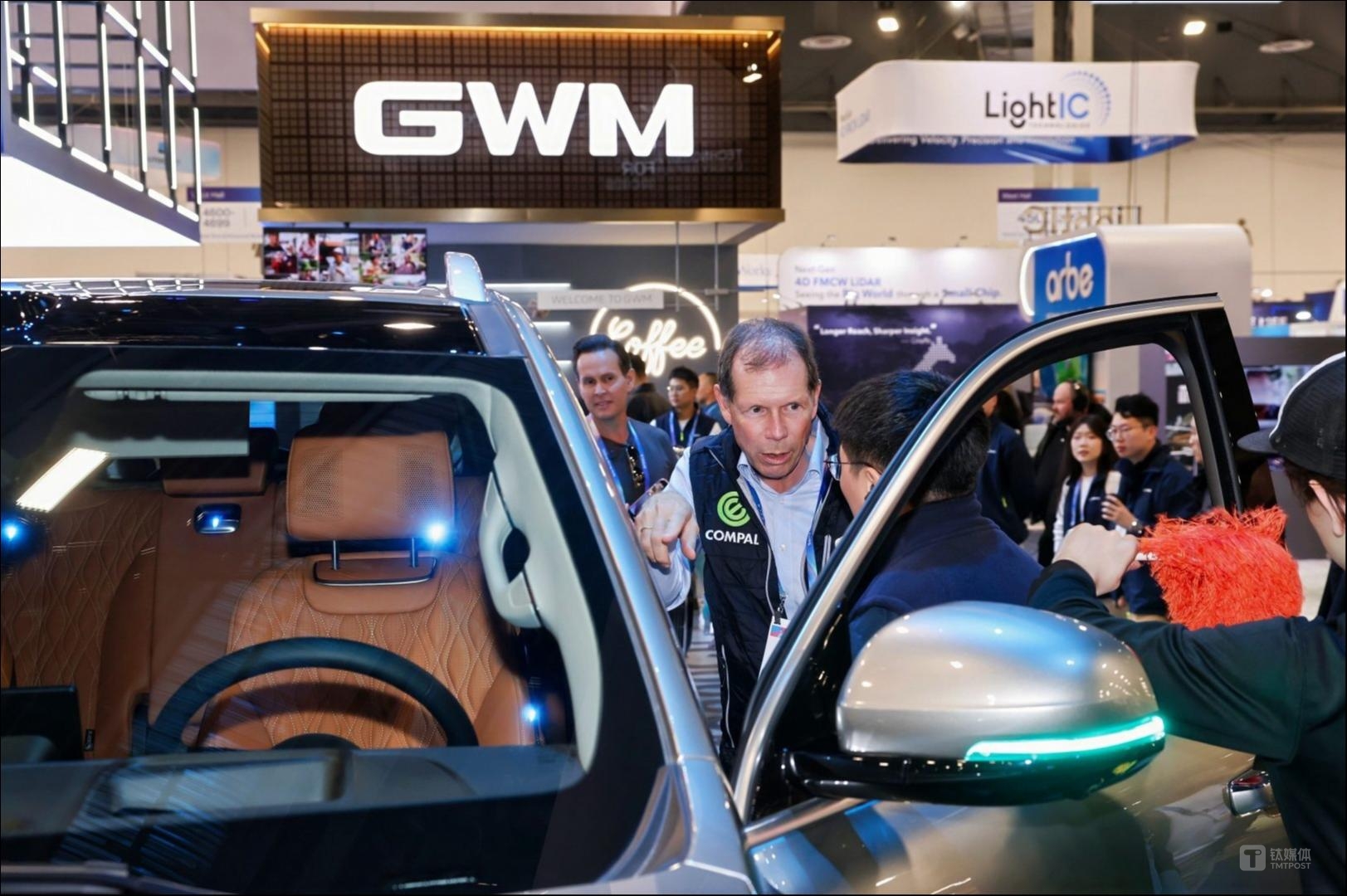
Great Wall Motors CES Booth
TMTPOST -- As the world’s largest technology and automotive companies gathered in Las Vegas this week for the 2026 Consumer Electronics Show (CES), China’s Great Wall Motors (GWM) arrived with a message that went beyond product launches: the next phase of global competition in the car industry will be decided not by hardware alone, but by how effectively companies adapt intelligent systems to different markets.
Rather than unveiling a single headline vehicle, Great Wall presented a portfolio of technologies and products — from its passenger-car intelligent cockpit and assisted-driving systems to its new Soul S2000 motorcycle — as part of what executives described as a long-term strategy to localise technology, build overseas research capacity and differentiate its brand in a rapidly converging global market.
“Globalisation is no longer just about selling more cars overseas,” Great Wall Motor Chief Technology Officer Wu Huixiao told reporters at a media briefing on the sidelines of CES. “It is about whether you can truly adapt to different users, regulations and infrastructure environments — and do that at scale.”
Great Wall’s overseas vehicle sales surpassed 500,000 units in 2025, according to company figures, as Chinese automakers expanded aggressively into markets across Southeast Asia, the Middle East, Europe and Latin America. But executives acknowledged that rolling out intelligent features globally has become more complex as markets diverge in connectivity, regulation, cost structures and consumer expectations.
Across the auto industry, many of the technologies that once differentiated smart vehicles — such as large touchscreens, voice control and assisted driving — are becoming standardised. At auto shows from Chengdu to Frankfurt, interiors increasingly look alike, with multi-screen layouts and similar user interfaces.
“Homogenisation is now the industry’s biggest risk,” said She Shidong, a senior technical expert at Great Wall. “Once everyone offers the same features, the question becomes: who offers a better experience — and who understands the user better?”
Great Wall says its answer lies in what it calls “agentification” — shifting from reactive systems that respond to commands toward proactive AI agents that anticipate user needs.
At CES, the company showcased its ASL (Agent Service Layer) system, which it plans to deploy in mass-production vehicles starting mid-2026. The system uses multimodal AI models to recognise occupants, interpret context and provide proactive services such as adjusting seats, climate control, navigation and entertainment without explicit commands.
“The goal is to move from human-machine interaction to human-machine co-existence,” She said. “The car should feel less like a device and more like an assistant.”
Executives stressed that deploying such systems globally is constrained not by technology alone, but by infrastructure and regulation.
In markets such as China, high-speed mobile networks and low data costs allow vehicles to run data-intensive ecosystems with cloud connectivity. In other regions, connectivity is expensive or unreliable.
“In some places, like Dubai, the cost of in-car data is extremely high,” She said. “So you cannot assume the same ecosystem can be deployed everywhere.”
As a result, Great Wall uses a layered approach: its own Coffee OS platform underpins vehicles globally, while local adaptations determine whether functions rely on cloud services, smartphone integration (such as Apple CarPlay or Android Auto), or embedded applications.
The company is also developing Coffee G — a global version of its operating system — to support multiple languages, driving orientations and regulatory requirements without fragmenting its core platform.
Intelligent driving faces even greater divergence.
China’s relatively flexible testing environment and intense competition have accelerated the development of advanced driver-assistance systems (ADAS). In contrast, Europe and North America impose stricter legal and liability frameworks.
“As a result, many functions available in China cannot be activated overseas yet,” Wu said. “So we pre-install the hardware and enable features gradually through software updates once regulations allow.”
Great Wall plans to expand its vehicle intelligence into lower-priced models over the next two years, aiming to make advanced features more accessible rather than restricting them to premium vehicles.
To support its global ambitions, Great Wall is expanding its overseas R&D footprint, not only to adapt products locally but also to tap into global talent pools.
The company already operates technology centres in North America, Europe and Japan, even in markets where it does not yet sell vehicles.
“The U.S. leads in AI, Japan excels in reliability and component standardisation, Europe in systems engineering,” Wu said. “We don’t set up centres only to serve markets — we set them up to learn.”
At the same time, core development remains concentrated in China, where large user bases and rapid iteration cycles allow faster validation of intelligent systems.
Great Wall is also adapting its powertrain strategy to different energy markets.
Its Hi4 hybrid system — combining combustion and electric power — is designed for regions where charging infrastructure is limited or fuel remains cheap.
“In some markets, electricity is more expensive than petrol,” Wu said. “So users don’t want large batteries. For them, hybrid systems without charging make more sense.”
The company plans to roll out plug-in hybrid (PHEV), hybrid (HEV) and fuel-focused variants depending on local conditions.
Alongside cars, Great Wall used CES to showcase its Soul S2000 motorcycle — a large-displacement, eight-speed flagship model.
Zhao Shengguang, CEO of Great Wall Soul Motorcycles, said the company is using motorcycles both as a technology testbed and as a branding exercise.
“The U.S. remains one of the world’s most important motorcycle markets,” Zhao said. “Even if we do not enter immediately, being here allows us to learn.”
Soul motorcycles feature automotive-grade electronics and over-the-air (OTA) update capabilities that allow software upgrades to engine calibration, safety systems and user interfaces — a rarity in the motorcycle segment.
However, Zhao acknowledged that breaking into markets dominated by brands like Harley-Davidson is as much a cultural challenge as a technical one.
“Motorcycles are about identity and heritage,” he said. “That cannot be built overnight.”
Executives said the biggest competitive barrier in intelligent driving is no longer algorithms but data — particularly rare and extreme driving scenarios.
Great Wall is shifting from rule-based safety systems toward data-driven models trained on vast real-world and simulated datasets, including behaviour from highly skilled drivers.
The company is also exploring the use of “world models” in the cloud to generate synthetic training data for rare scenarios, complementing on-device models used in vehicles.
Wu said progress in intelligent driving over the next two years will outpace the previous decade, citing recent demonstrations of long-distance autonomous driving with minimal intervention.
“By 2027 or 2028, L3 and even L4 capabilities will advance much faster than people expect,” he said.
For Great Wall, the challenge is not whether the technology will arrive — but whether it can be deployed safely, affordably and in a way that resonates with users across cultures.
“Technology alone is not enough,” Wu said. “Global success depends on whether people trust it, understand it, and feel that it genuinely improves their lives.”
As CES 2026 made clear, the race in intelligent mobility is no longer about who builds the smartest car — but who builds the smartest relationship between people, machines and markets.


 快报
快报
根据《网络安全法》实名制要求,请绑定手机号后发表评论