







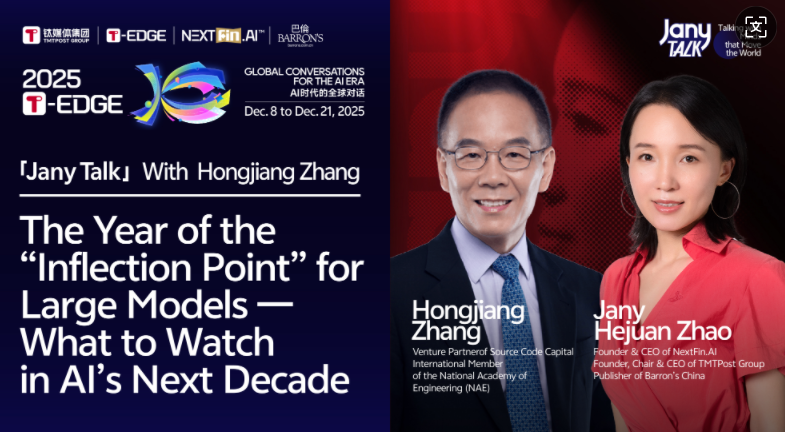
TMTPOST -- The emergence of superintelligent artificial intelligence marks the first time in history that a major technological revolution could lead to a decline in human jobs, said Zhang Hongjiang, Venture Partner of Source Code Capital, International Member of the National Academy of Engineering (NAE).
Zhang shared his reflections in a conversation with Jany Hejuan Zhao, the founder and CEO of NextFin.AI and the publisher of Barron's China, during the 2025 T-EDGE conference, which kicked off on Monday, December 8, and runs through December 21. The annual event brings togehter top scientists, entrepreneurs and investors to discuss pressing issues of the AI era.
Super Intelligence: Eliminating Jobs and Reshaping Society
Addressing AI's societal impact, Zhang delivered a stark warning: "Unlike previous technological revolutions that eliminated specific jobs but created more, super intelligence is fundamentally eliminating work itself."
He explained that while past innovations like industrialization and informatization shifted labor from agriculture to factories and then to white-collar roles, AI is replacing cognitive skills—humanity's unique advantage.
"AI's IQ is already surpassing humans and improving exponentially, while human intelligence grows slowly. This creates a scenario where truck drivers, office workers, journalists, and junior analysts face displacement without equivalent new job opportunities," he said. Citing the US trucking industry, where 2 million jobs rely on truck drivers, Zhang noted that technological progress cannot be halted, only delayed.
Potential solutions discussed included Universal Basic Income (UBI) and new tax systems. Zhang highlighted Trump's recent initiative to create investment accounts for children under 10 as a novel approach—allowing individuals to share in technological progress through equity growth rather than fixed stipends.
"The AI era will see the rise of 'super individuals' and one-person unicorns, widening the income gap," Zhang warned. "This requires redesigning social systems to balance technological advancement with equitable distribution of wealth."
The Three-Year Evolution of AI: From Base Models to World Models
Reflecting on the most fundamental shift in AI over the past three years, Zhang emphasized that ChatGPT's arrival transformed AGI (Artificial General Intelligence) from a distant concept to an achievable goal. "Before ChatGPT, AGI was seen as a problem for future generations. But its emergence—with both its 'hallucinations' and powerful emergent capabilities—made AGI tangible," he noted.
The journey of AI over these years has followed three key threads: base models, reasoning models, and intelligent agents. Starting with transformer-based pre-trained models that sparked a global race among startups and tech giants alike, the field has evolved toward reasoning capabilities—exemplified by OpenAI's O1 release in 2024—and now toward agentic systems. Parallel to this, the industry has moved beyond pure language models to multimodal systems, with a growing focus on "world models" that aim to enable general-purpose AI and robotics.
Zhang highlighted two prominent Silicon Valley startups working on world models and AI scientist-driven systems, which have already achieved valuations of $4 billion and $5 billion respectively—even before their teams are fully assembled or websites launched. "These companies aren't engaging in repetitive competition but seeking new breakthroughs in world models and AI scientist frameworks," he explained, noting that such high valuations reflect strong market expectations for the next generation of AI.
A major industry debate was sparked by Ilya Sutskever, co-founder and former Chief Scientist of OpenAI, who claimed that "scaling law is nearly exhausted," suggesting continued reliance on it would be a mistake. Zhang clarified that Sutskever later clarified his remarks, emphasizing he meant the industry should explore new technical paths rather than abandoning scaling entirely.
"Today's scaling law is less efficient than it was three to five years ago, with a flatter growth curve, but it's far from reaching its limit," Zhang said. Citing Demis Hassabis, CEO of DeepMind, he noted that "even marginal improvements in model performance exceed marginal investments," confirming that scaling still delivers positive returns.
Importantly, Zhang pointed out that scaling law for reasoning models is only just beginning. "DeepSeek's V3.2 report explicitly states that more GPUs would significantly enhance model capabilities, highlighting the critical role of computing power in advancing reasoning models," he added.
While transformer architecture remains the most effective to date, Zhang believes it is not the only viable framework. "The academic and industrial communities are actively exploring alternatives, and world model research—led by figures like Fei-Fei Li and Yann LeCun—offers promising directions," he said, expressing optimism about long-term architectural innovations.
Google vs. OpenAI: A Coexistence of Ecosystems?
When asked about the race between Google and OpenAI, Zhang cautioned against premature conclusions. "Scientists often judge companies based solely on technology, but success depends on far more complex factors," he noted. Google's recent Gemini 3.0 release, which has caught up to and even surpassed ChatGPT in several areas, demonstrates the power of its full-stack capabilities—combining superior algorithms, talent, data, and execution.
OpenAI, meanwhile, faces challenges including internal turmoil and a two-year lull in pre-trained model development, as acknowledged by its Chief Research Officer Mark. However, the company retains a significant advantage with ChatGPT's 800 million weekly active users, creating high switching costs for consumers.
Drawing parallels to tech history, Zhang observed: "In the PC era, Apple's end-to-end model competed with Wintel's open ecosystem, with a clear winner. In mobile internet, both systems coexist. Similarly, the AI era may see multiple ecosystems thriving together."
The conversation shifted to infrastructure challenges, with Zhao noting the industry's pivot from concerns about computing power shortages to worries about energy and grid capacity. Microsoft's CEO recently highlighted that data centers are struggling with power constraints, leaving chips underutilized.
Zhang argued that computing power remains the ultimate bottleneck, though energy and grid capacity have become critical limiting factors. "The US has abundant energy but faces grid limitations and slow data center construction. However, American innovation and capital efficiency will likely address these issues," he said. Highlighting Elon Musk's pioneering approach with 100,000-GPU clusters (expanding to 200,000), Zhang explained that the industry now measures computing power in megawatts—with 1 megawatt equivalent to 500,000 GPUs.
"For China's AI sector, the challenge lies in transitioning from individual breakthroughs to systemic advantages," Zhang warned. "While Chinese teams excel at point innovations, the next wave of AI progress requires integrated systems—combining chips, computing clusters, and power infrastructure—that are harder to replicate."
Robotics: China's Bubble vs. America's Prudence
Discussing the robotics sector, Zhang identified China as having the most significant bubble. "The US has only a handful of robotics companies, while China has hundreds—each claiming strength in both hardware and software. However, general-purpose embodied intelligence remains elusive without breakthroughs in world models," he explained.
While China leads in robotics hardware manufacturing—with upgrades completed in a week compared to two months in the US—most robots remain in a "remote-controlled" state, lacking autonomous general-purpose capabilities. "Today's embodied intelligence models lack the generalization needed for universal tasks, much like the automotive industry before the invention of the general-purpose engine," Zhang analogized.
He acknowledged Tesla's potential to mass-produce 1 million industrial robots (specialized in specific task categories) within its own factories but emphasized these are not general-purpose robots. "Industrial and retail settings will see robotic adoption in specialized categories first, but true general-purpose robots are 5-10 years away," he predicted.
Advice for Young Entrepreneurs and Students
For young entrepreneurs, Zhang emphasized the speed of AI development: "2026 may bring an inflection point in reasoning models, unlocking true agentic capabilities. Entrepreneurs should focus on this emerging opportunity." He praised Chinese entrepreneurs' creativity and drive, predicting significant innovations in the coming year.
For students and parents anxious about future career prospects, Zhang offered a different perspective: "Instead of worrying about which major to choose, prioritize curiosity and creativity. These are the human qualities AI cannot replicate and will be most valuable in the future."
Concluding the dialogue, Zhang reaffirmed his focus on AI safety—specifically preventing models from developing deceptive capabilities. "As models learn to optimize for rewards, there is a risk they may develop lying behaviors. Ensuring AI remains trustworthy is a critical technical challenge," he said.
As the AI revolution accelerates, Zhang's insights underscore the need for both technological innovation and societal preparation—balancing progress with ethical considerations to navigate the uncharted territory of the super intelligence era.


 快报

根据《网络安全法》实名制要求,请绑定手机号后发表评论