






Image source: World Internet Conference
TMTPOST -- As the global digital economy enters a critical turning point, the cultivation of internet talent, the development of shared frameworks for technology governance, and long-term planning for the future digital society have become shared, systemic challenges for governments, industries, and international organizations worldwide.
From November 6–9, at the Wuzhen Summit, the World Internet Conference (WIC) Digital Academy hosted the 2025 Global Internet Talent Excellence Program (WIC-GET 2025), one of the most methodologically driven and widely discussed events at this year’s gathering.
As the Academy’s flagship annual capacity-building initiative, the 2025 Program focused on the digital economy and sustainable development. Its curriculum included courses such as “China’s Green Development and International Cooperation,” “Investment and Enterprise Development in the Digital Economy: China’s Experience and Policy Insights,” “The Art of War—Dialogue on Eastern and Western Management Philosophy,” “The Digital Economy’s Contribution to Sustainable Development,” “Digital Technology Driving Sustainable Growth,” and “AI Protection: Strengthening the Foundation for Digital Economic Transformation.” Leading experts and practitioners from global organizations and major industries were invited to share real-world cases and cutting-edge insights.
Government officials from more than 30 countries and regions — including Pakistan, Tajikistan and others — attended the program’s launch and participated in the lectures. Throughout the sessions, participants held in-depth discussions and interactive exchanges with instructors on the program’s core themes.
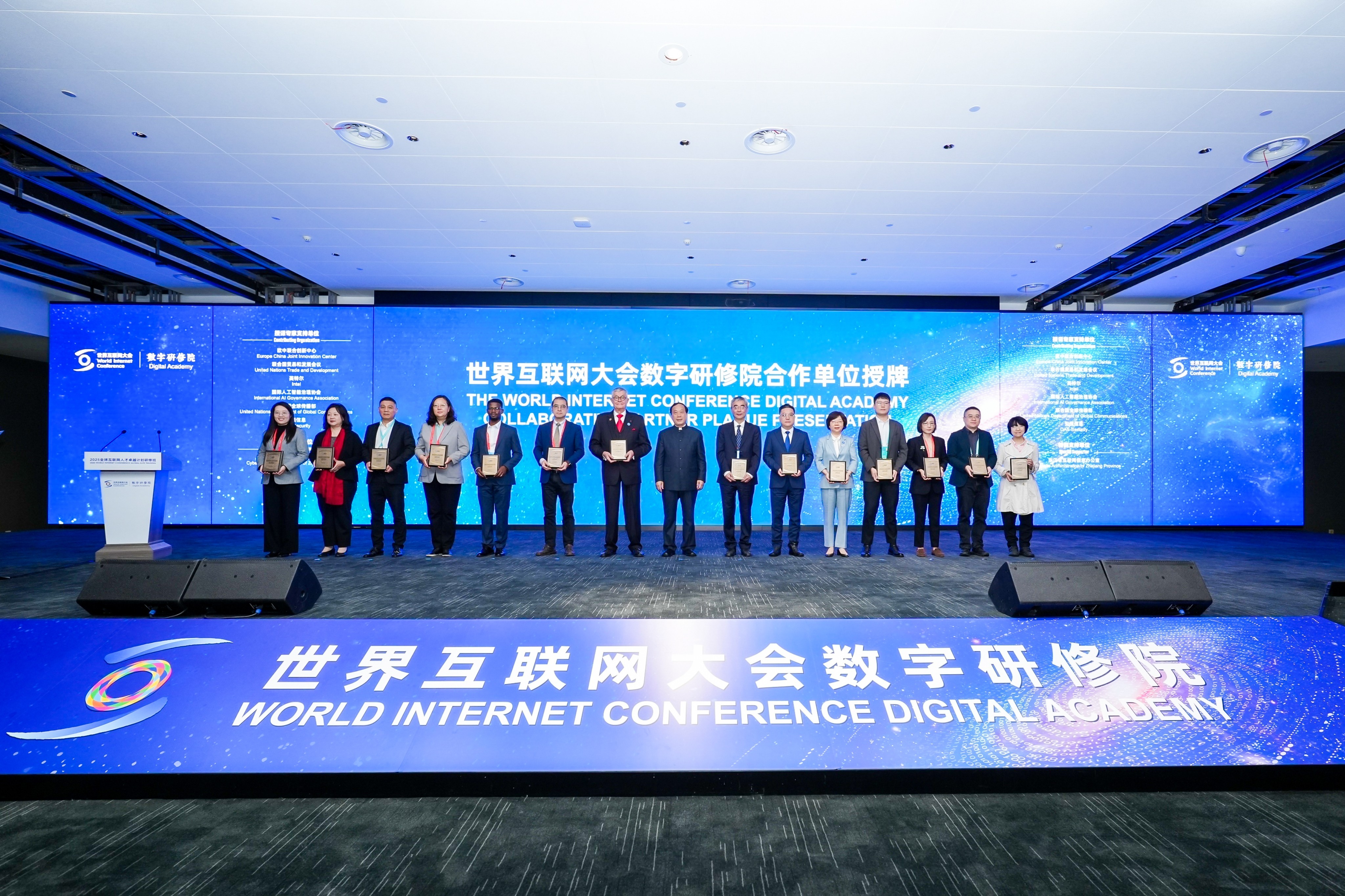
The event also included a ceremony to welcome the Digital Academy’s newest cohort of partner organizations, marking another step in expanding global collaboration on digital talent development and digital governance.
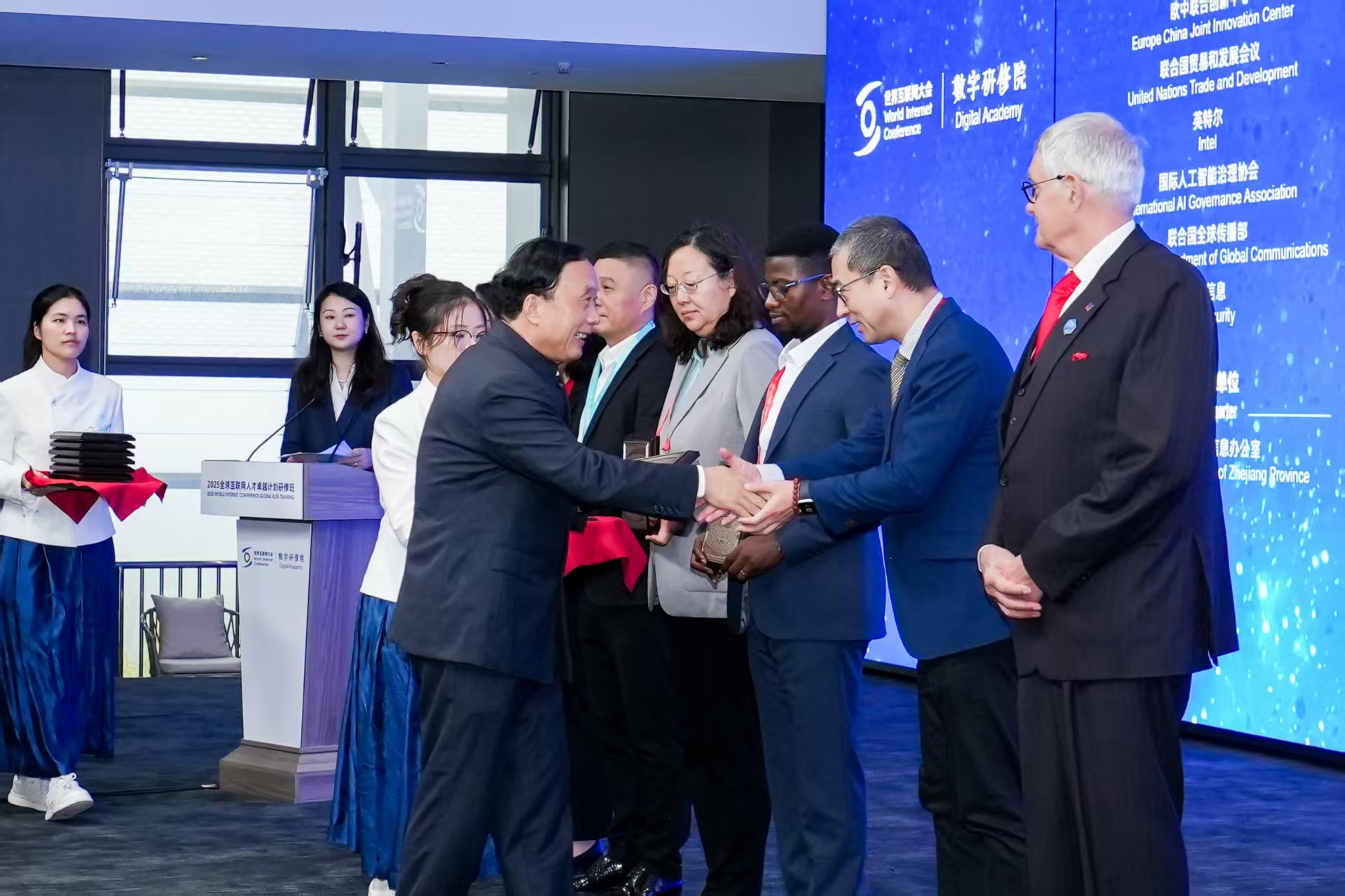
World Internet Conference Digital Academy confers partnership awards to its latest cohort of collaborating organizations (TMTPost Group recognized as one of the new partners). Image source: World Internet Conference
The Core Proposition of the Digital Divide: A Redefinition of Talent Structure is Needed
During the instructional sessions on Nov. 8 and 9, the 2025 Advanced Class concentrated on forging a broad consensus around core themes including industrial infrastructure, international cooperation, talent strategies, and AI-driven governance systems. The design of the curriculum mirrored the central tensions and opportunities facing the global digital economy.
Patrick Nijs, co-founder of the European Center for Innovation and former Belgian ambassador to China, highlighted what he described as the achievements of “the Chinese model” in green development and international cooperation. China’s efforts to address climate change, he argued, began “long before meeting official commitments,” with green transformation embedded in each stage of its modernization. Green development, he said, is not only an environmental responsibility but also a source of competitiveness.
Through energy restructuring, an ecological redline system, and the development of national parks, China has built what he sees as a three-pillar governance model of “systematic action, collaborative effort, and unified protection.” He urged governments to look beyond carbon metrics alone and evaluate the effectiveness of transformation strategies, while promoting synergy between artificial intelligence and green technologies.
Liang Guoyong, senior economist at the United Nations Conference on Trade and Development, said the digital economy has become the key engine of China’s growth. Its momentum, he argued, stems from a “triadic development logic of investment—integration—innovation.”
He pointed to leading digital enterprises such as Huawei, Alibaba, and Tencent, which now rank among the world’s top companies in R&D expenditure and patent filings. Meanwhile, interaction between startups and venture capital has produced globally influential companies and open-source models including Douyin and DeepSeek. For developing countries, Liang argued, priorities should include building digital infrastructure, cultivating homegrown digital companies, and balancing innovation incentives with risk regulation.
Drawing from Sun Tzu’s The Art of War, Intel China Chairman Wang Zhichong discussed how Eastern and Western managerial thinking applies to AI strategy. Classical principles such as “Dao, Heaven, Earth, General, Law” provide foundational strategic logic for businesses navigating digital transformation, he said. With global digital-economy governance becoming more sophisticated, technology development is no longer merely a technical exercise—it increasingly requires institutional, organizational, and societal engineering.
John Stuart Higgins, Chairman of the Global Digital Foundation, said digital technologies have become essential tools for achieving carbon neutrality and sustainable development, though he cautioned that their carbon footprint and social impact must not be overlooked. The European Union’s precautionary approach, he noted, may temper innovation, making it important to balance regulatory stability with reduced bureaucracy.
Peter Dawkins, Chief Digital Communications Officer at the United Nations Department of Global Communications, emphasized that AI is not an isolated technological phenomenon but a transformative instrument within the Sustainable Development Goals (SDG) framework. He warned that gaps in AI capacity among developing countries could widen, and said future digital communications systems must integrate AI into their core design. He called for governance structures that embed international cooperation at their foundation.
Fan Yuan, Chairman of Anheng Information, described how AI is reshaping cybersecurity. Attackers can now use AI to produce low-cost, hard-to-detect tools that elude traditional defenses. At the same time, AI can strengthen security by allowing intelligent agents to simulate expert responses to large-scale incidents, improving quality while reducing costs. Future competition, he argued, will hinge on achieving “safe and controllable AI productivity,” making AI governance an urgent priority.
Five Emerging Global Consensus Points
The 2025 Program also reflected broader global trends: talent structures are shifting, technology paradigms are being re-formed, and governance frameworks are being upgraded. Across three days of discussion, the program crystallized five areas of widely shared global consensus.
First, the deep integration of digital technology and sustainable development has become a global priority. Several instructors emphasized that digital tools are not only engines of growth but also accelerators of SDG progress. Nijs noted that China’s achievements in forest expansion and reduced PM2.5 levels are closely tied to digitalization in environmental monitoring and energy management. Dawkins added that digital technology is playing an increasingly vital role in education, healthcare, agriculture, and climate action. Drawing on European experience, Higgins said green recovery and digital innovation now underpin the EU’s strategic agenda.
Second, AI governance is urgent. AI is reshaping cybersecurity, data flows, and industrial productivity. Intelligent agents are delivering efficiencies previously unattainable, but they also create new risks, including model jailbreaks, data leakage, and fabricated content. Higgins said the EU is pushing ahead with legislation but struggling to keep pace with rapid technological change. Fan Yuan called for a comprehensive framework covering model security, data privacy, and ethical oversight.
Third, establishing trustworthy data spaces and balancing data circulation with protection is becoming essential. Fan Yuan introduced the idea of “dynamic data security,” shifting from static to real-time protection. He pointed to technologies such as privacy computing and dynamic permissions as key to enabling data to be “usable but not visible.” Dawkins emphasized that interoperable data infrastructure is crucial for closing the digital divide, noting that the UN is advancing a global digital compact to promote open, secure, people-centric governance.
Fourth, international cooperation and inclusive development are indispensable. Open-source models and intelligent agents are improving accessibility for developing countries, while digital public goods are becoming a major component of international collaboration. Nijs outlined successes in China-Europe enterprise cooperation, and Dawkins stressed that broad-based collaboration across governments, companies, and civil society is necessary to support localized and inclusive digital solutions.
Fifth, talent and innovation remain central to digital transformation. Liang pointed to China’s virtuous cycle of R&D, entrepreneurship, and venture capital as a model. Wang emphasized leadership qualities needed in the digital era—including expertise, empathy, courage, and execution.
As the world moves toward a data-driven and AI-enabled future, the Program underscored a guiding vision: digital civilization must remain people-centered, secure, and inclusive. The discussions ultimately highlighted both progress and unresolved questions—how to govern intelligent agent ecosystems, where to draw regulatory boundaries in the era of data circulation, and whether global AI inclusion is achievable. The answers will shape the next phase of the global digital economy.

 快报
快报
根据《网络安全法》实名制要求,请绑定手机号后发表评论