







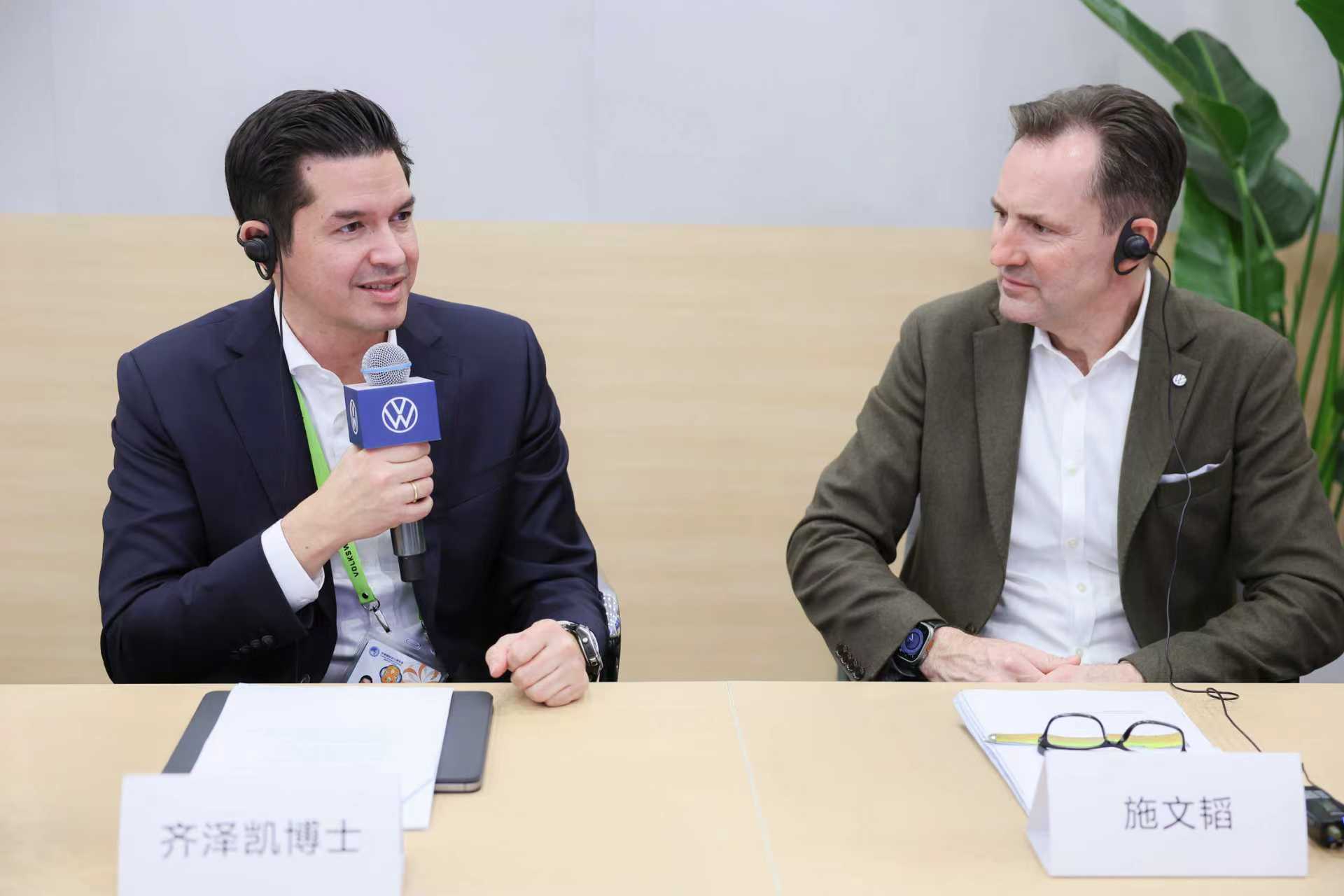
Thomas Schäfer, CEO of Volkswagen Passenger Cars, and Dr. Robert Cisek, CEO of Volkswagen Passenger Cars China
TMTPOST -- At the 2025 China International Import Expo (CIIE), Volkswagen showcased three concept cars that signaled a strategic evolution for the century-old automaker, a move away from its traditional “German flavor” toward a deeper embrace of Chinese innovation.
The display underscored how the world’s largest carmaker is reengineering its brand identity and development strategy for the world’s largest auto market.
"This year’s CIIE stands as yet another testament to Volkswagen Group’s unwavering commitment to the Chinese market and to long-term investment here," said Volkswagen Group Chairman Oliver Blume during his opening remarks.
Over the past two years, Volkswagen has shifted from being a “global standard bearer” to an “adopter of local innovation,” marking one of the most significant transformations in its history.
Thomas Schäfer, CEO of Volkswagen Passenger Cars, said that global consumer demand is increasingly fragmented and that the company must establish a strong regional response system to accelerate localization. “Today, global consumer needs are more diverse than ever. Volkswagen must establish a robust response system to promote in-depth localization in different regions,” he said.
The shift represents a strategic redefinition. For decades, Volkswagen built its reputation on global uniformity, from production processes to product design. Now, the company sees “localization in China” as its new core competitive edge.
Dr. Robert Cisek, CEO of Volkswagen Passenger Cars China, said that China’s speed of innovation has already surpassed many other regions globally. “Volkswagen’s role in China is no longer just as a manufacturer, but as an innovation co-creator,” he said. By leveraging Volkswagen China Technology Co., Ltd. (VCTC) in Anhui, the company has synchronized its R&D pace with China’s rapid innovation cycle.
As of October 2025, Volkswagen’s sales in China exceeded 1.67 million vehicles, keeping it the top foreign car brand. But maintaining market share is no longer the main goal. The challenge for Volkswagen now is to redefine its brand value amid the rapid transition to electric and intelligent vehicles.
Volkswagen’s largest R&D center outside of Germany, VCTC, opened in Hefei in 2023 and now employs more than 3,000 engineers. The facility has become Volkswagen’s “second headquarters” in China. Shi Wentao, head of the center, said VCTC allows Volkswagen to develop products at “China speed” while maintaining German safety and quality standards. This marks a shift of Volkswagen’s R&D gravity from Wolfsburg to China.
VCTC’s work has already yielded tangible results in driver-assistance systems and smart cockpit design. “By working closely with local innovators, we have improved our product launch speed by over 30%,” said Qi Zekai, another senior executive.
A key example of this local collaboration is CARIZON, Volkswagen’s joint venture with Horizon Robotics. At CIIE, Volkswagen announced plans to co-develop a system-on-chip (SoC) with Horizon Robotics, which will underpin future advanced driver-assistance systems (ADAS) and autonomous driving features. The chip, expected to deliver 500 to 700 TOPS of computing power, is scheduled for mass production within three to five years.
Volkswagen’s decision to co-develop chips represents a strategic pivot from purchasing off-the-shelf components to building proprietary advantages in computing power — a crucial step in the age of intelligent vehicles. Compared to Tesla’s closed-loop FSD model and Huawei’s integrated Ascend–Qiankun framework, Volkswagen’s collaborative approach represents a rare depth of localized development among European automakers.
Shi Wentao said Volkswagen is now transitioning from an electrification phase to an intelligence-led stage. “The key is not the different powertrains, but whether the technical architecture can be truly standardized and modernized,” he said.
Volkswagen’s technology roadmap centers on three core elements: the CMP platform, the CEA electronic architecture, and its ADAS intelligent driving system. These technologies together form the foundation of Volkswagen’s transformation into a software-defined vehicle company.
The CEA, developed jointly by VCTC, CARIAD China, and XPeng Motors, is the automaker’s first regionally controlled architecture designed specifically for the Chinese market. Its embedded AI capabilities allow for more efficient and flexible vehicle management. Volkswagen is also developing its GAIA data platform to enhance perception, prediction, and decision-making for next-generation driver-assistance systems, with the first models using the system set to debut in 2026.
Qi Zekai emphasized that Volkswagen will maintain its brand identity centered on safety and reliability rather than chase after aggressive autonomous-driving labels. “We always insist on applying new technologies only when they are mature, safe, reliable, and easy to use,” he said.
This philosophy reflects the rational, precision-driven ethos of German engineering. Yet, in China’s fast-moving, software-defined market, such prudence carries risks. As local automakers iterate their algorithms quarterly, Volkswagen’s ability to balance caution with speed will determine whether it can remain relevant in the years ahead.
If VCTC is Volkswagen’s Chinese brain, its three joint ventures — FAW-Volkswagen, SAIC Volkswagen, and Volkswagen Anhui — form the backbone of its operations in the country. Shi said this multi-joint venture structure provides significant economies of scale, but differentiation remains a pressing challenge. The homogenized ID. electric vehicle lineup has shown that “German quality” alone is no longer enough to attract younger Chinese consumers.
Volkswagen Anhui has been tasked with leading a new design direction aimed at younger buyers. Its upcoming “Unique” series will feature lighter, sportier, and more locally inspired models. Over the next year, Volkswagen Anhui plans to launch a range of B-segment SUVs, sedans, and A-segment models to build a more comprehensive lineup.
Meanwhile, FAW-Volkswagen and SAIC Volkswagen will continue to serve as the company’s stable core, focusing on gasoline and plug-in hybrid models. “We aim to maintain a balanced approach, combining collaboration in core technologies with differentiation in design,” Qi said.
In the broader picture, Volkswagen’s China strategy illustrates a structural shift from manufacturing to co-innovation. But as the market becomes increasingly fragmented, ensuring that these three ventures still represent a unified “Volkswagen” identity will be a major test.
“China is Volkswagen’s second home,” said Stefan Mecha, another senior executive. But he also acknowledged that being at home in China doesn’t mean having an advantage. “Today’s Chinese market is not only the most open but also the most competitive in the world,” he said.
From BYD to Huawei, and from NIO to Li Auto, domestic automakers are redefining consumer expectations with new technology and faster iteration cycles. In response, Volkswagen is sticking to its core values of reliability and safety, even as it accelerates digital transformation.
Klaus Zellmer, another Volkswagen executive, said: “We will not compromise on safety and reliability, nor will we trade long-term profits for short-term sales.”
Volkswagen considers 2026 a “breakout year” for its China operations, with new models based on the CMP and CEA platforms set to launch across key market segments. The company hopes these vehicles will reestablish its sense of technological leadership in the age of intelligent mobility.
Whether Volkswagen’s methodical, German-style transformation can succeed in a market defined by speed and software remains to be seen. But for now, the company is betting that its fusion of reliability, localized innovation, and “China speed” will ensure that the Volkswagen brand remains relevant in the world’s most dynamic automotive arena.


 快报

根据《网络安全法》实名制要求,请绑定手机号后发表评论