







TMTPOST -- China has announced a sweeping tightening of rare earth export controls, marking the first time Beijing has brought overseas semiconductor products containing Chinese rare earths under regulatory oversight.
The move is widely interpreted as a countermeasure to U.S. technological restrictions and has rattled global markets, highlighting China’s pivotal role in critical materials for advanced manufacturing.
The newly introduced rules require overseas manufacturers sourcing Chinese rare earths to obtain export licenses. Beginning December 1, 2025, any product containing Chinese rare earths intended for export will need case-by-case approval.
This effectively represents China’s first application of “long-arm jurisdiction” in the rare earth sector—meaning that even chips produced abroad could fall under Chinese export controls if they contain Chinese-sourced rare earths.
While rare earth elements are abundant in geological terms, China maintains a global advantage through decades of experience in refining, separating, and processing these critical materials. The US Geological Survey (USGS) classifies rare earths into 15 lanthanides plus scandium and yttrium. They are typically grouped as light, medium, or heavy rare earths. China’s recent export controls focus primarily on medium and heavy rare earths, such as samarium, gadolinium, terbium, dysprosium, lutetium, yttrium, and scandium.
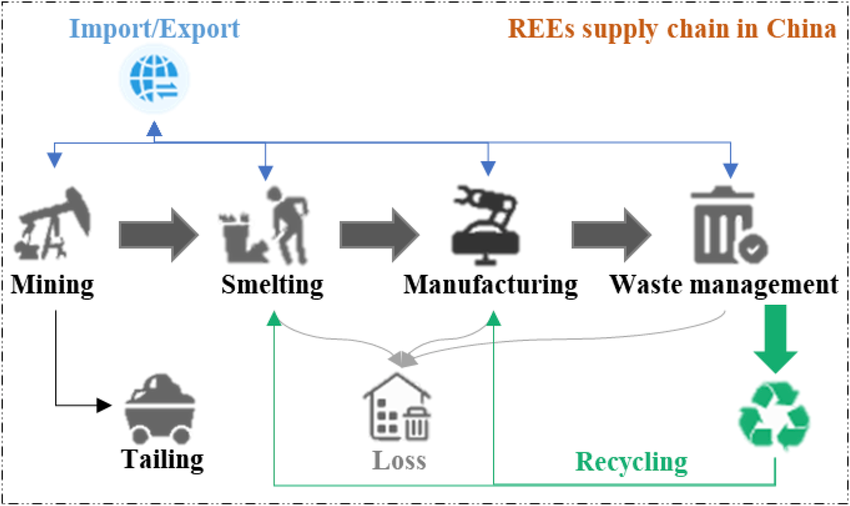
China dominates global production and refining capacity, producing 69% of rare earth minerals in 2024 (270,000 tons out of 390,000 tons globally) and controlling 90% of the world’s refining capacity. China’s integrated rare earth supply chain, from mining to high-purity processing, gives it an outsized influence over global industries that rely on these materials.
Rare earths are widely known as the “vitamins of industry” due to their critical role in advanced technologies. They are essential in AI chips, electric vehicles, missile guidance systems, and semiconductor manufacturing equipment. Neodymium-iron-boron magnets are used in ASML lithography machines, yttrium oxide coatings in etching chambers, and lanthanum dopants in gate materials. The new controls, therefore, could disrupt even minor links in global supply chains that are technologically critical.
The immediate market impact was visible: spot prices for rare earths in Asia surged 15% on the announcement day, with heavy rare earths like neodymium and dysprosium seeing the sharpest increases. Companies in the US, Japan, and South Korea were reported to have less than two months of rare earth inventory, prompting urgent stockpiling and recalibration of supply chains.
China’s export controls provide a clear short-term leverage point. By restricting access, Beijing signals its ability to influence high-end manufacturing chains, compelling other countries to reassess supply chain dependencies. However, economists caution that the strategic risks of such policies are substantial.
Two days after the announcement, the United States imposed a 100% tariff on Chinese goods, raising cumulative tariffs to 130%, and threatened to add key software to its export control list. Such measures may curb overseas demand for Chinese products, including electromechanical components, electronics, and automobiles, and could suppress capacity utilization in China’s rare earth sector. Already, first-half 2025 data shows rare earth magnet exports fell 18.9% year-on-year, forcing smaller producers to halt production or lay off workers.
Historically, the effect of Chinese rare earth export restrictions has often been limited. During the 2010 China-Japan rare earth incident, exports were not halted for two consecutive months, and from 2023 to 2024, Chinese rare earth export volumes increased by 6% even as total export value fell 36%. A similar pattern occurred with gallium and germanium controls in 2023: prices spiked briefly but returned to previous levels within months. These patterns suggest that while China can influence the market short-term, scarcity-driven long-term effects remain uncertain.
Repeated regulatory interventions accelerate global efforts to reduce dependence on Chinese rare earths. The U.S., Australia, EU, and Japan are expanding domestic extraction, processing, and recycling capacities.
The U.S. has invested over $400 million in Mountain Pass, aiming for a self-sufficient rare earth supply chain by 2028.
Australia’s Lynas is expanding separation facilities in Malaysia to reduce reliance on Chinese rare earths to 20% within three years.
The EU and Japan have funded domestic refining and recycling initiatives, and the US Department of Defensehas invested in MP Materials and partnered with Lynas to build a Texas plant.
As a result, the EU’s dependence on Chinese rare earths has dropped from 60–70% in 2010 to about 46% today, Japan’s from 90% to below 60%, and the US is actively developing alternative sources, including Greenland, Canada, Mongolia, and Russia.
These long-term efforts highlight a key risk: repeated use of rare earths as a geopolitical tool erodes trust in Chinese manufacturing. Germany, Japan, Taiwan, and the EU are all exploring alternative sourcing, stockpiling, and strategic reserves to mitigate sudden policy shifts.
Global efforts are also targeting technological alternatives to reduce reliance on rare earths. Programs such as DARPA’s EMBER are exploring biomolecular methods to separate rare earths. Researchers in Cambridge and Austria are investigating substitutes like tetrataenite, while companies like Niron Magnetics are developing permanent magnets using abundant elements like iron and nitrogen. AI is being deployed to optimize microstructures, predict magnetic properties, and discover novel materials. While early-stage, such innovations could eventually undercut China’s resource-based leverage.
China’s dominance in rare earths is the result of decades of industrial evolution. During the 1990s, unregulated mining and exports caused ecological damage and price volatility. By 2014, consolidation and environmental regulations strengthened the industry, but high value-added applications such as magnets and catalysts remained dominated by foreign companies.
Current export controls reveal a contradiction: while China holds a strong position in midstream processing, it remains dependent on imported ores and overseas markets. As such, these measures serve as a temporary geopolitical tool but do not equate to full strategic control. Resource depletion, environmental pressures, and global innovation further limit long-term leverage.
Experts suggest the path forward is not “blockade,” but value addition. China should strengthen environmental governance, promote technological innovation in rare earth applications, and develop recycling systems to transform waste magnets and electronics into new resources. Only then can rare earths move from being a raw material to a cornerstone of technological innovation, enabling China to transition from a resource-rich nation to a global tech leader.


 快报

根据《网络安全法》实名制要求,请绑定手机号后发表评论