






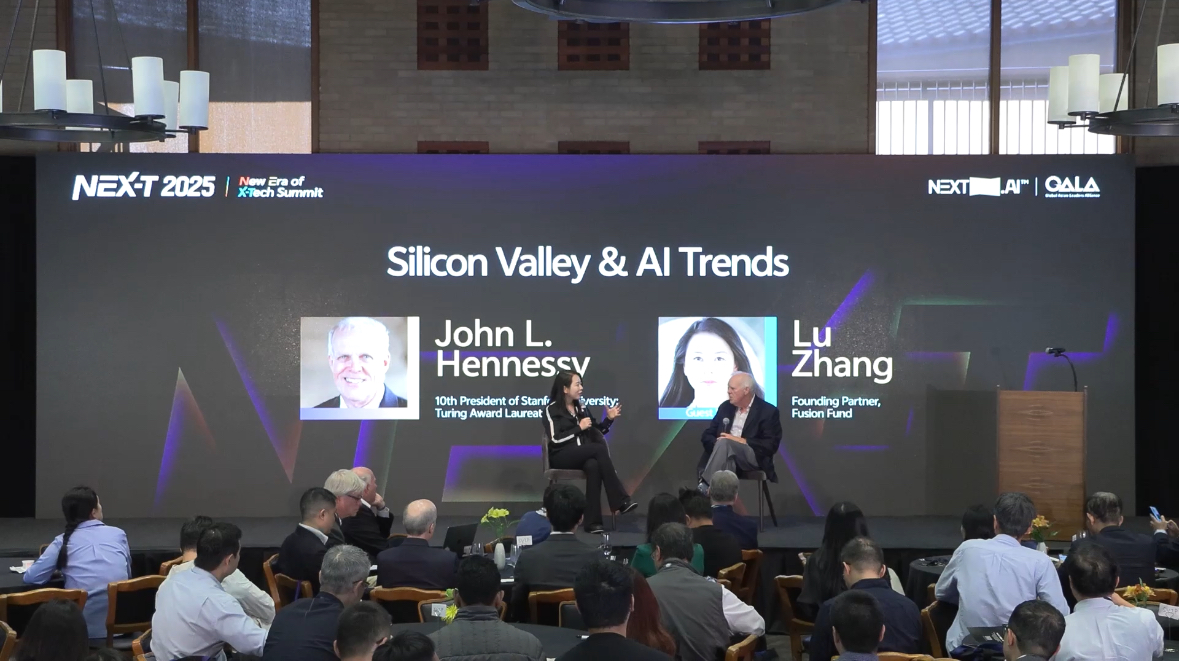
On-site photo
TMTPOST — The explicability of AI models is a significant challenge, especially in high-impact fields such as medical diagnostics, AI systems must provide transparent reasoning for their outputs, said John L. Hennessy, a Turing Award Laureate.
Hennessy, also the 10th President of Stanford University, shared his insights at a dialogue named “Silicon Valley & AI Trends” with Lu Zhang, the Founding Partner of Fusion Fund, during the NEX-T Summit 2025 in Silicon Valley on September 27.
“If you're going to start doing medical diagnosis, for example, or other high impact kinds of things, you're going to have to explain. The model is going to have to explain somehow. There's work going on in this area, but it's early on this fundamental research. People are trying to get to improve this kind of explicability problem,” he explained. “I think we're going to continue to see the models evolved, because we're now at the point where, as the number of people using these AI models goes way up, the total amount of computation involved in inference is going to blow past the amount of time and training,” he noted.
Innovations in smaller, edge-deployable models were highlighted as crucial for reducing energy consumption, enhancing accessibility, and enabling real-time inference on distributed devices, he added.
Hennessy, the former president of Stanford University, pointed out that multimodal models—capable of processing text, images, and video simultaneously—will define the next wave of AI development. Unlike early large language models, these models aim to activate only relevant nodes, reducing computational and energy costs.
He mentioned that with the combination of text, images, videos, and other media, multimodal models are expected to play a leading role. He also noted that mixture-of-experts models have already taken over many tasks because of their lower inference costs.
High-quality data emerged as another critical pillar for AI advancement. While data quantity has historically driven AI performance, the quality and accessibility of data are now paramount. Hennessy pointed out that data ownership is often fragmented, especially in enterprise contexts, necessitating fair compensation mechanisms for data creators.
Zhang pointed out that federated learning is a promising approach to address data isolation and privacy concerns, allowing AI models to train across distributed datasets without compromising sensitive information.
Hardware innovation remains a central component of AI progress, Hennessy said. While GPUs continue to dominate generative AI training, TPUs and other specialized processors have demonstrated superior cost-performance ratios, he added.
Hennessy noted that techniques such as quantization using lower-precision arithmetic have enhanced efficiency, but inherent physical limitations, particularly communication costs between chips and memory, will shape future hardware design. Achieving further breakthroughs may require fundamentally new architectures inspired by the energy efficiency of the human brain.
“We have already used several of the big opportunities for improving performance. One was what's so called quantitization. So rather than do everything with 32 or 64 bit floating point, we now do things with four bit floating point,” he elaborated.
Zhang said healthcare as a sector with enormous AI potential. Currently, AI applications utilize less than 5% of available health-related data in the United States, despite healthcare representing nearly 20% of U.S. GDP. Opportunities exist across diagnostics, digital therapeutics, and workflow optimization.
“I personally think this year is the prime time for AI in healthcare that probably lots of you didn't know that first, healthcare is almost 20% of U.S. GDP, the whole industry, and also in the human society 30% of the data we have are healthcare related. Guess how much (is) being used for application right now? Less than 5%. So it's like a huge amount of value we haven't be able to discover with AI,” Zhang illustrated with numbers.
She stressed that AI should augment rather than replace physicians, improving efficiency and patient outcomes. Examples included AI-assisted radiology and automated medical coding, which allow healthcare professionals to spend more time with patients. Achieving large-scale adoption requires aligning incentives across diverse stakeholders, including insurers, pharmaceutical companies, regulators, and patients. Globally, AI could help address shortages of healthcare professionals, especially in low-resource regions.
They also discussed the role of academic institutions in nurturing entrepreneurship. Stanford University’s programs—such as the Stanford Technology Ventures Program and Lean LaunchPad—provide students with mentorship, funding access, and practical experience. Students are encouraged to become "π-shaped," combining deep technical expertise with cross-disciplinary knowledge to maximize innovative potential.
“With the depths of the research, horizontal is like actually exposure to different types of technology and also there's another creative innovation mindset. I think that's kind of the foundation for lots of students (who) want to become entrepreneurs,” Zhang explained.
International talent is vital to sustaining U.S. leadership in technology. Restrictive policies on research funding or global recruitment could undermine innovation ecosystems. By maintaining openness and supporting global scholars, universities can continue to produce world-leading entrepreneurs and breakthrough technologies, they both said.
“My view is that U.S. research universities are one of the jewels in the crown of this country, and undermining them, whether it's by cutting research or inhibiting our ability to bring the best and brightest from around the world, is a major mistake,” Hennessy warned as he concluded the dialogue.
During the conference under the theme of the New Era of X-Technology, a galaxy of luminaries, including John Hennessy, the Chair of Google’s parent company Alphabet; Gary Gensler, the former Chair of the U.S. Securities and Exchange Commission (SEC); and Michael Snyder, a pioneer in genomics, shared their insights on artificial intelligence, innovation, global cooperation and governance. The discussions at the event sparked ideas that are set to shape the future of the tech industry.




 快报
快报
根据《网络安全法》实名制要求,请绑定手机号后发表评论