







Photo taken at the 2025 JDDiscovery
TMTPOST -- China’s tech giants are making their biggest bets yet on artificial intelligence as the nation pivots toward a “smart economy.” Two flagship events kicked off recetly—Alibaba’s Apsara Conference in Hangzhou and JD.com’s JDDiscovery in Beijing—underscored the centrality of AI in China’s next decade of growth. Both companies unveiled aggressive strategies aimed at shaping AI’s role across consumer and industrial sectors.
At JDDiscovery, JD Group CEO Xu Ran announced that company founder Liu Qiangdong has assumed the role of president of JD Group’s Exploratory Research Institute. Xu said JD plans to continue heavy investment in AI over the next three years, building what he called a trillion-yuan AI ecosystem spanning industries from logistics to healthcare. Since the company’s full-scale technology transformation in 2017, JD has invested over 150 billion yuan in R&D, underscoring its long-term commitment to tech-driven growth.
The event also showcased JD’s newly upgraded large-language model brand, JoyAI, which debuted three flagship products: Jingxi, HeTaTa, and JoyInside Embodied Intelligence. The company presented AI applications spanning retail, healthcare, logistics, and industrial operations, emphasizing real-world utility over hype. Xu stressed that JD’s focus is on sustainable AI that drives measurable industrial value rather than flashy demos.
Alibaba, meanwhile, is pursuing a more ambitious, high-level AI agenda focused on superintelligent AI (ASI). At the Apsara Conference, Alibaba CEO Eddie Wu Yongming said the company plans to increase capital expenditure beyond an already staggering 380 billion yuan.
Wu described large-language models as the next-generation operating system, noting that artificial general intelligence (AGI) is only the starting point, with the ultimate goal being ASI. He projected that only five or six global supercomputing clouds might exist in the AI era, with Alibaba’s Tongyi Qianwen platform aiming to become the “Android of AI.”
The two companies have long competed across China’s consumer and e-commerce landscape, from the 2013 “two-choice” e-commerce battle to recent food delivery subsidy wars and offline retail expansion. As China’s e-commerce market matures, AI represents the next frontier, offering potential for cost efficiency, productivity gains, and entirely new value creation. Xu explained JD’s approach to AI value creation as a function of model capability, user experience, and industry depth squared. JD’s retail R&D team also confirmed that their open-source large-language model inference engine, Oxygent-9N-xLLM, has boosted retail efficiency fivefold while cutting costs by 90%.
Investor response reflected confidence. By Thursday, JD’s Hong Kong shares (09618.HK) rose 3.46%, while U.S. shares (NASDAQ: JD) gained 0.98%, giving the company a market capitalization of $54.9 billion.
Bridging B2B and B2C with AI
The AI surge, triggered by ChatGPT in November 2022, has reshaped global tech valuations. The six largest U.S. tech companies—NVIDIA, Microsoft, Apple, Amazon, Meta, and Alphabet—have collectively gained $10.9 trillion in market value since then, with NVIDIA alone adding $3.9 trillion, a nearly tenfold increase. AI is no longer a niche field; it now touches daily life for people of all ages, from children to seniors, highlighting generative AI’s broad accessibility.
In China, AI adoption is rapidly expanding across both consumer (C) and enterprise (B) sectors. Terms like AI agents and embodied intelligence are becoming common parlance, while traditional enterprise software models face disruption from large language models. Global AI investment has exceeded $400 billion in the past year, with five-year cumulative spending projected to surpass $4 trillion, marking the largest surge in computing and R&D investment in history.
Alibaba and JD are leveraging decades of mobile internet experience, massive user bases, and entrenched ecosystems to deploy AI-driven solutions for both B2B and B2C markets. Alibaba’s strategy integrates foundational models, computing infrastructure, and applications, with Tongyi Qianwen serving enterprise needs and Quark targeting consumer applications. Wu said Tongyi Qianwen has open-sourced over 300 models, spanning all modalities and sizes, with more than 600 million global downloads and over 170,000 derivative models, forming the world’s largest open-source AI model matrix. Alibaba Cloud also provides integrated development tools and agent platforms, enabling rapid AI deployment by developers worldwide.
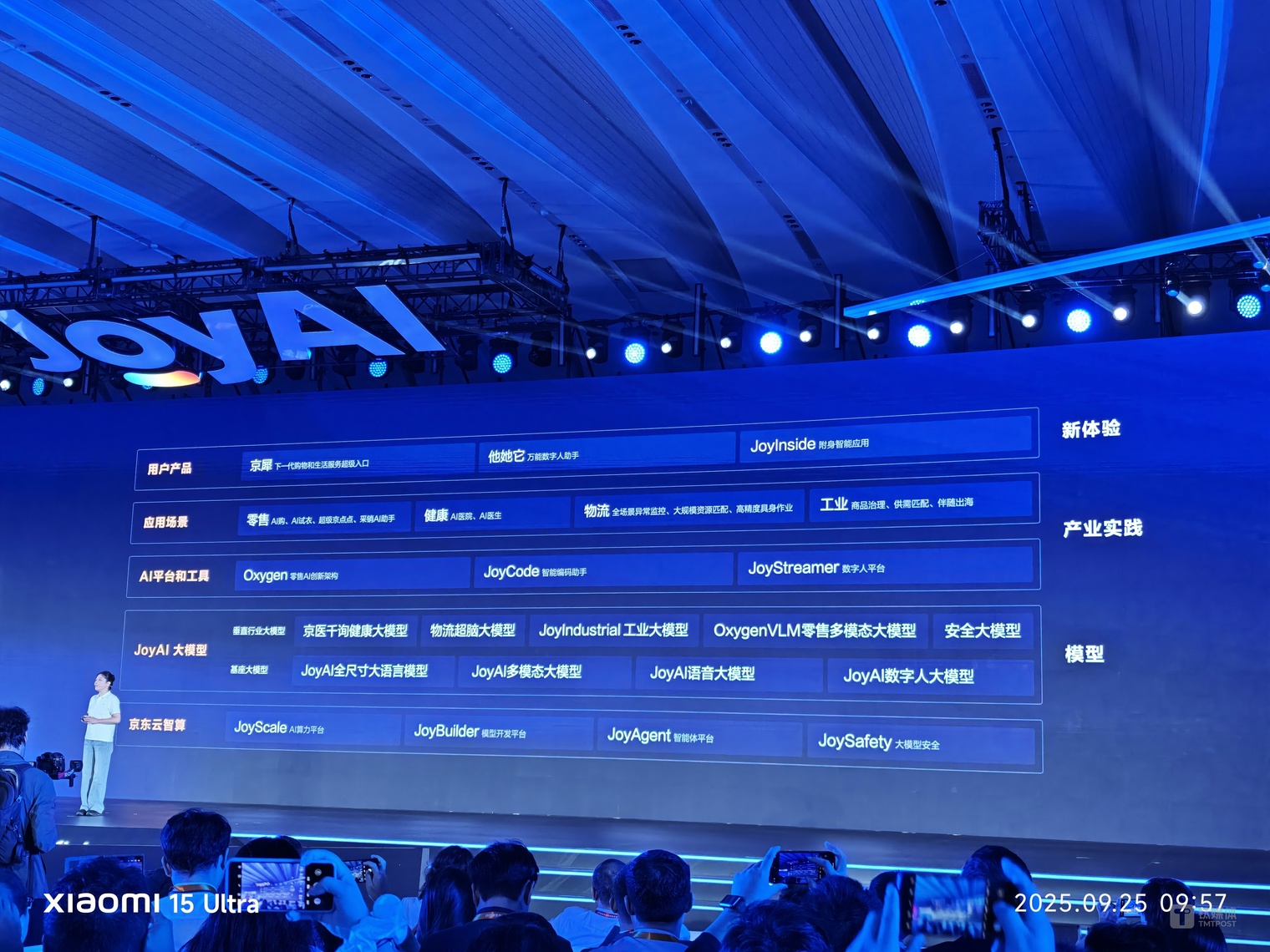
JD’s strategy emphasizes practical applications that enhance supply chains and industrial operations. Xu outlined a comprehensive AI roadmap, from foundational infrastructure and large-language models to platform tools and solutions for both enterprise and consumer users.
Among JD’s key products are Jingxi, a next-generation shopping and lifestyle app that leverages AI for intelligent product selection and ordering, and HeTaTa, a digital human assistant providing everything from weather updates to food delivery. JoyInside offers embodied AI for robots, smart toys, and wearable devices, enabling cross-modal perception and autonomous decision-making. JD has integrated JoyInside into over 30 hardware brands and collaborated with more than 10 humanoid and companion robot companies, boosting user engagement by more than 120%.
JD’s AI-enhanced logistics system, upgraded to model 2.0, improves human-machine collaboration and operational efficiency, while its Oxygen AI architecture enables personalized recommendations and smart search across retail operations. Healthcare and industrial AI applications employ multi-expert virtual agents and extensive datasets to optimize operations. Platforms like JoyAgent 3.0 and JoyCode IDE 2.0 streamline enterprise AI deployment, while the digital human platform 4.0 cuts live streaming costs by 90%. The JoyScale AI computing platform supports both NVIDIA and domestic heterogeneous acceleration cards, boosting throughput and reducing latency.
JD’s JoyAI models now cover full-size multimodal applications, with algorithmic innovations that have significantly improved performance. Senior VP He Xiaodong said the JoyAI inference engine, Q-EPLB, achieves 3,000 tokens per second per card, a 1.8x performance increase, ranking second globally on reasoning benchmarks, surpassing all domestic models.
He emphasized that the embodied intelligence industry is developing along two primary trajectories: reinforcement learning and motion control, and integrating foundational models with dexterous manipulation. JD’s initiatives, including JoyInside, aim to accelerate the industry by offering partners access to logistics, healthcare, and industrial data for model training and testing.
JD envisions robots as companions first, then as knowledge tools capable of understanding human language and executing tasks like food delivery. As AI advances, the boundaries between digital and physical intelligence will blur, creating applications across services, healthcare, and entertainment.
Global AI Landscape and China’s Edge
U.S. AI startups raised $200 billion in venture capital in 2025, with 41% concentrated among the top 10 companies, illustrating market consolidation. Chinese tech giants such as Alibaba, JD, and ByteDance, by contrast, combine capital, user bases, and real-world applications, positioning them to capture substantial returns in the coming decade.
Wu outlined a three-stage roadmap for ASI: the emergence of generalized intelligence, autonomous action where AI learns tools and programming, and self-iteration through interaction with the physical world, ultimately surpassing human capabilities. JD, meanwhile, emphasizes industrial application and value creation, sharing supply chain and operational data with partners to accelerate AI model development.
Both companies acknowledge AI hype and the potential for bubbles but remain confident. Industry experts, including NewView Capital founder Ravi Viswanathan, compare today’s market to the 2021 tech boom: significant opportunity exists alongside inevitable winners and losers.
As AI and robotics evolve, intelligent machines are expected to become increasingly integrated into daily life, reshaping both digital and physical economies. Alibaba and JD are positioning themselves to lead this transformation, leveraging their technological depth, vast ecosystems, and strategic vision to shape China’s AI-driven future.


 快报

根据《网络安全法》实名制要求,请绑定手机号后发表评论