






TMTPOST -- In a year defined by growing skepticism of centralized AI platforms and Big Tech dominance, one blockchain-based AI startup is charting a different course. At this year’s DePIN Expo, held on August 27–28 in Hong Kong, Hyra Network made its case for a radically different AI future—one where control doesn’t reside in Silicon Valley boardrooms, but in the hands of users themselves.
The company, which has quietly amassed more than 2.7 million users across 205 countries, is advocating for what it calls a "Sovereign AI Future.” The term was coined by Hyra to describe a system where individuals and organizations own and govern their AI models, data, and compute power, rather than renting them from centralized cloud providers.
“The vision is that AI should be something people own, not just something they use,” said Bui Minh Ngoc, known as “Min”, Hyra’s Head of Fundraising, in an interview with Barron’s, AsianFin, and ChainDD, strategic media partners of the event.
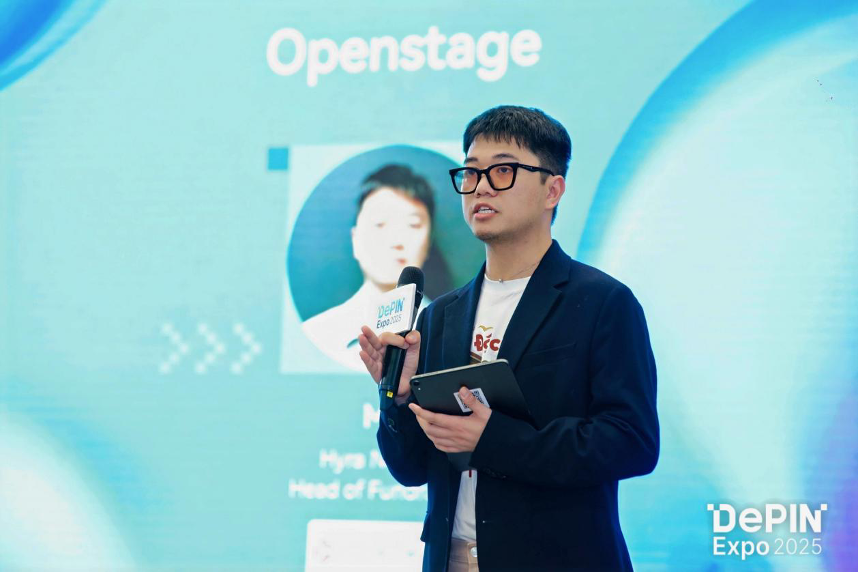
Min is delivering a speech at DePIN Expo 2025.
Min’s remarks reflect a growing sentiment in the tech community: that the next phase of artificial intelligence development must include a transparent, decentralized infrastructure layer—especially as AI begins to influence critical sectors like healthcare, finance, and media.
Hyra’s pitch rests heavily on zero-knowledge proofs (ZKPs), a cryptographic method more often associated with privacy coins than machine learning. The company uses ZKPs to allow model owners to prove that their AI executed as claimed—on specific data, with a specific model—without revealing the underlying inputs or algorithms.
It’s a high-wire act of privacy and accountability.
Before computation begins, Hyra’s system records a cryptographic fingerprint of the model—typically a hash of its architecture and weights—on-chain. When a user submits data, the AI runs locally, and the system produces a proof that each computational step aligned with the published model.
“The point is to create mathematical trust,” Min explained. “Not just between companies and users, but between machines and regulators, across jurisdictions.”
That level of verifiability, proponents argue, could one day allow a regulator to audit a financial algorithm’s decision-making process, or let a patient confirm that an AI-generated medical diagnosis was based on a certified model.
Hyra’s infrastructure hinges on a Decentralized Physical Infrastructure Network (DePIN), a relatively new category of blockchain protocol that crowdsources real-world computing resources—everything from idle GPUs to mobile phones.
Participants contribute computing power to the network and, in return, earn tokens or other rewards. The result is a kind of decentralized cloud, without the data silos or corporate gatekeepers.
For developers, it means lower costs and greater transparency. For users, better privacy and potentially fairer pricing. For Hyra, it’s a wedge into an industry currently dominated by hyperscalers like Amazon Web Services, Google Cloud, and Microsoft Azure.
“This is about more than decentralization—it’s about infrastructure independence,” said Min. “In the long run, we believe a DePIN model is more resilient and more inclusive than traditional cloud systems.”
Despite Hyra’s rapid global expansion—stretching across more than 200 countries—Min was quick to note that technical scalability is only part of the equation.
“The hardest challenges are not technical,” he said. “They’re social, regulatory, and behavioral. Technologies can move fast, but governments, policies, and people’s habits don’t evolve at the same speed.”
That uneven adoption curve is especially pronounced in emerging markets like Vietnam, where Hyra sees massive upside in blockchain and decentralized AI infrastructure.
According to Min, Vietnam is still “in the early stages” of its DePIN journey, but shows strong signs of growth. He believes the country could see “explosive adoption” of AI and decentralized infrastructure in the next 12 to 24 months, driven by grassroots developer activity and growing demand for localized AI services.
Looking beyond 2025, Hyra sees itself as the verifiable foundation layer for AI across multiple industries.
In healthcare, it could provide transparent, auditable diagnostics. In finance, AI decision-making could be subject to algorithmic compliance checks. In media, content could be cryptographically verified to combat misinformation and deepfakes.
These are lofty goals for a company still in its startup phase. But Min argues that the trust architecture Hyra is building could one day be as critical as the AI models themselves.
“The core question for the next decade of AI isn’t just about intelligence,” he said. “It’s about trust. Who controls the models? Who verifies them? And who benefits?”
If Hyra gets its way, the answer to all three questions might increasingly be: everyone.
 快报
快报
根据《网络安全法》实名制要求,请绑定手机号后发表评论