






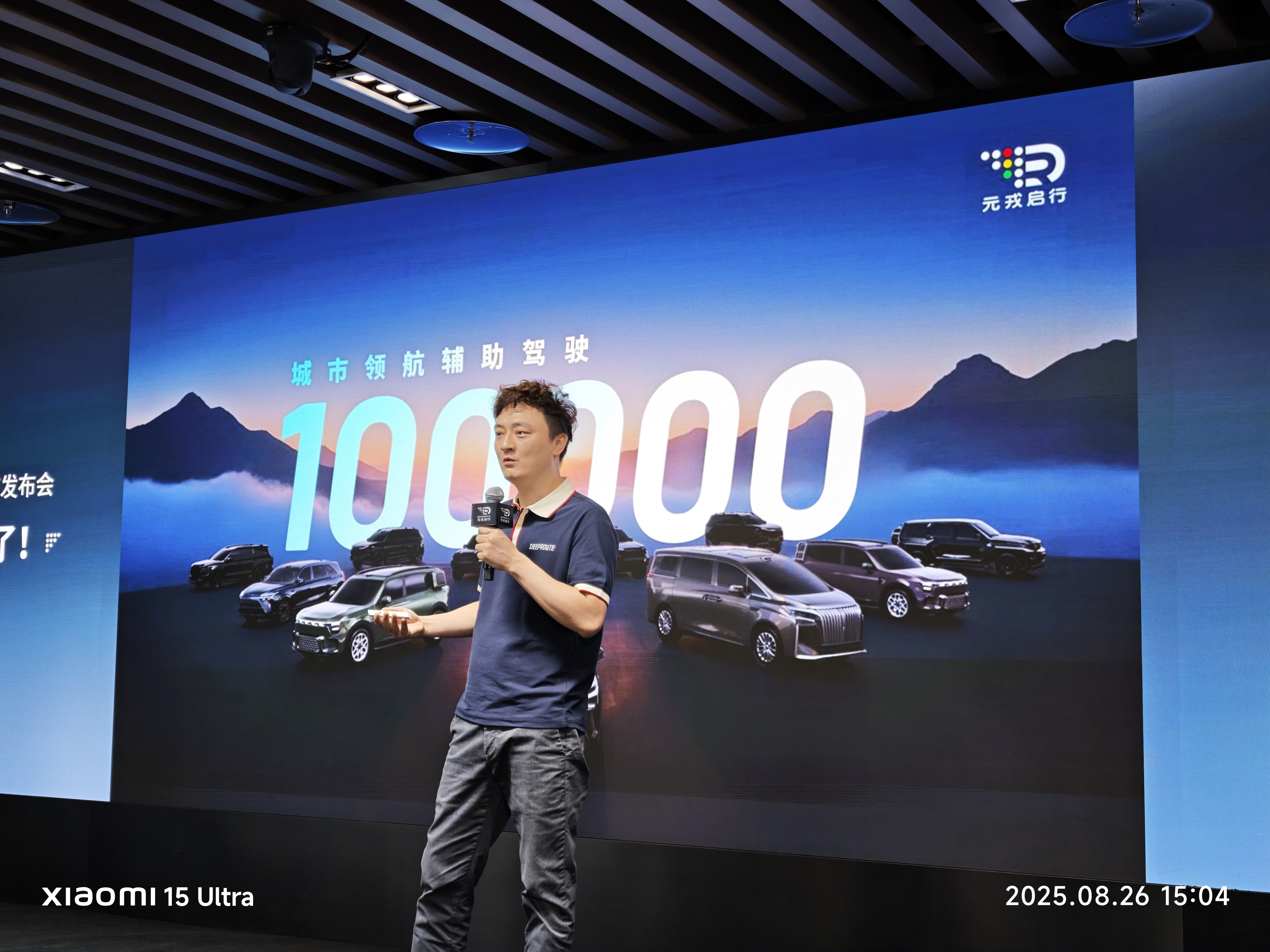
Zhou Guang, Founder and CEO of DeepRoute.ai
TMTPOST — DeepRoute.ai, a leading Chinese autonomous driving technology firm, on Monday launched its next-generation assisted driving platform, DeepRoute IO 2.0, featuring its self-developed Vision-Language-Action (VLA) model.
The platform promises to elevate vehicle intelligence by integrating visual perception, semantic understanding, and action decision-making into a single AI framework.
Unlike traditional end-to-end AI systems, the VLA model leverages a Chain of Thought (CoT) mechanism, allowing it to process complex driving scenarios with improved safety and comfort. The move positions DeepRoute.ai at the forefront of the next era of intelligent driving, where AI large models are applied directly to road scenarios.
“When language models meet assisted driving, everything becomes simpler,” said Zhou Guang, CEO of DeepRoute.ai, at the launch event in Shenzhen. “The VLA model represents a generational leap in vehicle intelligence and marks a major milestone in our technological development.”
The DeepRoute IO 2.0 platform emphasizes multi-modal, multi-chip, and multi-vehicle compatibility, supporting both lidar and pure vision deployments. This flexibility allows automakers to tailor the system for a variety of mainstream passenger vehicles. DeepRoute.ai has already secured five designated cooperation projects, with the first batch of mass-produced vehicles expected to hit the market shortly.
Zhou highlighted that the company has agreements for mass production on over 10 vehicle models, and nearly 100,000 vehicles have already been equipped with urban pilot-assisted driving systems, positioning DeepRoute.ai among industry leaders in China. Looking ahead, the company aims to expand its VLA model into AGI (Artificial General Intelligence) for robotics, extending its capabilities beyond road vehicles.
In a post-event interview, Zhou noted that AI chip costs remain the largest component in the current VLA model. Factors such as manufacturing processes, adaptation costs, and data requirements contribute to overall expenses. “We believe vehicles priced above 150,000 yuan will be able to integrate the VLA model,” he said, adding that cost optimization could expand its adoption further.
Though currently optimized for automobiles, Zhou emphasized that the VLA model exhibits strong generalization and adaptability for mobile robots. “This architecture is naturally positioned to acquire universal capabilities as we extend it into robotics,” he said.
Founded in 2019, DeepRoute.ai (also known as Yuanrong Qixing) has focused on integrating AI into autonomous driving, with the goal of building general AI for the physical world. The company has pioneered mass-production solutions that do not rely on high-precision maps, combining end-to-end AI with multi-modal VLA models to create intelligent driving systems.
CEO Zhou Guang, a Tsinghua University alumnus, previously worked at the Tsinghua University High Energy Physics Research Center and led autonomous driving robot projects at Texas Instruments’ Kilby Lab. He later joined Baidu’s U.S. Autonomous Driving Division before returning to China to establish DeepRoute.ai. Today, the company employs over 1,000 staff, 84% of whom are dedicated to R&D.
Financially, DeepRoute.ai has completed six funding rounds totaling over $500 million, with investors including Alibaba, Fosun RZ Capital, Yunqi Partners, and Lightspeed China Partners. Most recently, in November 2024, the company closed a $100 million Series C1 strategic round led by domestic automaker Great Wall Motors.
On the commercialization front, DeepRoute.ai has partnered with multiple automakers to deploy assisted driving systems across more than a dozen vehicles. By 2025, over 200,000 vehicles featuring the company’s combined assisted driving technology are expected to enter the consumer market.
Technically, the VLA model is designed to overcome the “black box” limitations of traditional end-to-end AI systems. By integrating chain-of-thought reasoning and a massive built-in knowledge base, it can analyze causal relationships and adapt to complex, ever-changing driving environments.
Zhou acknowledged that the assisted driving sector still faces significant challenges, particularly as more vehicles integrate these systems. “We must approach this industry with the utmost respect; it’s not like making a robot dog,” he said. He emphasized that healthy competition is critical for industry development and that safety remains the top priority.
Going forward, DeepRoute.ai plans to expand VLA applications in passenger vehicles and Robotaxi services while gradually evolving the model into a general intelligent agent system within its Road AGI framework. Zhou said the company is also exploring L4 and L5 autonomous driving using a large-model approach similar to Tesla’s, moving away from the rule-based CNN methods pioneered by Waymo.
“Autonomous driving definitions are outdated,” Zhou said. “The real difference between L4 and L5 is simply whether a vehicle relies on a map or can drive fully autonomously anywhere. AI development has reshaped this landscape entirely.”
Zhou reiterated that true autonomous driving requires large models and end-to-end architectures. Leveraging reinforcement learning and VLA, DeepRoute.ai is moving toward strong expert systems capable of handling the complexities of real-world driving.
“We will make every effort to advance mass production and apply VLA technology to relevant fields, including Robotaxi and the passenger vehicle sector. Eventually, we plan to deploy the VLA model across all mobile platforms to realize physical AGI,” Zhou said. He predicted that cars would likely be the first robots to reach scales of 100,000 to over a million units.
With its DeepRoute IO 2.0 platform, DeepRoute.ai is positioning itself as a major force in China’s autonomous driving industry, blending cutting-edge AI with mass-market vehicle applications, and charting a path toward a future where intelligent vehicles and mobile robots share the same AI architecture.


 快报
快报
根据《网络安全法》实名制要求,请绑定手机号后发表评论