







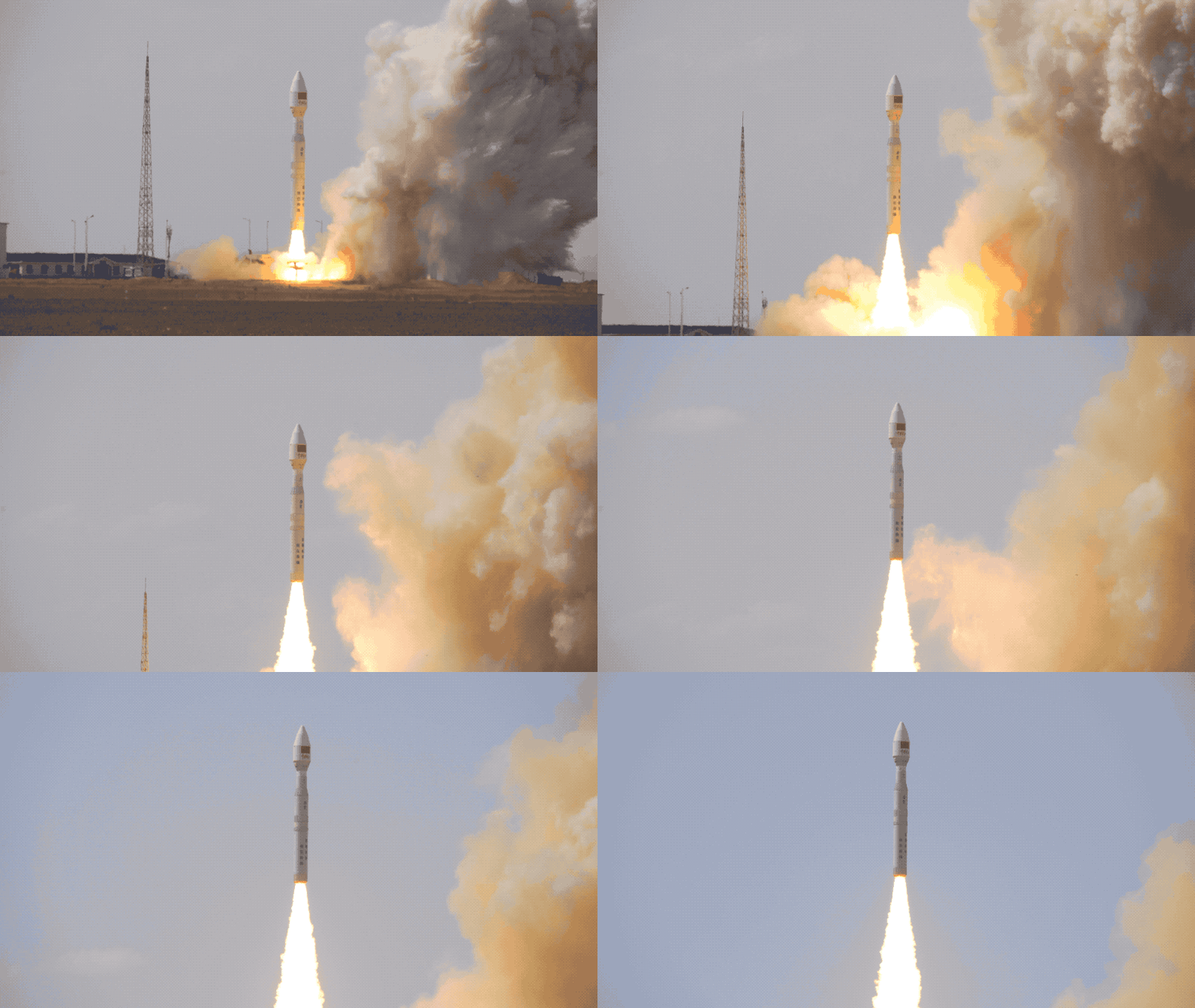
TMTPOST -- On August 19, at 15:33 local time, AIRSAT's Lijian-1 Yao-10 launch vehicle successfully lifted off from the Dongfeng Commercial Space Innovation Experimental Zone, delivering seven satellites into their designated orbits. The mission marked the eighth flight of the Lijian-1 rocket and was declared a complete success.
请输入图说
According to AIRSAT, the Lijian-1 series continues to dominate China’s commercial space launch sector, having successfully placed a total of 70 satellites into orbit, with a cumulative payload exceeding seven tons. The company stated that it aims to meet growing global demand for high-frequency satellite launches and expects to soon have the capability to deploy over 50 satellites in a single mission.
AIRSAT, a high-tech enterprise incubated by the Institute of Mechanics of the Chinese Academy of Sciences, was founded in 2018. The company specializes in medium and large launch vehicles, custom space launch services, suborbital scientific experiments, and space tourism. Its Lijian-1 rocket, once China’s largest solid-fuel launch vehicle, gained recognition in July 2022 after completing a “one rocket, six satellites” mission, officially ushering China’s private space sector into the era of medium-class rockets.
In 2023, AIRSAT announced the development of the Lijian-2, a liquid-fueled rocket designed to carry the prototype of the Qingzhou cargo spacecraft for China’s crewed space station program. This initiative aims to reduce cargo transport costs and improve operational efficiency for the Chinese space station. Meanwhile, the company’s reusable Lihong series is expected to provide suborbital microgravity experimental platforms for research beginning this year.
AIRSAT has developed a fully integrated “design-test-production-launch” operational chain. It operates China’s only domestically built and managed facility capable of supporting both solid and liquid rockets, satellite-rocket integration, and dedicated satellite technology workshops, along with dual solid-liquid launch pads. The company’s launch services now cover regions including China, Europe, North America, South Asia, and the Middle East, establishing it as the only private commercial rocket company in China with repeated extraterrestrial payload launches.
In April 2024, AIRSAT completed its Series C+ funding round, attracting investors such as Galaxy Investment, Guangzhou Industrial Investment, CAS Star, Red Horse Investment, and Yuexiu Industrial Fund. On August 12, 2025, the company officially began its IPO counseling and filing process with the China Securities Regulatory Commission, planning to list on the STAR Market with Guotai Haitong Securities as its counseling institution.
Yang Yiqiang, AIRSAT chairman and former manager at the China Academy of Launch Vehicle Technology, leads the company. Yang has over 30 years of experience in aerospace project management and is also the main contributor and controller of Beijing Pengyi Junlian Space Technology Center, AIRSAT's controlling shareholder with a 27.7476% stake.
The Lijian-1 Y10 mission carried seven satellites: AIRSAT Satellite 05, Multi-Function Experimental Satellites No. 2-01, 02, and 03 (Tiantuo-6 satellites), Tianyan-26 (Zhongyuan-3), ThumbSat-1, and ThumbSat-2. All satellites were successfully delivered into their planned orbits. Aerospace Yuxing provided telemetry and control for AIRSAT Satellite 05 and Tianyan-26.
Deputy Chief Commander of Lijian-1, Meng Xiangfu, highlighted that technological innovations, such as multi-satellite stacking adapters, and operational optimizations, including rolling backup production and remote testing, have reduced the launch cost per kilogram of payload to under $10,000. Lijian-1 can deliver up to 1.5 tons to a 500-kilometer sun-synchronous orbit and is capable of launching over 50 satellites in a single mission, further lowering per-satellite costs.
For this mission, final assembly, testing, and satellite integration were all completed at AIRSAT's Lijian Rocket Assembly and Testing Facility, marking the first time that these processes were fully integrated in China. This streamlined approach significantly shortened the overall assembly-to-launch cycle.
China’s space sector is currently experiencing a surge in launch activity. On August 17, Long March 6A and Long March 4C rockets successfully launched multiple satellites into orbit, reflecting a busy period for both state and private enterprises. In 2024, China conducted 68 rocket launches, 12 of which were by private companies, while 201 spacecraft were successfully placed into orbit, both record-setting figures.
Commercial space enterprises now account for 80% of the Chinese sector, with Chinese Academy of Sciences-affiliated and aerospace system enterprises sharing the remainder. Analysts project that by 2025, the private space market will reach 2.8 trillion yuan.
Other private companies, including LandSpace and Jiangsu Yixin Aerospace Technology, are also preparing IPO filings. However, challenges persist. On August 15, LandSpace’s Zhuque-2 Improved Y3 rocket experienced an abnormal flight, resulting in mission failure, possibly due to a servo circuit malfunction.
Industry observers note that China’s commercial space sector still faces limitations. Hu Zheng, co-founder of Shanghai Huanyu Qiankun Aerospace Technology, pointed out that the industry’s profit model remains heavily reliant on launch service fees, with insufficient data monetization and commercialization opportunities. Supply chain maturity, reusable rocket technology, and low-cost launch capabilities still lag behind the United States, constraining overall growth.
Yuan Huaming, General Manager of Guangdong Huahui Chuangfu Investment Management, expects that by 2025, increased launch frequency, expanded low-Earth orbit satellite networks, and greater capital investment will accelerate the development of China’s commercial space sector, reduce operational pressures, and help establish a sustainable commercial ecosystem.

 快报

根据《网络安全法》实名制要求,请绑定手机号后发表评论