







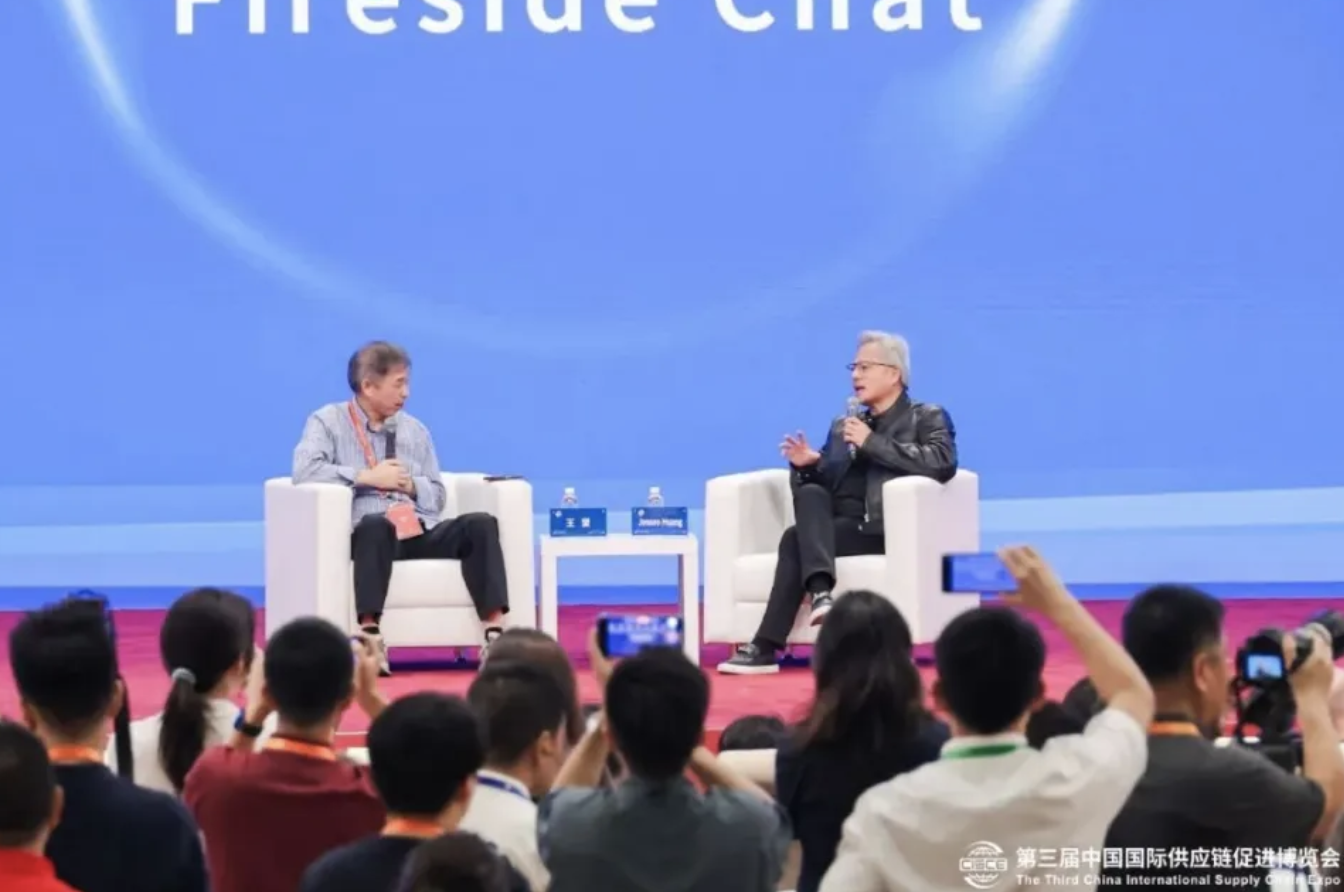
TMTPOST — Nvidia CEO Jensen Huang joined Alibaba Cloud founder and Zhijiang Lab director Wang Jian for a fireside discussion at the Chain Expo’s Advanced Manufacturing Forum on Thursday, where the two tech leaders exchanged views on the future of artificial intelligence, semiconductor innovation, and how the next generation can thrive in an AI-driven world.
The conversation touched on the rapid evolution of AI technology, with Huang describing it as a new form of software development grounded in first-principles thinking. Over the past decade, AI has transitioned from systems that require manual programming to models capable of learning from data to make predictions. These shifts, he noted, have brought breakthroughs roughly every four to five years — most recently with generative and reasoning-based AI systems. Huang believes the next wave will involve the integration of AI into physical machines such as robots, setting the stage for the era of Physical AI.
He also suggested that artificial general intelligence (AGI) — where AI systems outperform humans across a broad range of cognitive tasks — is approaching feasibility, and that AI is on track to exceed human-level problem-solving capabilities in the near future.
Wang Jian, reflecting on the infrastructure underpinning these developments, argued that computing power, more than AI itself, has been the foundational driver of technological transformation. While AI is a visible outcome, he said, the expanding scale of computational capacity is what has fundamentally enabled these advancements.
Both speakers emphasized that AI should not be seen simply as a simulation of human intelligence, but rather as an augmentation of it. They agreed that like cars and airplanes expanded human physical reach, AI can broaden intellectual capacity and creativity.
China's Open-Source Contributions Gain Recognition
The discussion also highlighted the importance of open-source development in AI. Huang acknowledged China's leadership in open-source AI research, pointing to its prolific publication record on platforms like arXiv and the global impact of models like DeepSeek-R1, Qwen, and Kimi — advanced, multimodal reasoning systems developed in China.
He described open-source AI as a globally beneficial approach, enabling transparency, collaboration, and safety through community oversight. Such practices, he noted, ensure that top-tier scientific work can be studied, improved, and safely deployed. Wang extended an invitation to Huang to visit Hangzhou, the birthplace of several of these leading models — an offer Huang said he plans to accept.
Turning to hardware, Huang reaffirmed that silicon remains essential to AI advancement, even as new materials and manufacturing techniques evolve. He pointed to the emergence of 3D transistor structures (GAA), backside power delivery, advanced packaging (CoWoS), and co-packaged optics (CPO) as evidence of continued innovation. He said Nvidia’s chip development roadmap extends nearly a decade forward, with ongoing breakthroughs expected for at least the next 20 years.
Young People Urged to Build Fundamentals Despite AI's Rise
As AI becomes more capable, Huang stressed that it should not replace foundational learning. He encouraged young people to approach complex problems by applying first-principles thinking — breaking down challenges step by step to build understanding from the ground up. Regardless of their field, he said, individuals must maintain a solid grasp of basic knowledge and avoid over-reliance on AI systems.
He also urged everyone to embrace AI technologies as early as possible. AI-powered computing, he said, is emerging as a powerful equalizer, providing individuals with access to the same cognitive and creative tools — regardless of background or resources.
Huang expressed admiration for the younger generation growing up in the age of AI, calling it a unique opportunity. These digital natives, he said, will be accompanied by AI throughout their lives — intelligent companions capable of learning from them, supporting their education, offering advice, and enhancing personal development.
On the business front, Nvidia shares closed at $171.37 on July 16, up 0.39%, pushing its market capitalization to $4.18 trillion.
Earlier this week, Huang confirmed two key developments in an interview with Chinese state media: U.S. regulators have approved the export of Nvidia’s H20 chips to China, and the company is preparing to launch its new RTX Pro GPU.

 快报

根据《网络安全法》实名制要求,请绑定手机号后发表评论