






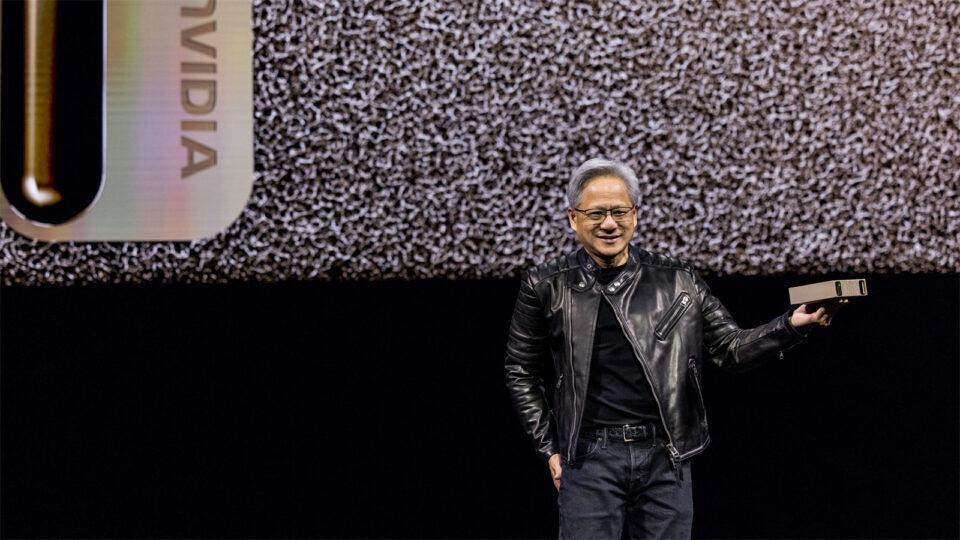
TMTPOST -- in his keynote at the annual GTC conference on Tuesday, Nvidia Corporation CEO Jensen Huang unveiled details on the company’s future artificial intelligence (AI) offerings for data centers in the next three years, and showcased developments in robotics and other industries.
Credit:Nvidia
Huang said Nvidia’s latest chip family on Blackwell architecture introduced last year is in full production, delivering 40 times the performance of its previous architecture Hopper. Huang tried to bring relief for investors who are wary about the demand for advanced AI chips amid the sudden rise of Chinese startup DeepSeek. “This last year, this is where almost the entire world got it wrong,” he said,noting that AI scaling law, or computing need, is more resilient, and actually “hyper-accelerated.”
Both the ramp and the customer demand for Blackwell chips are “incredible”, according to Huang. “And for good reason, because there is an inflection point in AI, the amount of computation we have to do in AI is so much greater as a result of reasoning AI, and the training of reasoning AI systems and agentic systems.” He anticipated the world will need 100 times more computing power for advanced AI than it deemed necessary a year ago.
He said Nvidia launched Blackwell to solve an extreme problem--inference, which is a token generation that will be critical to businesses. AI factories that generate these tokens have to be built with extreme efficiency and performance. And demand for tokens will only grow, with the latest generation of reasoning models able to think through and solve increasingly complex problems.
To further accelerate inference on a large scale, Huang announced Nvidia Dynamo, open-source software for accelerating and scaling AI reasoning models in AI factories. “It is essentially the operating system of an AI factory,” Huang said.
Huang introduced Blackwell Ultra, a new evolution of the Blackwell AI factory platform that is set to come out in the second half of this year. Blackwell Ultra boosts training and test-time scaling inference — the art of applying more compute during inference to improve accuracy — to enable organizations everywhere to accelerate applications such as AI reasoning, agentic AI and physical AI.
“AI has made a giant leap — reasoning and agentic AI demand orders of magnitude more computing performance,” said Huang. “We designed Blackwell Ultra for this moment — it’s a single versatile platform that can easily and efficiently do pretraining, post-training and reasoning AI inference.”
Backwell Ultra includes the Nvidia GB300 NVL72 rack-scale solution and the Nvidia HGX 300 NVL16 system. The GB300 NVL72 connects 72 Blackwell Ultra graphics processing units (GPUs) and 36 Arm Neoverse-based Nvidia CPUs in a rack-scale design. It delivers 1.5 times more AI performance than the predecessor Nvidia GB200 NVL72, as well as increases Blackwell’s revenue opportunity by 50 times for AI factories, compared with those built with the Hopper architecture
With GB300 NVL72, AI models can access the platform’s increased compute capacity to explore different solutions to problems and break down complex requests into multiple steps, resulting in higher-quality responses. HGX B300 NVL16 features 11x faster inference on large language models, 7x more compute and 4x larger memory compared with the Hopper generation to deliver breakthrough performance for the most complex workloads, such as AI reasoning.
Following the Blackwell , Vera Rubin is Nvidia’s next generation GPU family, and system built on it, including the Vera Rubin NVL 144, are expected to start shipping in the second half of 2026. The GPU familiy is named after the astronomer who discovered dark matter. And systems built on Rubin Ultra are due for the second half of 2027. “You can see that Rubin is going to drive the cost down tremendously,” Huang said. He also said the generation after Rubin will be named after famous U.S. physicist Richard Feynman.
Huang described the growth of AI over the past decade, including the emergence of agentic AI — which can reason how to solve a problem, plan and take action. Huang believes the era next to the Agentic AI is Physical AI and robotics. Calling robots the next $10 trillion industry, Huang expected the world is going to be at least 50 millioin workers short by the end of this decade.
Nvidia announced on Tuesday a suite of technologies for training, deploying, simulating and testing next-generation robotics, including Nvidia Isaac GR00T N1, the world’s first open, fully customizable foundation model for generalized humanoid reasoning and skills. Nvidia said itwill pretrain and release GR00T N1, available now, to worldwide robotics developers, accelerating the transformation of industries challenged by global labor shortages estimated at more than 50 million people.
Other Nvidia’s technologies to supercharge humanoid robot include simulation frameworks and blueprints such as the Nvidia Isaac GR00T Blueprint for generating synthetic data, as well as Newton, an open-source next-generation physics engine that is under development in collaboration with Google DeepMind and Disney Research.
“The age of generalist robotics is here,” said Huang. “With Nvidia Isaac GR00T N1 and new data-generation and robot-learning frameworks, robotics developers everywhere will open the next frontier in the age of AI.”
During the keynote, Huang also released personal AI computers --DGX personal AI supercomputers powered by the Nvidia Grace Blackwell platform. Describing it as the perfect Christmas present, Huang announced GB10 Grace Blackwell-backed DGX Spark and DGX Station, which is powered by the NVIDIA Blackwell Ultra platform. Users can run these models locally or deploy them on Nvidia DGX Cloud or any other accelerated cloud or data center infrastructure.
DGX Spark and DGX Station bring the power of the Grace Blackwell architecture, previously only available in the data center, to the desktop. Pre-oders of DGX Spark began on Tuesday and be available in the coming months, and DGX Station will hit the market later this year. “This is the computer of the age of AI,” Huang said. With these new DGX personal AI computers, AI can span from cloud services to desktop and edge applications, He added.



 快报
快报
根据《网络安全法》实名制要求,请绑定手机号后发表评论