







BEIJING, December 6 (TMTPOST) – Experts at the T-EDGE Conference have agreed that China should deepen openness and continue to integrate into the global supply chain while going through industrial upgrade.
In a panel discussion centered on "How China Should Address the Challenges and Opportunities of Corporate Globalization," luminaries from international organizations also underscored the imperative of creating a more transparent and open business environment, leveraging technological strengths to attract foreign investment and boost investor confidence in China.
The 2023 T-EDGE Conference, held from December 1 to December 3 in Beijing, was not just a symposium of ideas but a witness of the seismic shifts in global business innovation strategies.
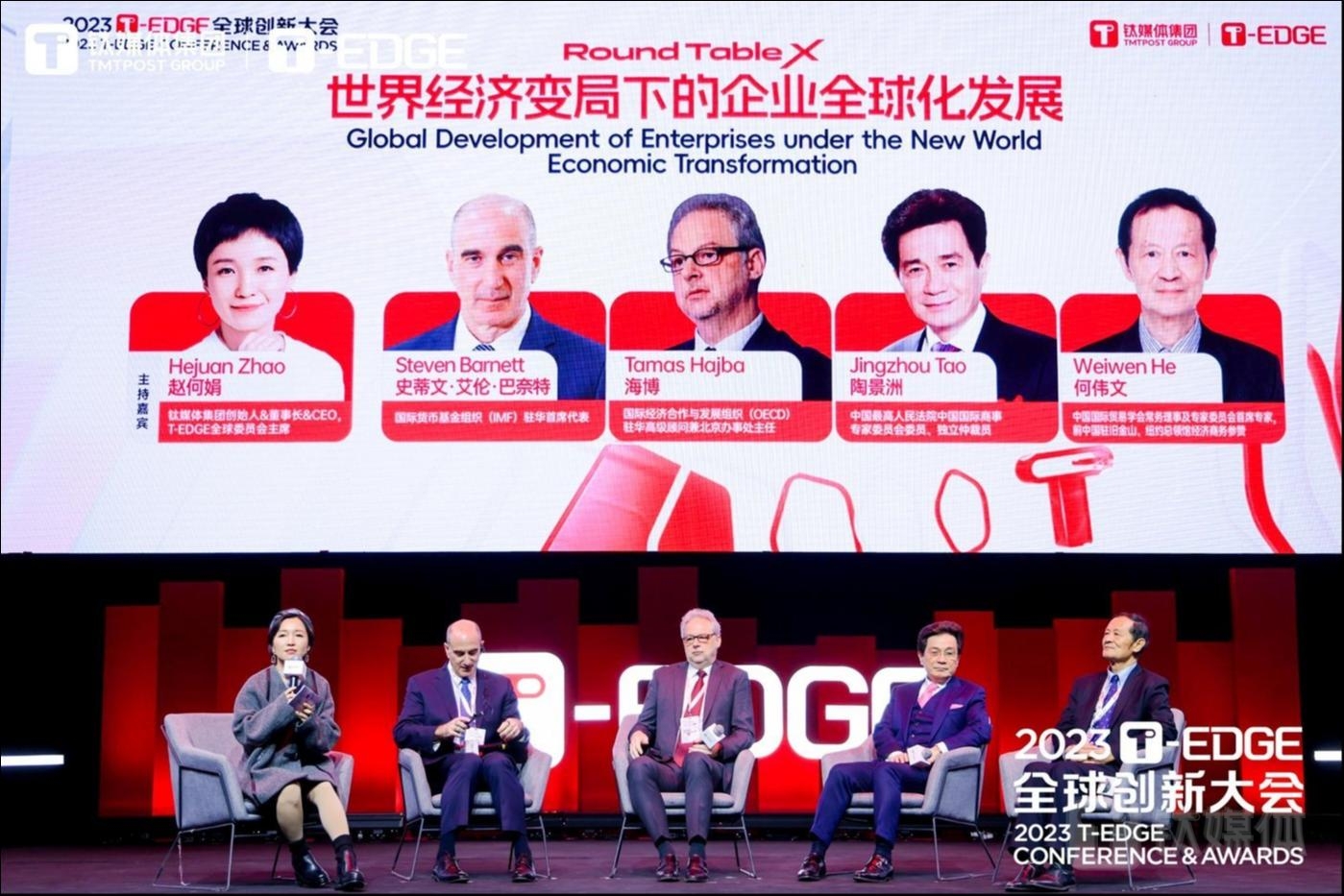
Steven Barnett, the International Monetary Fund (IMF)'s Chief Representative in China, Tamas Hajba, the Senior Advisor and Director of the Organisation for Economic Co-operation and Development (OECD) Beijing Office, Tao Jingzhou, a member of the Supreme People's Court of China's International Commercial Expert Committee and independent arbitrator, He Weiwen, a Senior Fellow at the China Society for World Trade Organization Studies, and Zhao Hejuan, the founder, the Chairperson, and the CEO of TMTPost Group, engaged in a profound dialogue on "Enterprise Globalization in the Context of a Changing World Economy."
China's Challenges and Opportunities
He commenced the discussion by recognizing China's enduring competitiveness in the global supply chain. He pointed out that the World Bank divides the global market into seven major blocks, with North America, Europe-Central Asia, and East Asia-Pacific being the most significant. These blocks are interdependent. The United States, Germany, and China occupy pivotal positions in the supply chains, a structure unlikely to change in the foreseeable future. Given this, China should be confident and proactive in its integration into the global supply chain, countering the current anti-globalization trend and decoupling measures, thus maintaining its competitive edge and ensuring long-term development.
Can China Continue to be the "World's Factory"?
This question sparked an in-depth discussion among the roundtable participants. Barnett noted that over the past 20 years, China has had a robust consumption power but it has been outpaced by its income growth, resulting in a lower proportion of consumption in GDP compared to other major economies. He hoped that future consumer spending could be a driving force for both China's and the global economy, as consumption generates less pollution than production, benefiting the world.
He argued that China should view the role of the world's factory from a developmental perspective, as it is subject to dynamic change. China has long held an advantage in assembly, but now, this advantage has moved to fields like electric vehicles, wind power, and photovoltaics. For instance, 60% of the world's wind turbines and 80% of photovoltaic equipment are produced in China. Moving forward is needed for China to excel in assembly; it must develop high-end industrial chains and become an innovative leader.
Hajba held a similar view, adding that due to changes in domestic production and policies, the way China offers products to the world is also evolving. China has become a major supplier in terms of green transformation, electric vehicles, and wind energy, accounting for about 30% of global manufacturing. He projected that China is likely to maintain its position in global manufacturing.
Tao argued that for China to continue as the world's factory, it needs to keep foreign businesses in China as a production base. The trend of relocating factories to Southeast Asia from China due to rising labor costs or supply chain disruptions must be stopped. China should leverage its technological advantages to lure foreign investment.
Zhao pinpointed an ongoing trend. Many Chinese factories are establishing factories in Mexico and Indonesia to serve Western suppliers better. According to the Ministry of Commerce, from January to September, China's use of foreign capital amounted to 919.97 billion yuan, a decrease of 8.4% year-on-year. In contrast, China's non-financial direct investments abroad grew by 18.7% year over year during the same period.
He attributed these contrasting trends to two main factors: policy and economic considerations. He noted the concerns among foreign businesses due to tense China-U.S. relations. An April survey by the American Chamber of Commerce showed that about 87% of its members were concerned about China-U.S. relations, which significantly affected their investment decisions, with about 11% planning to relocate their industries. Additionally, more than half of the members had yet to make plans to expand their investments for the time being.
He further pointed out that with the stabilization and improvement of China-U.S. relations, American business confidence is recovering. Currently, the Chinese Ministry of Commerce is advocating for equal treatment of state-owned enterprises, private enterprises, and foreign enterprises, which should facilitate the reversal of foreign investment declines.
From an economic standpoint, China's industrial equipment utilization rate in the third quarter was 75.6%, compared to 78.9% in the United States. China has yet to achieve full operation, indicating excess capacity. Moreover, from January to October, the value added of industrial enterprises above a designated size grew by 4.1% year-on-year, with high-tech manufacturing increasing by 1.9%. Therefore, identifying growth points is essential for determining the right investment direction.
Guidance for Chinese Enterprises Going Global
In the face of a complex international environment, He and Tao offered constructive advice and guidance for Chinese enterprises looking to expand globally.
He emphasized that regardless of external changes, Chinese enterprises must steadfastly pursue globalization strategies. They should rely on local resources, including government, mainstream consultants, law firms, banks, accounting firms, and consulting companies, to meet their developmental needs.
Tao said that overseas investment should be encouraged but stressed the importance of considering investment safety. He emphasized heeding political, legal, military, and security risks and seeking high-quality consulting companies for guidance and protection.
Enhancing Foreign Investor Confidence
In the discussion on bolstering foreign investor confidence, Tao stressed that as a key WTO member, adhering to WTO’s transparency principle is crucial for China. For foreign investors, the lack of clear and enforceable regulations or the inability to understand applicability can significantly impact their willingness to invest. He believed that making more information available and listening to their suggestions would ensure a transparent and open investment environment in China, fostering a better business climate.
From a macroeconomic perspective, Barnett emphasized that healthy and sustainable economic growth is vital to attracting investments. Deepening reforms, increasing openness, and allowing the market to play a decisive role are crucial to achieving medium-term economic growth.
Hajba spoke on the challenges China faces in its green and digital economy and the transition of its real estate sector. He underscored the importance of continuous reforms to enhance productivity and consumer power. He highlighted the critical role of the private sector in the overall economic recovery, calling for empowering it and creating a conducive financing environment.


 快报

根据《网络安全法》实名制要求,请绑定手机号后发表评论