








Credit: Visual China
BEIJING, October 30 (TMTPost) – The internationalization of the Chinese Yuan (RMB) has accelerated in recent years, with its status as an international payment and financing currency gradually consolidated.
The People's Bank of China (PBOC), China’s central bank, released its 2023 Yuan Internationalization Report last Friday, which indicated that the yuan's share in cross-border payments had increased, and its financing function had also been further enhanced.
The report stated that in the first nine months of 2023, the cross-border trade settled in yuan was 38.9 trillion yuan, a 24% year-on-year increase. Yuan-denominated cross-border trade in goods accounted for 24.4%, a 7-percentage-point increase year-on-year and the highest proportion in recent years.
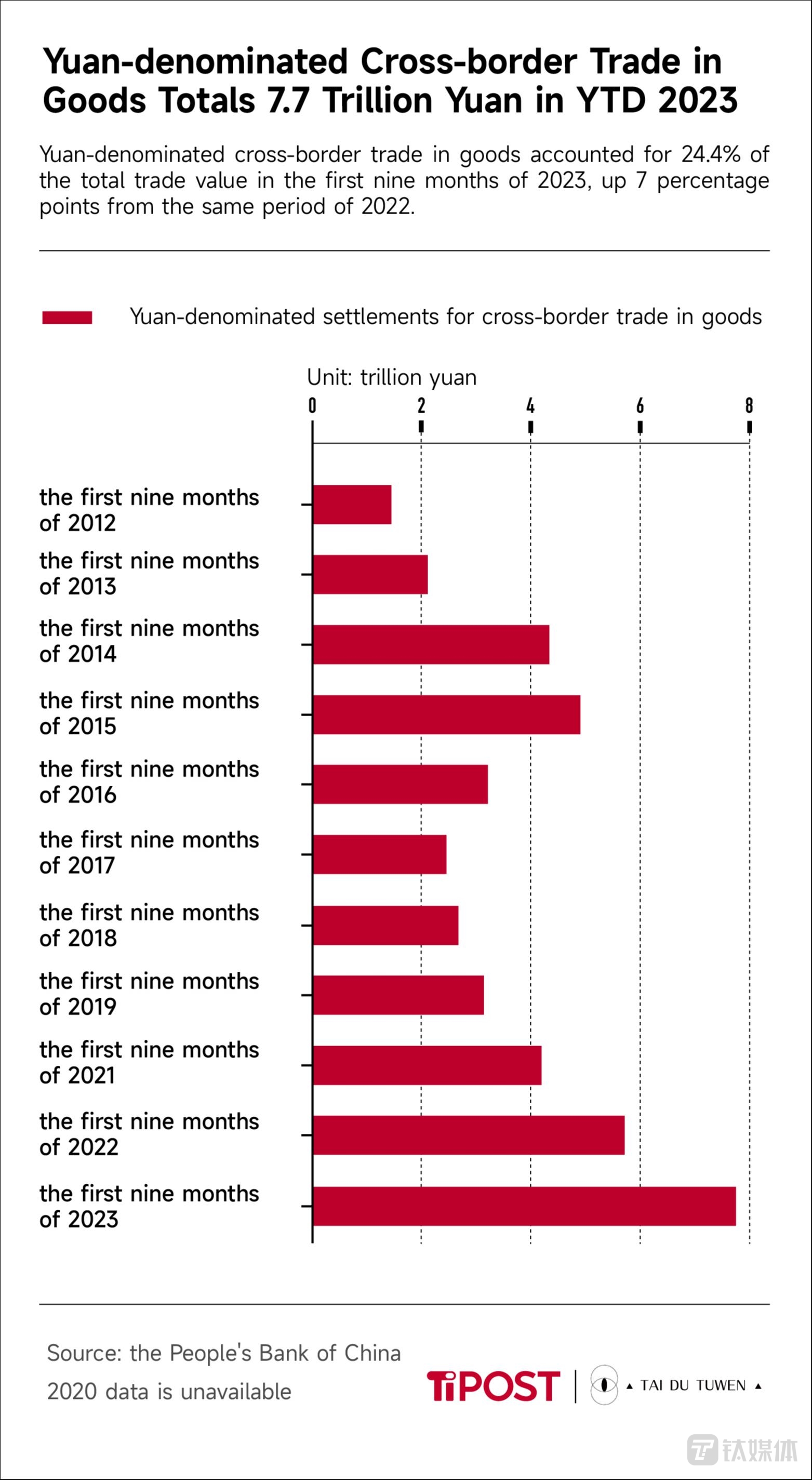
Yuan-denominated Cross-border Trade in Goods Totals 7.7 Trillion Yuan in YTD 2023
The RMB has also overtaken the euro to become the world's second-largest trade financing currency. According to data from the Society for Worldwide Interbank Financial Telecommunication (SWIFT), the RMB's share in global trade financing was 5.8% in September, a 1.6 percentage point increase year-on-year.
However, the RMB's share in global trade financing is still lower than its historical high of 8.66% in October 2013. It surpassed the European Union to secure the second spot for the first time. Subsequently, the yuan was overtaken by the euro in October 2015, as its share in global trade financing declined.
The report highlighted that over the past year, foreign entities' accessibility to the Chinese bond market had improved, and the RMB's function as a financing currency had been steadily enhanced, with Panda bonds (Chinese renminbi-denominated bonds from a non-Chinese issuer) playing a significant role. As of the end of August 2023, foreign entities had issued a total of 434 Panda bonds in the Chinese market, with a cumulative issuance size of 740.22 billion yuan. During the first eight months of 2023, the issuance size by foreign entities in the Chinese market was 106 billion yuan, a 58.2% year-on-year increase.
It is mentioned in the report that the primary issuance platform for Panda bonds in the Chinese market is the interbank market, with maturities mainly being 3 years or shorter. In the first eight months of 2023, the issuance size of bonds with maturities of 3 years or shorter was 101 billion yuan, accounting for 95.3% of the total issuance size. Among them, short-term bonds with maturities of 1 year or less accounted for 46.1%. Nearly 90% of foreign issuers from January to August 2023 were non-financial enterprises, an increase of nearly 10 percentage points compared to 2022.
The report also stated that the PBOC will continue to promote the development of the Panda bond market, enhance the breadth and depth of the bond market, steadily promote the high-level opening of the bond market, and continue to optimize the policy environment for cross-border investment and financing in RMB, to serve the development of the real economy.
The use of RMB financing by international institutions has also increased the transactions in China’s foreign exchange market. The report noted that in 2022, 88% of foreign banks' transactions in China’s interbank foreign exchange market were related to foreign exchange demand for bond investment. As of the end of 2022, there were 197 foreign institutions participating in the interbank foreign exchange market, accounting for 7% of the transactions. The range of institutions had expanded from overseas RMB clearing banks to overseas central banks, participating banks, and non-bank financial institutions.
The report stated, "(The PBOC and China’s State Administration of Foreign Exchange) support overseas investors in conducting foreign exchange funds exchange and exchange rate risk hedging through the Chinese market, forming positive interactions between the foreign exchange market, the bond market, and the stock market."
The offshore RMB market has also grown. As of the end of 2022, the balance of RMB deposits in major offshore markets was 1.5 trillion yuan, reaching a historical high. Besides, China has signed bilateral currency swap agreements with central banks or monetary authorities in 40 countries and regions, with 29 agreements currently in effect, totaling over 4 trillion yuan in scale. As of the end of September 2023, foreign monetary authorities had used 117.1 billion yuan of RMB, a slight increase from 115 billion yuan at the end of the second quarter.
The report mentioned that the PBOC will "continue to improve the liquidity supply mechanism of the offshore RMB market, enrich the product system of offshore RMB markets such as Hong Kong, promote a positive cycle between the onshore and offshore RMB markets, and support the healthy development of the offshore RMB market."


 快报

根据《网络安全法》实名制要求,请绑定手机号后发表评论