







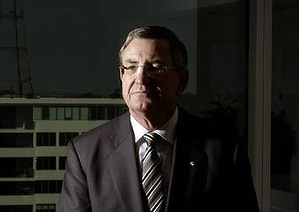
He once fought China-backed Vietcong, now John Lord represents the controversial Chinese telecoms supplier.(点击看中文版)
When John Lord joined the Royal Australian Navy in 1965 as a cadet midshipman, Australian Diggers were fighting alongside Americans in the jungles of Vietnam against black-clad Vietcong guerillas supported by Red China.
Forty-seven years later, after rising through the ranks to become the fleet commander of the Australian Navy, and retiring as a rear admiral, he is still fighting, this time as a representative of a technology company of his former foe, China.
Since the late 1970s, China has mostly abandoned its evangelical fervour of spreading international communism in favour of embracing its former arch-enemy - capitalism.
Chinese companies, not Red Army soldiers, are conquering the world.
One of its leading national champions is Huawei, a technology giant and the largest vendor of telecommunications equipment in the world.
Lord is the chairman of its local board - and the ''second oldest employee'' after its elusive founder, Ren Zhengfei, he quips.
After leaving military service 10 years ago, after serving three tours of duty in Vietnam including a seven-month stint on HMS Brisbane, he has been entrusted with a monumental task of convincing his former colleagues in the national security establishment that Huawei is not a cyber security threat.
It is an uphill battle that is no less difficult than defeating the ghost-like Vietcong. Huawei has been accused of being a national security threat by the US and has been unofficially excluded from the $36 billion national broadband project on the advice of ASIO, Australia's domestic spy agency.
Although no publicly available evidence has emerged to indict Huawei, the company must dispel the strong suspicion it has links to the People's Liberation Army, which has been fighting a secret cyber war with the US, according to numerous reports from America.
Huawei's charm offensive includes help from Australia's longest serving foreign minister, Alexander Downer, and the former Labor premier of Victoria John Brumby.
Lord had not even heard of the company when he got an early morning phone call from a former colleague on behalf of Huawei in November 2010, asking him to be a director on its local board.
He was reluctant to accept the offer in the first few months and wondered about the potential impact on him and his position at the time as the chairman of a defence company.
But he agreed to join after seven months of intensive due diligence, including talking to his former military and civilian colleagues in Canberra and the imperial chief executive of Huawei, Ren.
The former admiral said not all his friends supported his decision to join a Chinese company, including his former officer corps.
''It will be fair to say that not all were overly enthusiastic, some of my ex-officer corps said, 'where are you going?','' said Lord. ''I guess in a way China had always been seen as a potential enemy in the past and particularly in the Cold War era.''
A retired senior military officer, who spoke to Weekend Business on the condition of anonymity, said he had a lot of respect for Lord and was in no doubt about his loyalty and commitment to Australia. He did not see a problem in Lord representing a Chinese company, saying ''it is not North Korea or Iran''.
A big part of Huawei's image problem is with the emerging rivalry between China and the United States. China has been identified by US intelligence agencies as one of the most active and persistent perpetrators of cyber espionage.
The bona fides of Chinese companies are in question. Many in the US view them as ''Trojan horses'' of Beijing that can be used to spy on the US. An influential US congressional intelligence committee has recently labelled Huawei and fellow Chinese telco ZTE ''national security threats''.
When asked what Huawei could do to address the broader concern about China's cyber-espionage, Lord was at pains to emphasise that Huawei was a private company and should not be confused with the Chinese government.
''Huawei is not China,'' said Lord, ''we are a private company.'' His frustration was palpable.
It is hard to imagine, however, that Huawei is completely free from influence under China's state capitalism system, which allows the ruling Communist Party a key role in running the economy.
Unlike many of China's state-controlled monopolies, Huawei is a globalised company with more than 70 per cent of its sales coming from outside China. It is highly regarded as one of country's most innovative companies.
Lord said if the government was concerned about China's cyber espionage, it should talk to Beijing. The underlying message was Huawei should not be a sacrificial lamb for national security concerns beyond its control.
Huawei's competitors are happy to fuel the suspicion to stop Huawei from getting large government contracts. Recently The Washington Post reported that US technology giant Cisco used an anti-Huawei marketing document that highlighted the connection between the company and the Chinese Army. Cisco denies the document existed or that it lobbied against Huawei.
However, Huawei does appear to have unlimited resources for international expansion and its own lobbying efforts, raising the question that it may not be a security threat but an economic one to its competitors.
Lord acknowledged that certain parts of critical national infrastructure should be beyond the reach of foreigners and Huawei didn't expect to win contracts in sensitive sectors.
''Huawei never expects to be involved in key government or defence equipment,'' said Lord. ''We don't even manufacture defence equipment in China.''
In an effort to address Canberra's concerns about the security of Huawei's equipment, Lord proposed the establishment of a national cyber security evaluation centre.
''[The] centre could be funded by vendors themselves and operated or overseen by security-cleared Australian nationals with complete transparency of all equipment,'' he said in a speech at the National Press Club recently. ''Huawei is willing to offer complete and unrestricted access to our software source code and equipment.''
A similar centre was set up in Britain after Huawei was awarded a large contract to supply equipment to the British equivalent of the national broadband network. It is staffed with security cleared personnel, some of whom used to work for Britain's signals intelligence agency, GCHQ.
Huawei also appointed the former chief information officer of the British government, John Suffolk, as its global cyber-security chief.
Lord said Huawei Australia would consider a similar appointment for its company here and that potential candidates could come from the Australian intelligence agencies. He asked wearily, however, whether Canberra would allow them to join.
Huawei flagged the idea of an independent cyber-security centre with the government last year during talks about its participation in the national broadband network project.
''We described to them [the government agencies] the UK model and they are aware of it,'' he said.
Lord also managed to shed some light on the reclusive founder and boss of Huawei, who he has met many times, including during Ren's recent trip to Australia.
Ren is very much an imperial chief executive, feared by competitors and adored by his young employees. He introduced a ''rotating CEO'' panel in April that splits the role between him, Guo Ping, Eric Xu Zhijun and Ken Hu Houkun. Each man takes the top job for six months at a time.
But it is his former job as an officer in the engineering corps of the People's Liberation Army that has caught the attention of foreign observers and is regularly used to link Huawei to the Chinese military.
Lord says Ren was a construction engineer and not a telecoms engineer as claimed by many. Lord read this response from a big green folder containing detailed responses to many of the common questions asked about Huawei.
He said Ren was hugely influential in the company, despite the fact he held only 1.3 per cent of the shares, and he still liked to approve personally Huawei's building projects. An engineer at heart.
When asked about whether he still felt comfortable being the chairman of Huawei in light of the national security controversy, Lord said yes without any hesitation.



 快报
快报
根据《网络安全法》实名制要求,请绑定手机号后发表评论