






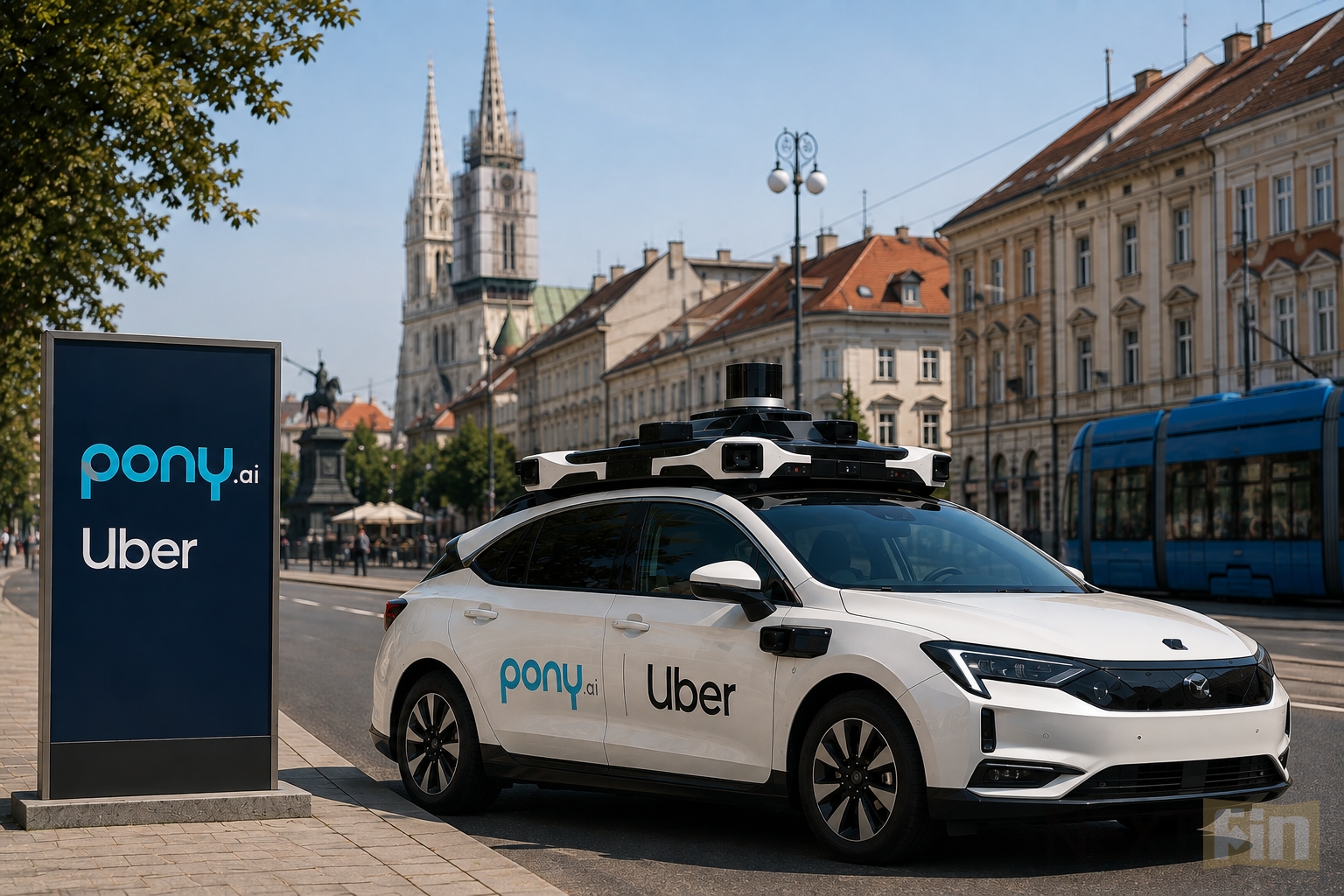
NextFin News — In mid-August, Pony.ai and Uber announced they would deploy more than 2,000 robotaxis across five European cities. The partnership begins where it already has a foothold: Zagreb, Croatia, where a commercial service has been running with a local operator since earlier this year. Soon, riders there will be able to summon the vehicles through the Uber app. Four more cities will follow in stages. The companies have also sketched plans for the Middle East. Specific names and dates remain unannounced.
The arrangement is deliberately modular. Pony.ai supplies its Level-4 driving system and the operational habits formed by fleets already circulating in Beijing and Shenzhen. Uber contributes the booking interface, payment rails and the residual advantage of a large existing rider base. Local partners are expected to own and maintain the cars, just as the Croatian firm Verne does in Zagreb.
The vehicles themselves are ArcFox Alpha T5 robotaxis, purpose-built with BAIC’s new-energy division and already in regular Chinese service. Hundreds have been produced; the European target would rank among the larger single overseas commitments yet declared by a Chinese robotaxi developer.
Europe has so far treated robotaxis as a series of careful experiments rather than a commercial reality. Most projects remain small, supervised or confined to limited zones. A multi-city fleet measured in thousands of vehicles would therefore represent a genuine change in scale—if the cars actually appear and stay in paid operation. For now the project lives in the realm of planning. Delivery schedules, city-level permits, insurance frameworks and full driverless authorizations must still be secured one jurisdiction at a time. No firm date has been offered for when the full complement of 2,000 vehicles will be carrying passengers for fare.
Each party brings a clear interest. Pony.ai gains a path into European streets without the expense of building its own consumer app or recruiting riders from zero. Uber continues a strategy of grafting external autonomous technology onto its existing network rather than shouldering the entire research burden itself. BAIC and the ArcFox brand obtain an overseas volume channel for a vehicle designed from the start for driverless work. The complementary logic is tidy. The practical frictions are less so.
European rules on Level-4 operation, data handling, liability and vehicle approval still differ by country and sometimes by city. Even where national frameworks exist, local safety cases and operating licenses must be won separately. Labor, real estate and service costs in many European markets sit higher than those in Chinese cities, raising the bar for unit economics. Sensors, compute platforms, redundant safety systems and remote support keep the full lifetime cost of each vehicle substantial. Without sufficient trip density, a larger fleet simply burns cash faster.
Competition is gathering as well. Local automakers, European technology firms and other mobility platforms are pursuing their own programs. Performance, cost, reliability and the quiet ability to navigate municipal permitting will all count. The asset-light structure chosen by Pony.ai and Uber—technology layered onto a platform and local operators—limits capital intensity for the principal partners. It also multiplies the number of interfaces that must function across borders and languages.
For the broader Chinese autonomous-driving sector the European commitment is a useful marker. It shows that production-ready Level-4 systems and purpose-built vehicles can attract a global platform partner at meaningful volume.
Whether the model proves commercially durable will depend less on the press release than on the pace of vehicle deliveries, the speed of regulatory clearance, and the simple arithmetic of paid trips once the cars are on the road. The distance between a signed target of more than 2,000 vehicles and a consistently profitable multi-city operation remains the central, unresolved test.


 快报
快报
根据《网络安全法》实名制要求,请绑定手机号后发表评论