






Image source: Internet
Booster Robotics, a Chinese developer of humanoid robots, has raised more than 100 million yuan ($14 million) in a new funding round as investors step up bets on the commercialization of embodied artificial intelligence, the company said.
The round was led by venture capital firm IDG Capital, with participation from state-backed Beijing Yizhuang Investment and existing investors including Source Code Capital, InnoAngel Fund, Shenzhen Capital Group and Bohua Capital.
It is the first time IDG Capital has led an investment in a humanoid robotics company, highlighting growing investor confidence that the sector is moving from laboratory demonstrations toward scaled production and real-world deployment.
Booster said the funds would be used to accelerate research and development, expand manufacturing capacity, support large-scale deliveries and build a developer ecosystem around its robots.
The company earlier completed two funding rounds in June and July, bringing its total Series A financing to nearly 500 million yuan. 100Summit served as the exclusive financial adviser across five rounds, the company said.
The fundraising comes amid intensifying global competition in humanoid robotics, as companies seek to build machines capable of operating safely and autonomously in human environments, from factories and warehouses to schools, hospitals and homes.
Unlike many startups in the sector that focus on demonstrations and prototypes, Booster has emphasized mass production and shipment, the company said.
Its latest humanoid robot, the Booster K1, was launched in October on Chinese e-commerce platforms including Alibaba’s Taobao and Tmall. The first batch of full-payment orders sold out in 20 minutes, the company said, with more than 1,000 units signed with dealers at the launch event.
The company pledged to compensate customers triple the purchase price if orders placed during China’s annual Double 11 shopping festival were not delivered by the end of December, signaling confidence in its supply chain and production capacity.
Booster said it has shipped more than 700 humanoid robots globally to more than 200 customers, including technology firms, research institutions, schools, competition teams and commercial exhibition organizers. Overseas markets account for more than half of shipments, it said.
As demand increases, Booster said it is expanding production and expects capacity to reach tens of thousands of units annually next year, while unit prices are likely to decline.
“Reliability and stability are what users care about most in real-world environments,” a company spokesperson said, adding that word-of-mouth referrals have become a major source of new customers.
Humanoid robotics has attracted heavy investment in recent years, with companies such as Tesla, Figure AI, Boston Dynamics and China-based UBTech and Fourier Intelligence pursuing different approaches to hardware, software and autonomy.
Yet most systems remain expensive, fragile or limited in their ability to operate outside controlled environments.
Analysts say the main challenge lies in making robots reliable enough for daily use, affordable enough for mass adoption and safe enough to operate around people.
“Humanoid robotics is moving out of research labs, but we are still early in the commercialization cycle,” said Li Ming, an analyst at Shanghai-based consultancy EqualOcean. “Investors are looking for companies that can demonstrate not just technical capability but also manufacturing, delivery and customer adoption.”
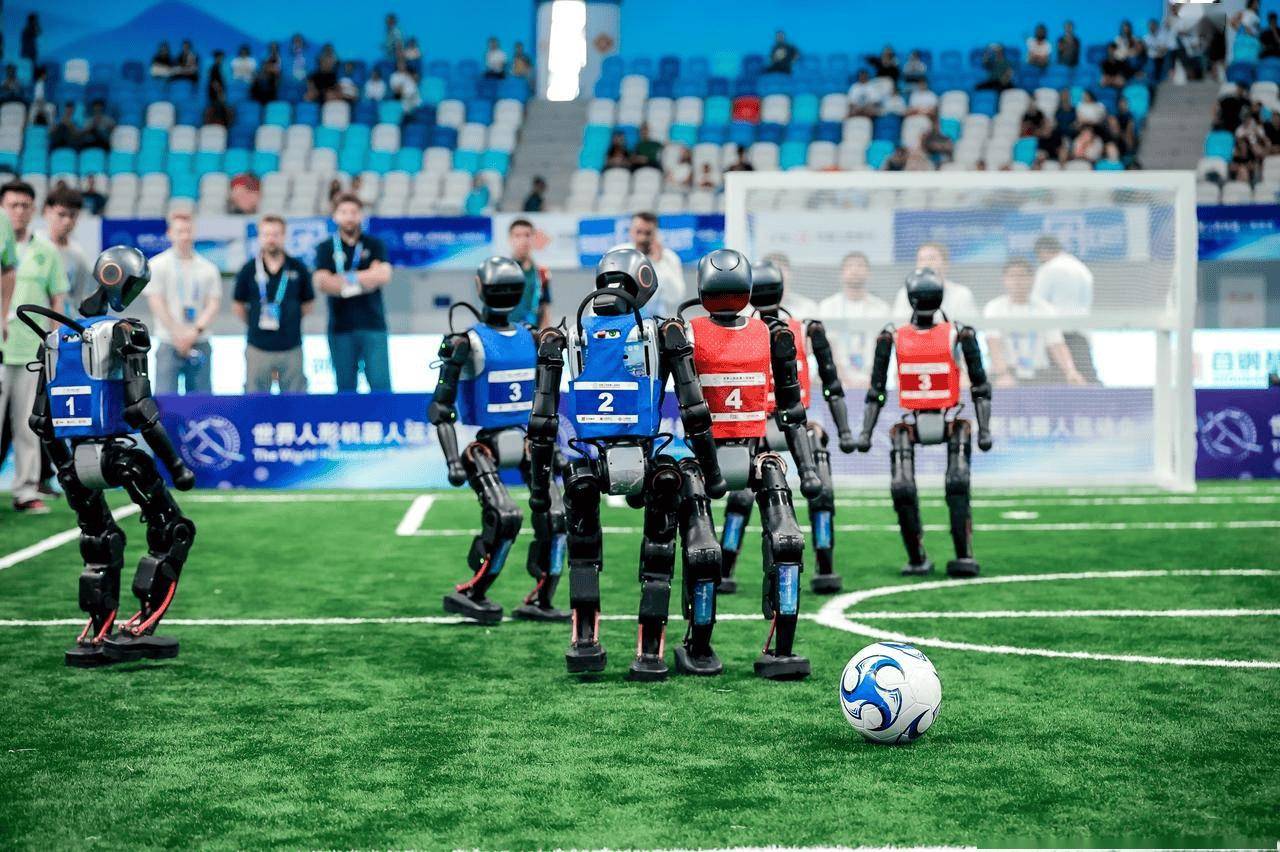
Booster has built much of its reputation through robotics competitions, particularly robot soccer tournaments.
Its earlier product, the Booster T1, and its newer K1 model have been used by teams in international competitions such as RoboCup, where robots must play football autonomously under standardized rules.
At the 2025 RoboCup World Championship, a team from Tsinghua University using Booster’s robots won the adult humanoid division — the first Chinese team to win the category in the competition’s 28-year history.
The company said competition environments provide a high-frequency testing ground for perception, decision-making, coordination and control, allowing it to improve its systems rapidly before deploying them to other use cases.
“Competitions compress years of testing into weeks,” the spokesperson said. “Every failure is visible, measurable and immediately instructive.”
Beyond hardware, Booster is developing a software and developer ecosystem around its robots.
Its K1 model includes an application platform that offers application programming interfaces (APIs), open-source frameworks and graphical tools for no-code programming, allowing users to teach robots new behaviors through demonstration or drag-and-drop interfaces.
The aim is to make robots usable by students, educators and small businesses without requiring advanced robotics expertise.
“AI development shouldn’t be limited to PhDs and research labs,” the spokesperson said. “Lowering the entry barrier is essential if the industry is to scale.”
The company is pursuing a strategy it calls “competition plus education,” linking high-end research and competitive testing with broader educational adoption.
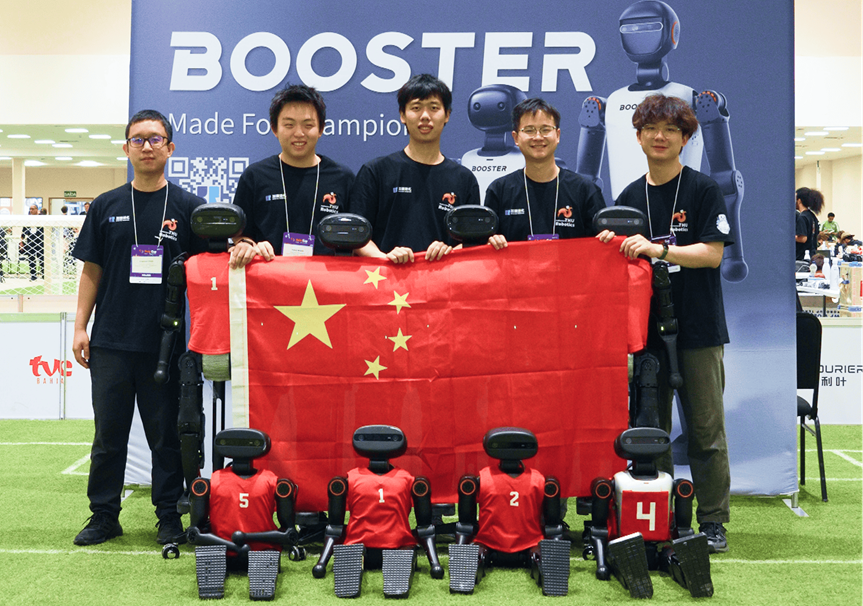
It has partnered with more than 20 universities globally, including in the United States and China, on research projects and academic publications.
It has also launched a “Hundred Cities, Ten Thousand Schools” program to introduce robotics curricula and labs into universities, vocational colleges and K-12 schools over the next three years.
Booster’s longer-term ambition is to position itself not only as a robot manufacturer but also as a platform provider for embodied AI — the integration of perception, cognition and physical action.
By building a network of developers, educators, researchers and application partners, the company hopes to create recurring revenue streams from software, services and ecosystem participation alongside hardware sales.
“Hardware margins alone are unlikely to sustain the industry,” said Li. “The winners will be those who control platforms, data and developer communities.”
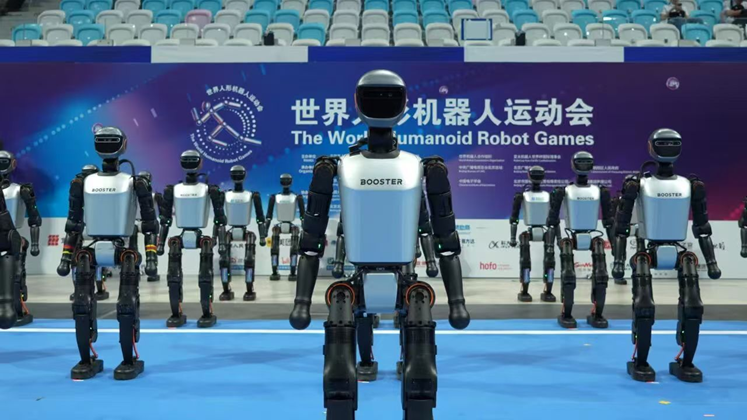
Booster T1 robots made their debut at the opening ceremony of the World Humanoid Robot Sports Games in August 2025.
Despite the optimism, significant risks remain.
Humanoid robots still face technical hurdles in navigation, manipulation, energy efficiency and safety certification. Regulatory frameworks for deploying robots in public or commercial spaces remain underdeveloped in many countries.
Competition is also intensifying, both domestically and internationally, with well-funded players racing to secure enterprise customers and government contracts.
But Booster’s ability to ship products at scale, analysts say, gives it an advantage in an industry where many competitors remain at the prototype stage.
“The fact that they are delivering hundreds of units is not trivial,” Li said. “That suggests operational maturity, not just technical vision.”
As embodied AI moves from concept to deployment, investors appear increasingly willing to back companies that can turn machines into products — and products into markets.

 快报
快报
根据《网络安全法》实名制要求,请绑定手机号后发表评论