






The heart of innovation lies not just in knowledge, but in the people who carry it forward, former Stanford University President John Hennessy has pointed out in a keynote speech tracing the arc of technological progress since the early days of Silicon Valley.
His remarks were made on September 27 at the NEX-T Summit 2025, jointly hosted by NextFin.AI, Global Asian Leadership Alliance (GALA), Shanda Group, Barron’s China and TMTPost Group.
Drawing on decades of academic leadership, deep ties to Stanford’s entrepreneurial culture, and his own role as Chair of Google’s parent company Alphabet, Hennessy offered an insider’s view on how ideas move from lab to market and why successful startups are born not just from intellectual property, but from the movement of talented people who believe in it.
“You don’t just transfer ideas or research papers,” Hennessy said. “You transfer people... People are the carriers of great innovation, partly because they're the ones who believe in it. They're the ones who see the glass as half full rather than half empty. They're the ones that understand the pluses and minuses about the technology.”
That simple insight — tested across generations of Stanford spinouts — has helped shape the DNA of Silicon Valley, from the garage-built audio oscillators of Hewlett-Packard to the trillion-parameter neural networks powering today’s AI breakthroughs.
Hennessy began his speech by naming Frederick Terman, a former dean of engineering at Stanford, as the “godfather of Silicon Valley.” Terman, who joined Stanford after a stint at MIT, played a pivotal role in launching the valley’s startup culture — not by founding companies himself, but by empowering others to do so.
Among his most consequential moves was recruiting a young Bill Hewlett back from General Electric and encouraging him to team up with fellow Stanford graduate David Packard. Terman nudged them toward entrepreneurship, a move that gave birth to Hewlett-Packard (HP).
Hennessy, also a Turing Award laureate, mentioned a temperature-compensated audio oscillator, a niche but crucial innovation for audio engineers. In a fateful early sale, Walt Disney Studios bought eight of these oscillators to produce sound for Fantasia, marking the commercial debut of what would become one of Silicon Valley’s founding companies.
HP’s original workspace, a modest garage in Palo Alto, has since become an iconic landmark. But as Hennessy noted, its significance is more than symbolic. It represents the early template: university-trained innovators, backed by mentorship, building real-world products.
Hennessy emphasized that Silicon Valley’s success has not been built on a few singular companies but on successive waves of technology — each bringing new players to the forefront.
“Semiconductors first, then the microprocessor, then the personal computer revolution. Then the Internet, and now AI,” he said. “Each wave creates 10 to 20 startups — and out of those, maybe three or four become long-term players.”
This cyclical renewal is part of what gives Silicon Valley its unique resilience. From Intel and AMD in the integrated circuit era, to Yahoo and Google during the rise of the web, to Facebook and Snapchat in the social media age, each technological leap has opened doors to new entrepreneurial ecosystems.
Importantly, Hennessy explained, the innovation behind these waves often originates outside of the startups themselves — in university labs and corporate R&D divisions like IBM Research, Bell Labs, and Xerox PARC.
“Bell Labs created the transistor. IBM built vertically integrated systems. Xerox PARC invented the Alto — the machine that inspired the Macintosh,” he said. “But without people leaving those institutions and taking risks, those technologies wouldn't have scaled.”
Stanford’s Startup Engine: the People Pipeline
One of the recurring themes in Hennessy’s speech was the critical role of talent mobility — especially from universities to startups.
“And if you look at the long history of Stanford and Silicon Valley, every single successful big spin-out has involved actually having people move. Students, faculty members move from the university to startups,” he pointed out.
“Stanford’s biggest contribution to the Valley wasn’t just research,” he said. “It was people. Larry Page and Sergey Brin came from Stanford. But Google wouldn’t be what it is without the next hundred Stanford and Berkeley graduates who followed them.”
Universities like Stanford, MIT, and Carnegie Mellon have long served as breeding grounds for talent and ideas. But what sets Silicon Valley apart, Hennessy argued, is the willingness that students and professors will spin out to build companies.
This human movement is what Xerox PARC famously lacked. While it pioneered many modern computing concepts, it failed to commercialize them, in part because the core teams didn’t leave to build startups.
Ideas need champions, Hennessy said. “And often those champions are the people who developed the technology in the first place. They understand its pluses and minuses about the technology. And they believe in it enough to take the risk.”
Hennessy noted that the world is experiencing the fastest technological wave yet: the AI revolution. The pace of change, he said, has outstripped previous tech booms — including the PC, mobile, and even the early Internet.
Several key advances converged to make this possible: Algorithms: the foundation for deep learning, including backpropagation, dates back to the 1980s. But recent architectural innovations, like transformers, introduced in 2017, unlocked a new level of capability. Data: High-quality datasets, such as ImageNet, curated by Stanford’s Fei-Fei Li, enabled major breakthroughs like AlexNet — which improved image classification performance by nearly 20%. Compute: Massive parallel processing and specialized hardware (e.g., GPUs and TPUs) now allow models with hundreds of billions of parameters to be trained on trillions of data points.
These systems are now competing with — and in some cases surpassing — human experts, Hennessy said. “OpenAI and DeepMind recently achieved gold medal performance on the International Math Olympiad. That’s PhD-level math.”
But he also warned that this progress comes at a cost. Training modern AI models is increasingly expensive — not just financially but in terms of energy. The hardware demands are scaling faster than improvements in efficiency, raising concerns about sustainability and accessibility. 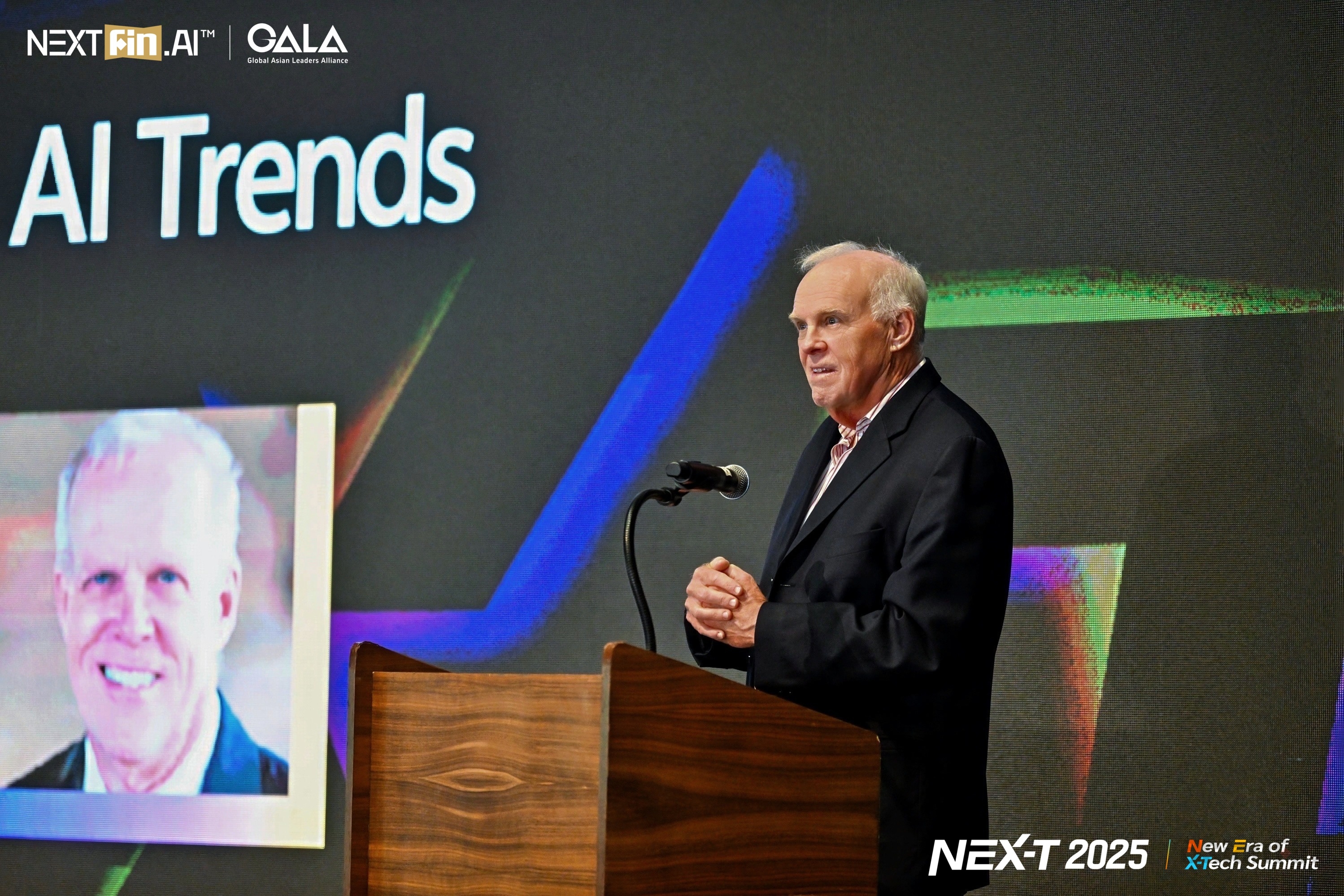
Former Stanford President John Hennessy delivered a keynote speech at the NEX-T Summit 2025.
The Data Bottleneck and Future Challenges
Hennessy outlined several technical and societal hurdles ahead:
First, training Costs. As models grow larger, so do their computational needs. Training costs are rising faster than the rate at which hardware is improving.
Second, energy Consumption. AI systems are power-hungry. While the human brain runs on about 20 watts, a single AI model can require megawatts. Big tech is now exploring fusion energy to meet future demands.
Third, Data Scarcity. Ironically, we’re running out of high-quality data. By 2030–2032, experts estimate we may exhaust the web’s useful content unless new sources are found.
He also talked about AI’s societal impact, including job markets changed by AI. As productivity rises, especially in software development, the demand for entry-level positions could drop.
These challenges, particularly the societal impact, have sparked public concern and regulatory interest. Hennessy acknowledged this unease but argued that AI should be framed as a tool for augmenting human capability, not replacing it.
“Think about physicians and teachers,” he said. “They spend too much time on paperwork and not enough on people. AI can help them focus on what matters.”
Rather than a zero-sum game between humans and machines, Hennessy advocated for a collaborative model — AI as an assistant, not a replacement.
He cited efforts by Khan Academy, where founder Sal Khan is developing AI tutoring systems that adapt to individual student needs. Similarly, in healthcare, AI assistants could help doctors with diagnosis, communication, and administrative tasks.
A human tutor with an AI assistant outperforms either alone, Hennessy said. “That’s the model we should strive for.” This approach, he believes, could democratize education, improve healthcare, and reduce inequality — if implemented responsibly.
Looking Ahead: Inspiration from the Human Brain
Despite AI’s rapid gains, Hennessy reminded the audience at the NEX-T Summit that human intelligence still has the edge in several areas: energy efficiency, learning speed, and adaptability.
Neuroscience, he suggested, may hold the key to the next breakthroughs — just as mimicking the brain’s structure helped spark the deep learning revolution.
As for the future of AI, Hennessy believes the timeline to human-level intelligence is shrinking. Once seen as decades away, general AI may arrive in less than ten years, thanks in part to advances in large language models (LLMs) that now outperform average humans on standardized tests.
"We still don't have the kind of effective learning that human brains are able to do. Babies learn how to speak. They learn how to walk ...They learn how to do lots of complex things," he said. "Then there are issues of energy efficiency as well. Human brain consumes about 20 watts. A data center consumes somewhere between a1,000 to 10,000 times that amount of power. So we we can still take lots of inspiration from how the human brain does these remarkable things."
In the end, Hennessy returned to his core message: whether it’s the 1940s electronics or the 2020s AI, real innovation happens when people, not just ideas, move.
 快报
快报
根据《网络安全法》实名制要求,请绑定手机号后发表评论