






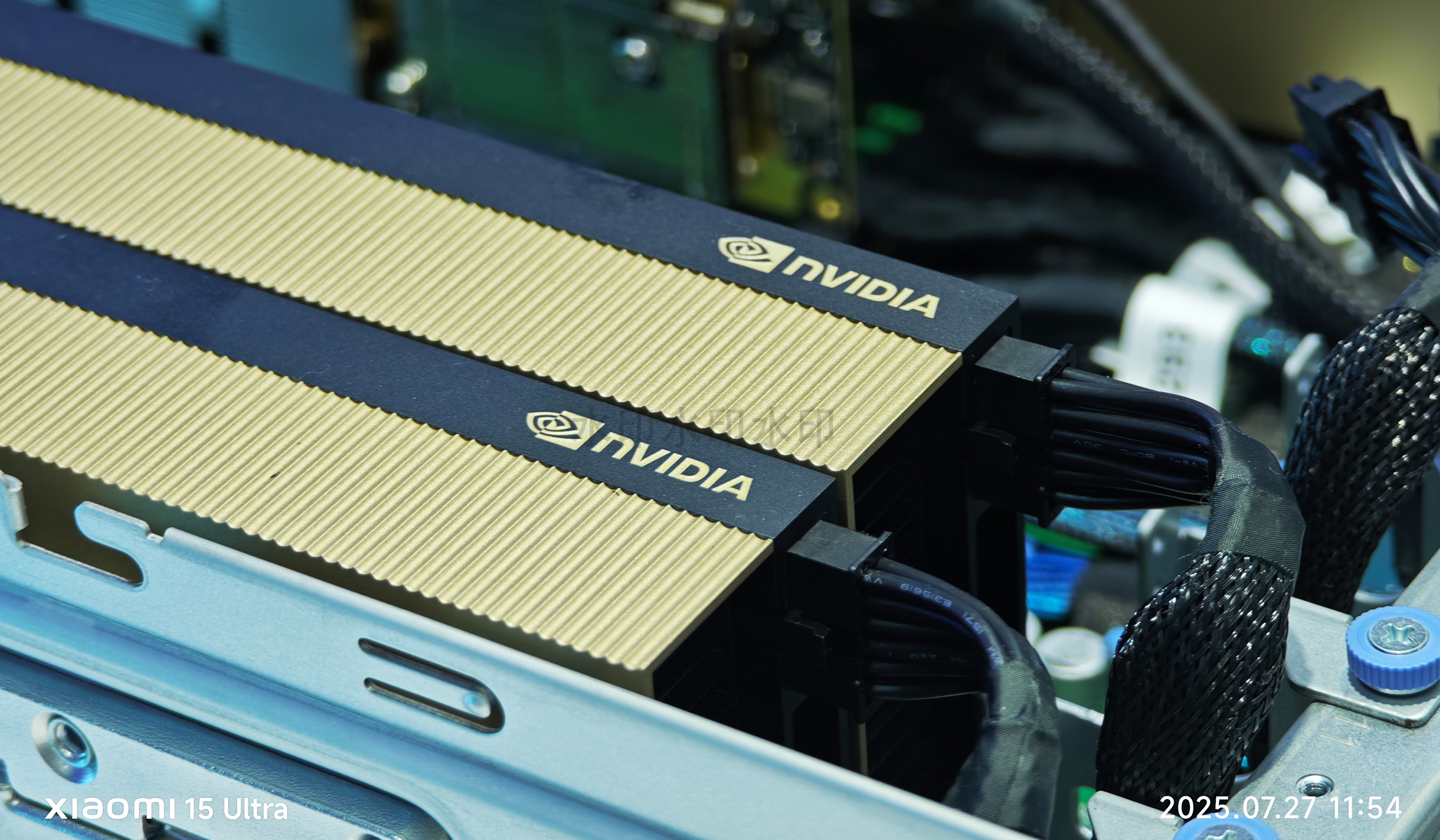
TMTPOST -- Nvidia has firmly denied allegations of “backdoors” or remote access capabilities in its H20 AI chips following a summons by Chinese regulators over reported security vulnerabilities.
A company spokesperson emphasized that cybersecurity remains a top priority and asserted that Nvidia’s chips do not contain any features that would allow unauthorized remote control, as Chinese authorities seek explanations about potential risks in the chip widely used across China’s AI sector.
In a statement early August 1, an Nvidia spokesperson said: “Cybersecurity is critically important to us. Nvidia does not have ‘backdoors’ in our chips that would give anyone remote access or control.”
According to a statement from China’s Cyberspace Administration, Nvidia’s H20 computing chips were found to have serious security vulnerabilities. This follows earlier U.S. congressional calls for exported advanced chips to include “tracking and positioning” features.
Experts in the American AI sector have disclosed that Nvidia’s chips already incorporate mature “tracking and positioning” and “remote shutdown” capabilities.
To protect cybersecurity and data privacy of Chinese users, Chinese regulators summoned Nvidia on July 31 to demand explanations and documentation regarding potential backdoors and vulnerabilities in the H20 chips sold domestically.
The H20 chip, a “customized edition” based on Nvidia’s prior-generation Hopper architecture, was designed specifically for the Chinese market to comply with U.S. export controls. Launched in early 2024, the H20 is considered a “downgraded” version of Nvidia’s top-tier AI processors. Though its performance trails the newest Blackwell architecture chips, it still surpasses most domestic Chinese AI chips and benefits from Nvidia’s mature software ecosystem, enabling lower AI development costs.
Following explosive demand for AI applications such as DeepSeek, the H20 has become highly sought after by China’s leading internet firms. Since 2022, amid multiple rounds of U.S. export restrictions, Nvidia developed China-specific versions of its A800, H800, and H20 chips to meet regulatory requirements. As of April 2025, Nvidia reportedly had secured approximately $18 billion in H20 orders from Chinese customers.
Despite plans announced in April to invest up to $500 billion in AI infrastructure in the U.S. over the next four years, the Trump-era restrictions on exporting H20 chips to China and Hong Kong/Macau remain in place, requiring government approval. Under the Biden administration, these export controls operate under a presumption of denial, complicating Nvidia’s sales in China.
Nvidia’s revenue share from China has declined from 20-25% to single digits, but the market remains strategically vital. CEO Jensen Huang has previously lamented the impact of export bans on the company’s Hopper data center business in China, forecasting multi-billion-dollar write-downs on unsellable inventory. Huang criticized U.S. policy assumptions that China cannot manufacture AI chips as outdated, warning that export restrictions may inadvertently bolster Chinese competitors and diminish American technological leadership.
Financial data for calendar year 2024 show Nvidia’s annual revenue from China reached a record $17.1 billion, a 66% year-on-year jump from $10.3 billion in 2023. In fiscal year 2025, 53% of Nvidia’s revenue came from outside the U.S., with China as its second-largest market (13% of revenue), behind the U.S. at 47%.
Bloomberg Intelligence analysts estimate that a ban on H20 exports to China could slash Nvidia’s Chinese data center market share back to pre-H20 levels, potentially costing the company $14 to $18 billion in revenue this year.
However, the situation shifted on July 15 when Nvidia submitted a fresh license application to the U.S. government for H20 chip exports to China. The government subsequently approved the export by July 31, clearing the way for shipments to resume.
Nvidia CEO Jensen Huang made multiple visits to China in 2025, including an appearance at the China International Supply Chain Expo on July 16, where he praised China’s AI potential and talent pool. He emphasized that the H20 chip remains well-suited for training large models and expressed openness to third-party platforms compatible with Nvidia’s CUDA software ecosystem.
Reports this week revealed Nvidia placed an order for 300,000 H20 chips with TSMC, abandoning plans to rely solely on existing inventory amid strong demand from China.
In December 2024, China’s State Administration for Market Regulation launched a formal antitrust investigation into Nvidia over suspected violations of the Anti-Monopoly Law. The recent “regulatory meeting” on July 31 is described by experts as an early-stage supervisory action aimed at risk prevention and transparency, rather than a formal probe.
On the political front, U.S. Senator Jeanne Shaheen recently urged Commerce Secretary Gina Raimondo to ensure that Nvidia’s H20 chip exports do not aid China’s AI advancement, following reports that Chinese company DeepSeek built advanced AI models using the H20.
Chinese Foreign Ministry and Ministry of Commerce spokespeople have deferred questions to relevant departments, stating no further information is available at this time.
Nvidia shares closed down 0.78% on July 31, with a market capitalization of approximately $4.34 trillion.

 快报
快报
根据《网络安全法》实名制要求,请绑定手机号后发表评论