






TMTPOST -- U.S. President Donald Trump last week broke his word as the tariff rate he announced was nearly double that the Vietnamese government previously agreed on, according to a report on Thursday.
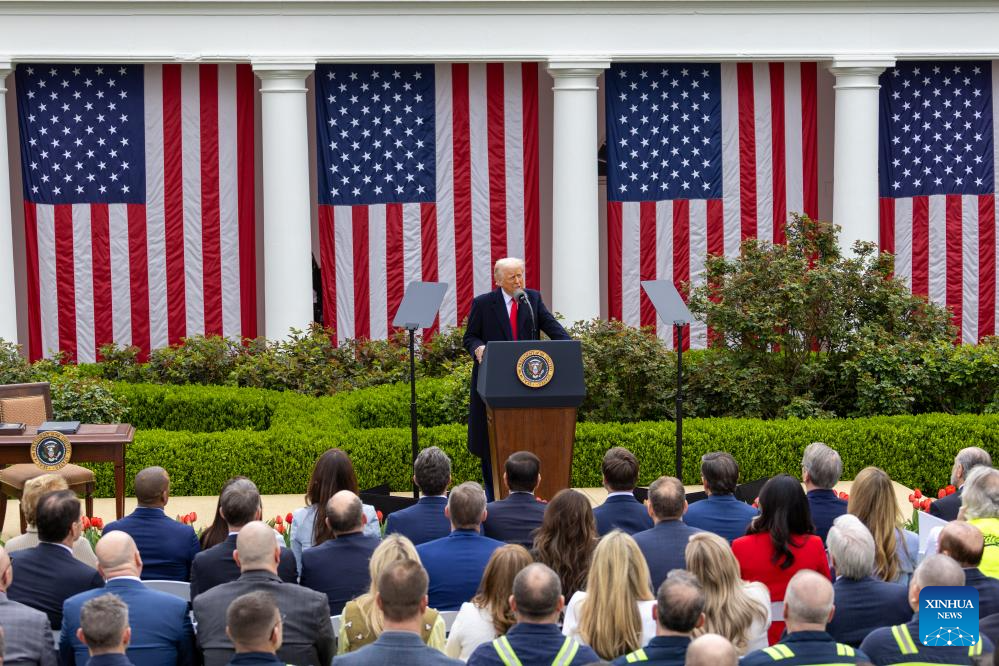
Credit:Xinhua News Agency
Vietnam thought it had reached a preliminary deal with the U.S. to lower its tariff level to around 11%, a massive cut from the reciprocal tariff rate of 40% that the Trump administration implemented in early April, but Trump, at the last minute, raised the rate to 20%, the Politico reported. As a result, the report noted, Hanoi has not formally accepted a key part of the agreement Trump touted last week.
Vietnamese negotiators had not agreed to the 20% rate Trump announced last week, and the president disregarded that figure in his phone call with To Lam, general secretary of the Communist Party of Vietnam Central Committee, the report cited people familiar with the matter. Trump’s announcement stunned the outside U.S. groups who had been tracking the talks, according to a lobbyist, who described the Vietnamese government’s reaction as “surprise, as well as disappointment and anger.”
However, a White House aide dismissed the aforementioned claim from the Vietnamese side and the lobbyist who works with the countries and other Asian governments. The person said the Vietnamese government was aware of the top-line tariff rates ahead of the call between leaders of two countries. “My understanding is that the two trade teams kind of hashed it out and it was a leader-to-leader thing to put final approval on it,” the aide said.
It is not clear when or if the higher tariff rate will go into effect since neither Hanoi nor Washington have released any paperwork about a final agreement including those tariff rates, and neither country has formally signed off on a deal yet.
The report obviously raised questions about the effectiveness of U.S.-Vietnam deal Trump touted given his previous back-and-forth on tariff policies. It also made people doubt the efficiency of Vietnam’s effort to help shut trade loopholes that China has used to bypass duties.
Trump on July 2 said on his social media platform Truth Social that he made a trade deal with Vietnam after speaking with To Lam. Touting the deal as “a Great Deal of Cooperation between our two Countries”, Trump said the two sides agreed that the U.S. would impose 20% tariffs on all goods imported from Vietnam and 40% tariffs on “any Transshipping.”
The “transshipping” tariff means “if another country sells their content through products exported by Vietnam to us — they’ll get hit with a 40% tariff”, U.S. Commerce Secretary Howard Lutnick clarified in a post on social media X later Wednesday.
The 20% tariff rate is higher than the current baseline 10% level but lower than the 46% reciprocal tariffs Trump announced on April 2, a date the president proclaimed “Liberation Day”.
Trump’s social media post suggested Vietnam agreed to offer duty-free to U.S. goods in exchange for relatively lower reciprocal tariffs. “In return, Vietnam will do something that they have never done before, give the United States of America TOTAL ACCESS to their Markets for Trade. In other words, they will ‘OPEN THEIR MARKET TO THE UNITED STATES,’ meaning that, we will be able to sell our product into Vietnam at ZERO Tariff,” Trump wrote in his post.
Vietnam is preparing stricter penalties to crack down on penalties to crack down on trade fraud and the illegal transshipment of goods, and has focused its inspections on Chinese products as it tries to comply with commitments made to Washington, Reuters quoted the governmental documents on Thursday.
The Vietnamese government will issue a new decree that will "prescribe additional levels of sanctions for fraud of origin," and introduce stricter measures and checks to prevent fraud, according to one of the documents dated on July 3. It was reported that Hanoi had directed authorities to intensify inspections focusing on exports to the U.S. “at risk of trade fraud... or Chinese items that are subject to trade defence measures by the European Union and the United States.”


 快报
快报
根据《网络安全法》实名制要求,请绑定手机号后发表评论